35 works in this view — arrow keys or swipe to move between them.
Dance in Art
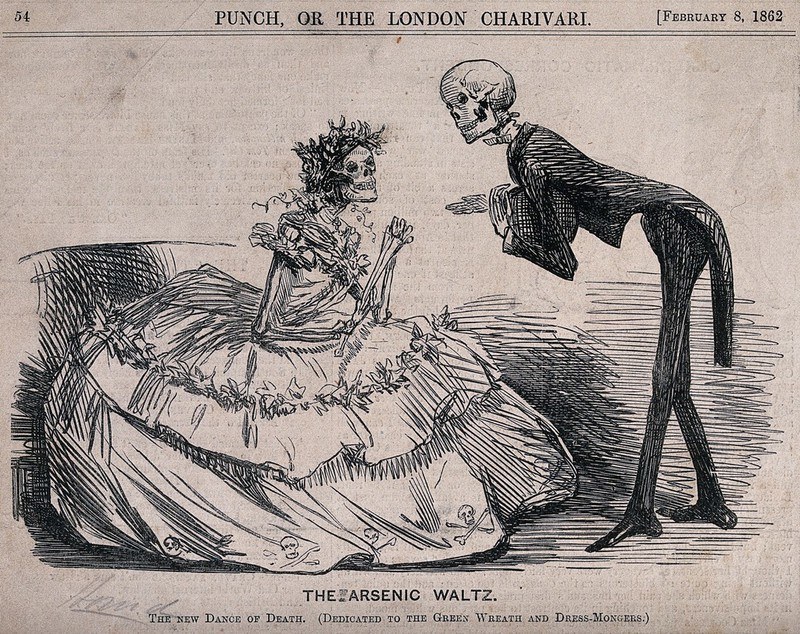
A skeleton gentleman at a ball asks a skeleton lady to dance; representing the effect of arsenical dyes and pigments in clothing and accessories. Wood engraving, 1862.
Unknown artist
- Dance:
- Waltz
- Source:
- Wellcome Collection
- Rights:
- Rights vary by item — check the source record before reusing this image. Source record ↗
- Recorded as:
- Check
The work documents a moment when dance imagery crossed from entertainment into medicine and toxicology. It shows how the waltz, as a symbol of modernity and fashion, could be conscripted into arguments about public health; it also reveals the material reality of 19th-century ballroom culture—that the very clothes worn to dance were instruments of chronic poisoning. For historians of dance, it is evidence that ballroom ritual, gesture, and costume were already so codified and recognizable that they could be instantly readable even when rendered as skeletons.
What you are looking at
A wood engraving depicting a moment of macabre courtship: a skeleton gentleman in formal dress—tailcoat, waistcoat, and bow tie—bends at the waist in an exaggerated bow of invitation toward a skeleton woman seated in an armchair. The woman, dressed in an elaborate ball gown with a full skirt, corseted waist, and decorative headdress adorned with feathers or ornament, sits with her bony hand raised in a gesture of acceptance or greeting. The composition is staged as a formal drawing room scene, with the figures isolated against a plain background. The skeletal forms are rendered with precise anatomical detail, the bones articulated clearly beneath the clothing, creating a grotesque contrast between the fashionable dress and the death's-head beneath. The woman's elaborate gown—with its layered skirts, trim, and visible buttons—occupies nearly half the composition, emphasizing the vanity and material excess being mocked by the skeleton imagery.
The dancing
The gentleman's posture is a textbook formal bow: legs stiff, torso folded from the waist, spine curved in courtly deference, one arm extended. The woman sits upright, her skeletal frame corseted into the fashionable S-bend silhouette of the 1860s, her raised arm showing the ballroom gesture of acceptance. Neither figure shows active dance movement; instead, they perform the ritual of invitation and acquiescence that precedes the waltz. The positioning and dress code—formal evening wear, structured bodies—belong to ballroom society, not social dancing.
The dance depicted
The work is titled 'The Arsenic Waltz' and depicts not a waltz in motion but the social prelude to one—the moment of asking and accepting. The skeleton imagery transforms the ballroom encounter into a memento mori: the invitation to dance becomes an invitation to death. This is a satirical commentary on the real hazard of fashionable dress in 1862: arsenic was used in synthetic dyes and pigments on clothing, wallpaper, and accessories, and chronic exposure caused poisoning. The woman's elaborate costume—the very garment that was poisoning her—is rendered in meticulous detail, making the gown itself the instrument of death. The work critiques not dancing itself but the fashionable world that produced both the waltz and the toxic materials that killed the people who danced it.
How it was made
This is a wood engraving, a relief printing technique that uses the end grain of a hardwood block. The artist has created the image by cutting away the surface to leave raised lines that hold ink, producing the fine cross-hatching and parallel lines visible throughout. Wood engraving was the dominant medium for mass-produced satirical and topical imagery in Victorian periodicals—this work appeared in *Punch* in 1862—and allowed rapid reproduction and wide circulation. The technique's precision and the intensity of line work suit the subject: the dense hatching on the skeleton bones creates sharp articulation, while the fine parallel lines render fabric texture and shadow with economy. This was a commissioned illustration for a weekly satirical magazine, reaching a broad educated middle-class audience aware of current health anxieties.
About this work
This is a wood-engraved satirical print published in *Punch* in 1862, depicting the moment before a waltz as an encounter with death. The skeleton couple—he in formal evening dress, she in an elaborate, poisoned ball gown—perform the social ritual of the ballroom invitation. The work is a visual pun on the title 'The Arsenic Waltz,' attacking the fashion industry's use of deadly synthetic dyes. It belongs in a dance archive not because it shows dance in action, but because it weaponizes the imagery of ballroom courtship and the waltz as a vehicle for social satire and public health advocacy. The waltz itself—the dance of the moment, symbol of respectable society—becomes the carrier of the message: elegance and death are locked in an embrace.
How to look at it
Attend to the precision with which the artist has rendered the formal ballroom gesture: the bow and the seated posture are anatomically exact, drawn from life or from careful observation of ballroom etiquette. The composition freezes the moment of social transaction—not the movement of the dance itself, but the negotiation that precedes it. The detail of the woman's gown is the visual argument: every button, seam, ruffle, and layer is rendered with care, making the garment prominent and beautiful, so that its deadliness is all the more pointed. The skeleton's grin is the only 'expression' in the image; everything else is formal and orderly. The contrast between the decorousness of the gesture and the grotesqueness of the form is where the satire lives.
The period
The 1860s were the height of the Victorian waltz's social dominance and also the moment when arsenic poisoning from synthetic dyes became a public scandal. Bright greens (Paris Green, Scheele's Green) and other vivid hues made possible by synthetic chemistry were woven into every fashionable dress, wallpaper, and accessory; chronic exposure caused skin lesions, neurological damage, and death. *Punch* magazine, founded in 1841, was the primary vehicle for social and political satire in Britain, and its wood-engraved illustrations were collected and circulated widely. The waltz itself—popularized in the 1820s-1830s—was by the 1860s the normative ballroom dance for respectable society, performed in formal evening dress at balls and assemblies across Europe. This print sits at the intersection of fashion anxiety, scientific crisis, and the consolidation of ballroom dance as a central image of civilization.
Where it lives
The work is held in the Wellcome Collection, a major archive of medical history, science, and material culture. It was published as a wood engraving in *Punch, or The London Charivari* on 8 February 1862. The Wellcome Collection's acquisition reflects the image's significance as a document of 19th-century toxicology and public health advocacy, not merely as an illustration or social satire.
Dance in this work
Questions about this work
Was the arsenic poisoning real?
Yes. Victorian synthetic dyes, especially bright greens, were formulated with arsenic compounds. Chronic exposure through contact with clothing, handling fabric, sleeping on arsenic-dyed bedding, and decoration of living spaces caused poisoning: skin conditions, neuropathy, and eventually cancer. The hazard was debated and gradually acknowledged in the 1860s-1880s, leading to dye regulations.
Is this image a waltz?
No. It depicts the social ritual that precedes a waltz—the formal invitation and acceptance. The gentleman and lady are performing ballroom etiquette, not the dance itself. The title puns on the waltz as a signifier of fashionable society; the real subject is the poison in the fabric.
Why was this printed in *Punch*?
*Punch* was Britain's leading satirical weekly, read by educated middle-class audiences. Using skeleton imagery and the recognizable format of a ballroom scene, the artist made a public health crisis legible and shocking. The print would have been collected, discussed, and circulated as a warning and a commentary on the excesses of fashion.
What does the title mean by 'Dedicated to the Green Wreath and Dress-Mongers'?
The subtitle directly names the targets: the manufacturers and sellers of arsenic-dyed fabrics ('Dress-Mongers') and the 'Green Wreath'—a fashionable accessory made from arsenic-green materials. The dedication is sarcastic: the print is offered as a gift to the industries profiting from the poisoning.
More Waltz artwork