49 works in this view — arrow keys or swipe to move between them.
Dance in Art
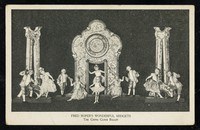
Fred Roper's wonderful midgets : the china clock ballet.
Unknown artist
- Dance:
- Ballet
- Source:
- Wellcome Collection
- Rights:
- Rights vary by item — check the source record before reusing this image. Source record ↗
- Recorded as:
- Check
This image documents a form of theatrical exploitation and spectacle that was mainstream in the early 20th century and reveals how performers with dwarfism were marketed as novelty attractions and component parts of visual design rather than as artists. For historians of theatre, dance, disability, and entertainment entrepreneurship, it is an essential if uncomfortable record of what audiences paid to see and what performers' bodies were asked to do. Understanding this history—and its ethical dimensions—is essential to understanding how modern dance and performance have moved away from such practices.
What you are looking at
A formal theatrical stage is set with a grand architectural backdrop: a large ornate clock face dominates the center, flanked by two tall classical columns. The scene depicts a troupe of diminutive performers—billed as "Fred Roper's wonderful midgets"—arranged in a symmetrical, processional formation. The performers wear pale, gleaming costumes that suggest porcelain or metallic finish, consistent with the "China Clock" conceit. They stand in disciplined rows, some on the stage proper and others positioned on stepped platforms, creating a pyramidal composition. The lighting is theatrical and even, rendered in the print as areas of shadow and highlight that give the figures sculptural definition. The entire composition reads as a tableau vivant—a frozen moment of pageantry rather than a dynamic action, which was typical of music-hall and vaudeville spectacle of the early 20th century. The symmetry and precision of the arrangement emphasizes showmanship and visual spectacle over individual movement expression.
The dancing
The performers stand in formal, upright postures with arms positioned at their sides or in restrained positions. There is no evidence of active stepping, turning, or the fluid arm movements characteristic of ballet proper. The bodies are aligned vertically and arranged in geometric patterns—lines and pyramidal tiers—rather than in pairs or groups engaged in partnered movement. The performers appear to be small-statured adults (midgets/dwarfs), presented as novelty performers in costume. The stillness and rigidity of the pose suggests this is a moment of display or tableau rather than a captured moment of choreographed movement.
The dance depicted
This is not a conventional ballet in the sense of Romantic or Classical ballet technique. Rather, it documents a music-hall or theatrical revue spectacle, likely from the early 20th century, featuring a novelty attraction: a troupe of performers with dwarfism or short stature, choreographed as a living decorative spectacle themed on a mechanical clock. The "China Clock Ballet" appears to be a sight-gag and visual conceit—the performers costumed and arranged to resemble the glazed figures of a porcelain clock—rather than a serious dance work. The appeal was novelty, symmetry, and the theme itself, not technical dance accomplishment. Fred Roper's management of such troupes was characteristic of Edwardian and early Georgian theatrical entrepreneurship.
How it was made
This is a photomechanical print or reproduction engraving, likely made from a theatrical photograph or drawn design. The technique allows for fine detail in the costumes and architectural setting while rendering the figures with uniform tone and brightness. The even, shadowless illumination and the uniform rendering of faces and bodies suggest this was either a publicity photograph that was then engraved, or a drawn design made to simulate theatrical lighting. The medium is suited to mass distribution as a theatrical programme illustration, lobby card, or press image—it was designed to advertise the spectacle to potential audiences.
About this work
This is a record of a theatrical spectacle rather than a dance work in the conventional sense. It documents the 'China Clock Ballet,' a novelty music-hall attraction managed by Fred Roper, in which a troupe of performers with dwarfism were arranged in symmetrical, costumed tableaux to simulate the figures of an ornate clock. The work sits at the intersection of dance history, theatre history, and the history of circus and music-hall entertainment. It represents a form of spectacle in which visual design, novelty, and novelty performance took precedence over formal dance technique, and in which performers with atypical bodies were exhibited as curiosities and design elements rather than as skilled dancers.
This image is valuable precisely because it captures a marginal, ephemeral, and ethically fraught corner of early 20th-century theatre—one in which disabled performers were central to the commercial appeal, and in which the border between theatre, circus, and human exhibition was fluid and poorly policed. It belongs in a gallery of dance in art because dance history must account for all the contexts in which bodies were set in motion for public viewing, not only those deemed respectable or technical.
How to look at it
Look at the perfect symmetry and geometric arrangement of the figures, which announces that this is design and display, not spontaneous movement. Notice the uniformity of the costumes and the way the bodies are posed at rest—there is no suggestion of weight in transition, no asymmetry of the kind that would indicate a captured moment of motion. The architectural setting—the clock, the columns—is as important as the figures themselves; the performers are components of a larger visual conceit rather than agents of movement. This is a photograph or engraving made to advertise a visual spectacle, and the artist has chosen to emphasize stillness, symmetry, and the novelty of the troupe's appearance and theme rather than any quality of dance technique or virtuosity.
The artist
The print is unmarked as to artist, engraver, or photographer. Fred Roper is documented as a theatrical manager and entrepreneur who assembled and toured troupes of performers with dwarfism in the early 20th century, marketing them under names like 'Roper's Midgets.' He was part of a long tradition of such entrepreneurs, from P.T. Barnum onward, who profited from the exhibition of human difference. Roper's practice was typical of music-hall and vaudeville management of the period, in which novelty acts, specialty performances, and the bodies of marginalized performers were the stock-in-trade.
The period
In the early 20th century, music-hall and vaudeville were dominant entertainment forms, and theatrical spectacle often prioritized novelty, visual design, and sensational subject matter over narrative or technical skill. Performances featuring performers with dwarfism were common attractions, often given whimsical or fantastical themes (soldiers, fairies, clock figures) to frame the novelty of their appearance. At the same time, ballet was undergoing a major transformation through the influence of the Ballets Russes (founded 1909), which was introducing modernist design, exotic themes, and formal innovation to theatrical dance. The 'China Clock Ballet' belongs to the older, music-hall tradition and represents a form of entertainment that was being displaced by more formally ambitious and artistically credentialed dance spectacles.
Where it lives
The image comes from the Wellcome Collection, a medical and cultural history archive. Its presence there suggests it may have been collected as a record of theatrical attraction, novelty, or the exhibition of human difference rather than as a dance document per se.
Dance in this work
Questions about this work
What is the 'China Clock Ballet'?
It was a music-hall spectacle in which a troupe of performers with dwarfism, managed by Fred Roper, were costumed and arranged to resemble the glazed figures of an ornate porcelain clock. The appeal was novelty and visual design rather than formal dance technique. Such acts were common in early 20th-century vaudeville and music-hall theatre.
Is this ballet in the classical sense?
No. While titled a 'ballet,' this is a novelty music-hall spectacle, not a work of ballet technique. The performers stand in formal tableau rather than executing steps or partnered movement. It represents an older tradition of theatrical entertainment in which visual novelty and spectacle took precedence over formal dance.
Why would such a performance have been popular?
In the early 20th century, audiences were drawn to novelty attractions and acts featuring performers with atypical bodies, presented as curiosities. The theme of the 'clock' added whimsy and design appeal. Such acts were advertised widely and were financially successful for their managers, though they relied on the exhibition of human difference as the main draw.
What does this image tell us about dance history?
It reminds us that dance history includes forms of entertainment we might not now consider 'dance'—and that the boundary between art and exploitation, between skill and novelty, was differently drawn in the past. It is an essential record of theatre practices we now recognize as ethically problematic.
More Ballet artwork