49 works in this view — arrow keys or swipe to move between them.
Dance in Art
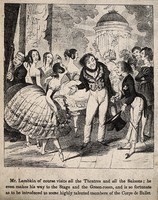
Mr. Lambkin (right) being introduced to a ballet dancer. Lithograph after G. Cruikshank.
Unknown artist
- Dance:
- Ballet
- Source:
- Wellcome Collection
- Rights:
- Rights vary by item — check the source record before reusing this image. Source record ↗
- Recorded as:
- Check
This work documents the cultural position of professional ballet dancers in early 19th-century England—visible enough in fashionable society to be a target of satire, yet marked as outsiders worthy of ridicule and gossip. It captures the tension between the respectable ballroom and the theatrical world, mediated through the figure of a woman trained in ballet being introduced to a gentleman of uncertain status. For dance historians, it is evidence of how ballet dancers were perceived and represented in popular visual culture when theatrical ballet was still a novelty.
What you are looking at
A crowded interior scene, likely a ballroom or assembly room, rendered in the manner of a satirical print. A well-dressed man in dark coat and light breeches (identified as Mr. Lambkin in the title) stands at centre-right, being presented to a woman in an elaborate white or pale dress with a full skirt. She wears her hair up and is positioned as if prepared to dance. Around them cluster other figures in evening dress—men in dark coats and breeches, women in high-waisted gowns and bonnets typical of the Regency or early 19th century. The composition is busy and crowded, with figures overlapping; the print is handled with the sharp linear clarity and satirical exaggeration typical of George Cruikshank's hand, even though this is listed as a work after him. The lighting is even and cool, typical of lithographic printing. The scene captures a moment of social introduction, with Lambkin presented as somewhat stiff or awkward in posture—a common target of Cruikshank's humour.
The dancing
Lambkin stands in an upright, formal pose, neither dancing nor in a closed hold with his partner. The woman he is being introduced to faces him in a similarly formal stance, her body held with the rigid propriety of a drawing-room scene rather than the ease of an active dancer. Other figures in the background are clustered in conversation or observation, some with raised arms or turned heads that suggest animation and gossip. The overall impression is of a social gathering at rest rather than active dancing, with bodies held in the stiff, elongated proportions characteristic of Cruikshank's grotesque style.
The dance depicted
The catalogue describes this as a scene involving 'a ballet dancer,' but the image does not depict ballet as a theatrical form or an active dance. Instead, it appears to be a Regency-era assembly or ball—a social dancing event where introductions like this would have taken place. The woman is identified as a ballet dancer by profession, but she is shown in formal dress at a social gathering rather than performing. The dance context is one of social courtship and ballroom convention (likely quadrille or cotillion based on the period and setting), though no actual dancing is visible. This is social dance as a framework for introducing an outsider (Lambkin) into fashionable society.
How it was made
This is a lithograph after a design by George Cruikshank, a satirical artist whose work was widely circulated in print form during the 19th century. Lithography allowed for rapid reproduction and distribution to a broad popular audience, and Cruikshank's prints were often published as social satire in journals and as standalone sheets. The sharp outlines, dense composition, and linear detail are characteristic of lithographic printing from this period. The technique enabled the fine cross-hatching and precise rendering of fabrics and features that give the work its satirical bite.
About this work
This is a satirical social scene from the Cruikshank circle, depicting the formal introduction of a provincial or awkward gentleman (Lambkin) to a fashionable woman identified as a ballet dancer at a Regency assembly. The work belongs to a tradition of print satire about social climbing, courtship, and the place of professional dancers in fashionable society. It is neither a theatrical ballet scene nor a record of actual dancing, but rather a commentary on social manners and class aspiration using the ballroom as its setting. The ballet dancer here is a figure of fascination or scandal in a drawing room, not a performer in action.
How to look at it
Notice Lambkin's stiffness and the woman's formal bearing—neither is in motion, and the 'introduction' is the moment frozen, not the dance. Look at how Cruikshank has exaggerated the social discomfort: the crowding, the overheard remarks (if the print carried a caption, it would likely include speech), the mismatch between Lambkin's provincial cut and the fashionable assembly. The ballet dancer is distinguished from other women present not by costume but by the title and by her role in the narrative of satire. This is satire about social aspiration and professional women in fashionable space, not about dance itself.
The artist
This is attributed to George Cruikshank or his circle. Cruikshank (1792–1878) was the pre-eminent English satirical printmaker of the early 19th century, known for his sharp social observation and grotesque exaggeration. He produced prints on theatre, courtship, fashion, and social manners, often depicting the aspirations and follies of the rising middle class. His style was influential and widely imitated; many prints of this period 'after Cruikshank' were executed by assistants or other hands working in his manner. The attribution here is uncertain because no artist is recorded.
The period
This print dates to the Regency era (circa 1811–1820) or early 1820s, based on costume and style. It was a period of intense interest in European ballet in England, following the arrival of dancers from the Continent after the Napoleonic Wars. Theatrical ballet was fashionable but still considered somewhat disreputable; ballet dancers were often conflated with actresses and other women of uncertain virtue in public discourse. At the same time, ballroom dancing—especially the quadrille and cotillion—was the centre of respectable social life for the gentry and rising middle class. The print sits at the intersection of these two worlds.
Where it lives
The work is held in the Wellcome Collection. The Wellcome Collection is a museum and library in London that holds prints, photographs, paintings, and objects relating to medicine, science, and social history. This print is catalogued there, suggesting it was preserved as a social or cultural document rather than as a dance record.
Dance in this work
Questions about this work
Is this a ballet scene?
No. Although the title identifies the woman as a ballet dancer, this is a social scene set in a Regency assembly or ballroom. It shows an introduction or moment of courtship, not a theatrical performance or even active dancing. The ballet dancer is a figure in fashionable society, not a performer.
Who was Cruikshank and why did he draw social scenes like this?
George Cruikshank was the leading English satirical printmaker of the early 19th century. He made prints mocking the manners, aspirations, and follies of society—especially the newly wealthy middle class. His prints were popular and widely circulated. This scene is typical of his work: it uses a moment of social awkwardness or pretension to ridicule his subjects.
What does this tell us about ballet dancers in this period?
It suggests that professional ballet dancers were visible and fashionable enough to move in high society, but also marked as outsiders or objects of curiosity and gossip. The satire implies that introducing a ballet dancer to a gentleman was a notable event—she was neither a respectable companion nor invisible, but a figure of interest and potential scandal.
What kind of dance would have been happening at an assembly like this?
The quadrille and cotillion were the dominant ballroom dances of the Regency era. These were social dances performed in sets, with multiple couples moving through prescribed figures. However, this print shows no active dancing—it captures the social moment before or between dances.
More Ballet artwork