49 works in this view — arrow keys or swipe to move between them.
Dance in Art
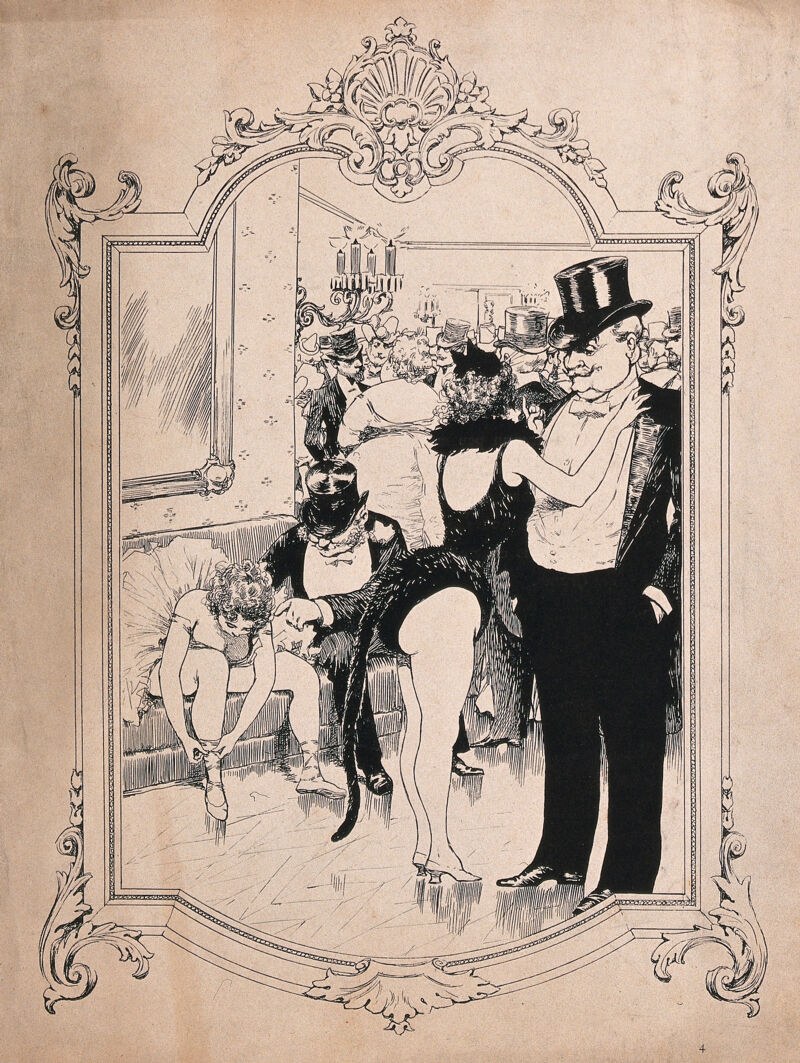
Roués at the theatre in the company of women dancers, one of whom sits down to tie up her ballet pumps. Process print, ca. 1890.
Unknown artist
- Dance:
- Ballet
- Source:
- Wellcome Collection
- Rights:
- Rights vary by item — check the source record before reusing this image. Source record ↗
- Recorded as:
- Check
This image captures the gap between ballet's public mythology and its private reality during the height of the fin-de-siècle theatre. The gesture of the seated dancer fastening her shoes—a moment of bodily fatigue and practical concern—reveals how dancers' labour was at odds with their representation as weightless, ethereal beings on stage. For anyone interested in the history of women's work in theatre, or in how artists documented the social conditions of performers, this scene is essential evidence.
What you are looking at
An elegant theatre interior circa 1890, viewed through an ornate rococo frame. A well-dressed gentleman in top hat and tails stands at centre-right, observing a group of young female dancers in a backstage or dressing-room moment. The immediate focus is a dancer seated on a chair, leaning forward to fasten her ballet pointe shoes—a candid, intimate gesture rarely depicted in formal dance imagery. Around her, other dancers in various states of preparation converse and adjust their costumes; a female companion in fashionable dress stands nearby. The setting is lit by an overhead candelabra and decorated with patterned wallpaper. The entire scene is rendered in fine pen-and-ink line work with dramatic cross-hatching that suggests the gaslit atmosphere of a late Victorian theatre.
The dancing
Five or six female figures dominate the composition, with the seated dancer as the focal point—her body folded forward in the practical, unglamorous posture of fastening her shoes, one foot extended. The standing dancers around her display varied postures: some rest their weight on one leg, others lean in conversation. The gentleman observer stands upright and formal, his silhouette emphasizing the contrast between male authority and female labour. The artist demonstrates anatomical understanding of the unguarded, offstage body: the seated dancer's spine curves naturally, and the standing figures show the soft, fatigued lines of bodies at rest rather than in performance.
The dance depicted
This is a backstage or green-room scene rather than a representation of dance itself—the actual performance is absent, displaced by the labour and ritual that precedes it. The pointe shoes are the only clear indicator of ballet practice. The work documents the 1890s theatre world in which young ballet dancers were routinely observed by male theatre-goers (the gentleman in the frame) in settings coded as semi-private or intimate. The scene captures the moment before the curtain—the dancer preparing her feet, the focus entirely on the material and physical work of ballet rather than its aesthetic display. This is a genre scene with dance as its subject, not a depiction of dance as performance.
How it was made
A process print (engraving or photomechanical reproduction) from circa 1890, executed in pen and ink with careful cross-hatching to model form and suggest interior lighting. The technique allowed for fine tonal gradation and precise linear detail, visible in the intricate rendering of fabric texture, the rococo frame, and the dancers' anatomies. Process prints of this period were distributed widely as illustrations in satirical journals, society magazines, and theatrical publications, reaching a broad urban audience interested in theatre gossip and the social hierarchies of the stage. The ornate frame suggests the work was originally published or framed as a finished art object, not merely a casual sketch.
About this work
A late-Victorian backstage scene in pen-and-ink, remarkable for its refusal to glamorize ballet. Rather than capturing the illusion of the stage, the artist documents the unglamorous reality of preparation: a young dancer seated to tie her pointe shoes, her body in an ungraceful fold, surrounded by companions and observed by a gentleman caller or patron. The composition challenges the Romantic-era tradition of depicting dancers as ethereal beings; here, dancers are ordinary young women performing labour in a semi-public space. The rococo frame ironizes the subject—ornate artifice surrounding the unvarnished truth of theatrical work. This work belongs in a dance archive both as a record of 1890s ballet practice and as a critique of how ballet dancers were positioned within the social and theatrical hierarchies of the period.
How to look at it
Focus first on the seated dancer's body—the curve of her spine, the extension of her foot, the concentrated attention to the mundane task of fastening her shoe. This is a moment stolen from performance, rendered with the kind of unflinching attention to bodily reality that was rare in ballet imagery of the period. Notice how the artist has positioned the gentleman observer in the background: his top hat and formal dress mark him as outside the dancers' world, yet his presence reminds us that this 'private' moment was actually semi-public, visible to male theatre patrons. The ornate rococo frame around the entire scene adds an ironic layer—all this artifice of decoration surrounding what is essentially an unguarded, practical moment.
The period
The 1890s witnessed an explosion of illustrated journalism and satirical art focused on theatre life, from Henri de Toulouse-Lautrec's cabaret scenes to countless society and gossip publications. Ballet was experiencing a revival of technical ambition (the 1890s saw the premieres of The Sleeping Beauty and Swan Lake) but remained socially fraught: young female dancers inhabited a liminal space between respectable profession and social precarity, frequently subject to the attentions of wealthy male patrons and theatre-goers. This print likely circulated as satirical or observational theatre commentary—wry documentation of the gap between the illusion of the stage and the social reality of the dressing room. The rococo frame is itself a period convention, referencing 18th-century aesthetics even as the content is starkly modern and unsentimental.
Where it lives
From the Wellcome Collection, a repository focused on the history of medicine and life sciences. The work's presence in a medical archive suggests it may have been catalogued as historical documentation of bodily practice or the social conditions of labour, rather than as fine art. The process-print technique indicates it was published and circulated, likely in a journal or collection of theatrical illustrations.
Dance in this work
Questions about this work
Is this a performance scene?
No. This is a backstage or dressing-room scene, depicting dancers preparing rather than performing. The artist has deliberately chosen an offstage moment, emphasizing the labour and unglamorous reality of ballet work rather than its public fantasy.
What are the ballet pointe shoes?
Pointe shoes allow dancers to rise onto the tips of their toes, creating the illusion of weightlessness central to classical ballet. The seated dancer in this image is fastening hers—the process is practical, sometimes painful, and entirely ungraceful. Her posture as she does this work is a direct visual counterpoint to the ethereal, weightless bodies ballet audiences see on stage.
Who is the gentleman in the scene?
Most likely a theatre patron, wealthy subscriber, or social acquaintance—someone with backstage access. His formal dress and detached posture suggest a figure of authority observing the dancers. His presence hints at the social dynamics of late-Victorian theatre, in which young female performers inhabited a precarious social position, frequently subject to the gaze and attention of male patrons.
Why use a rococo frame?
The ornate, deliberately artificial frame creates irony: it wraps a moment of unguarded, practical reality in decorative excess, mirroring the gap between ballet's public luxury and the dancers' private labour. The frame references 18th-century aesthetics while the content is starkly modern and observational.
More Ballet artwork