49 works in this view — arrow keys or swipe to move between them.
Dance in Art
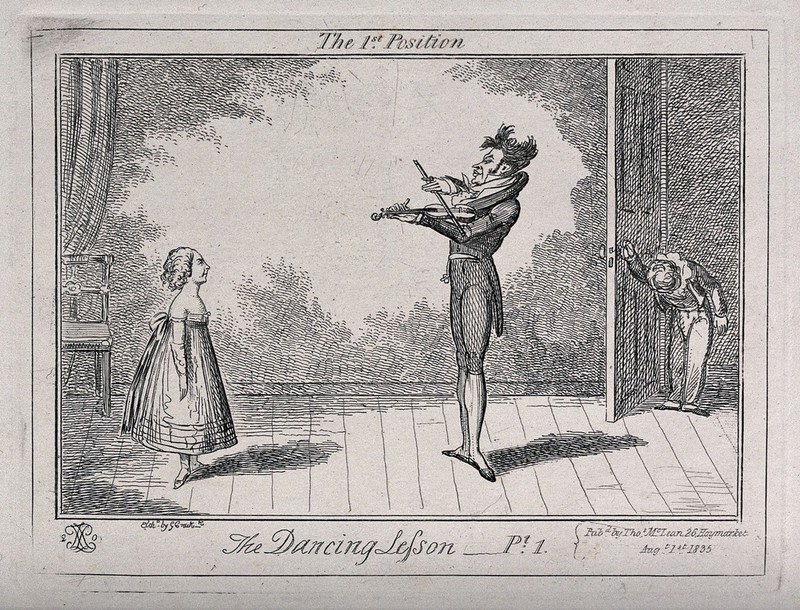
A dancing class: a girl and a boy stand in first position, as the teacher plays the violin. Etching by G. Cruikshank.
Unknown artist
- Dance:
- Ballet
- Source:
- Wellcome Collection
- Rights:
- Rights vary by item — check the source record before reusing this image. Source record ↗
- Recorded as:
- Check
This print is an invaluable artifact for understanding how dance—and dance teachers—were perceived by 18th-century society, particularly in Britain. Satire reveals cultural anxieties and blind spots; the violent exaggeration of the boy's posture tells us that extreme flexibility and turnout were already recognized markers of the dance world, and that this world was ripe for mockery. The image also documents what a dance lesson looked like materially: the studio, the violin, the clothing, and the hierarchical relationship between teacher and student.
What you are looking at
An etching depicting an indoor dance lesson in what appears to be an 18th-century setting. A young girl in a long-sleeved dress stands on the left, observing or waiting her turn. In the center, a boy in tight breeches and a coat strikes an exaggerated pose with one leg extended high and arms raised, his body twisted dramatically backward. On the right, an older figure (likely the teacher) leans forward, peering intently at the boy's position. A violinist stands in the background, bow raised, providing the music. The floor is rendered in perspective planks, and the walls are suggested by hatched architectural framing. The style is satirical—the boy's extreme, almost contorted posture and the teacher's intense scrutiny suggest this is mock-heroic commentary on dancing instruction rather than straight documentation.
The dancing
Three figures occupy the space, with the boy at the center dominating through exaggerated extension. His right leg is kicked high, nearly vertical; his torso is arched backward in an extreme position, arms outspread. His head is thrown back, mouth open as if straining. The girl stands passively in a modest stance, watching. The teacher leans in with focused attention, one arm extended toward the boy in a gesture of correction or demonstration. All three figures are clearly delineated in the etching, with strong contour lines defining musculature and the dynamics of the positions.
The dance depicted
This appears to be a lesson in ballet's foundational positions and movements, specifically demonstrating the kind of high leg extension and arabesque-like attitudes that would have been taught in 18th-century dance studios. The extreme exaggeration—the legs higher than anatomically practical, the contortions of the back—signals that the print is satirical. The title 'The Dancing Lesson Pt 1' and the caption reference to Cruikshank suggest this is one of a series mocking the pretensions and rigidity of formal dance instruction. The presence of the violin indicates the musical accompaniment customary in such lessons. The student's strained expression and the teacher's hawk-eyed scrutiny parody the intensity and often-absurd demands of period dance pedagogy.
How it was made
This is an etching, a print medium created by incising lines into a copper plate with a needle and acid. The technique allowed for wide circulation and rapid reproduction, making satirical commentary accessible to a broad urban audience. Etching's linear, high-contrast aesthetic suited caricature well—note the emphatic hatching used for shadows and volume, and the exaggerated proportions of the dancing boy. The fine detail possible in etching enabled the artist to render the interior setting, costumes, and facial expressions with clarity. This was an economical medium for producing multiple impressions, ideal for distributing social satire.
About this work
This is a satirical etching of an 18th-century dance lesson, showing a young student in an exaggerated, almost contorted attitude while a stern teacher scrutinizes his form and a violinist provides accompaniment. The print belongs to a tradition of illustrated satire about dance instruction, mocking both the technical extremism and the social pretension attached to formal dance training in the Georgian era. It documents not what dance *was* but how dance pedagogy was perceived and ridiculed by the wider public—as an absurd, physically punishing, and socially ridiculous discipline. The work sits at the intersection of dance history, visual satire, and social commentary on class and manners.
How to look at it
Pay attention to the moment frozen: the boy is not in a stable position but mid-strain, pushed to his limit. His open mouth and contorted spine are the visual punch line. The teacher's magnifying gaze—literally bending in to scrutinize—emphasizes the obsessive attention to bodily detail. The girl's passive waiting suggests the repetitive, hierarchical nature of instruction. The violin in the background is easy to miss but crucial; it locates this not as a private exertion but as a formalized, musicalized lesson. The artist chose a moment of maximum absurdity, not of accomplished grace—that is the satire.
The artist
The catalogue attributes this to G. Cruikshank, though the record notes the artist as unrecorded. If this is George Cruikshank (1792–1878), one of Britain's most prolific and celebrated caricaturists, the print would date to his most active period. Cruikshank was known for savage social satire, particularly on class, manners, and pretension. His style—exaggerated physiognomy, dynamic composition, moral or comic intent—is consistent with this image. Cruikshank often worked in series on related themes, which aligns with the 'Pt 1' notation. However, the record's uncertainty should be noted; confirmation would require further research.
The period
In the 18th century, formal dance training was becoming increasingly rigorous and codified under the French ballet system. Turnout, extension, and elegant carriage were essential accomplishments for the gentry and aspiring middle classes. Dance was both an art form and a marker of social refinement, taught by masters who maintained strict (often harsh) pedagogical methods. At the same time, Enlightenment satire was flourishing in Britain, with prints mocking everything from fashion to education to social climbing. Cruikshank's era (late 18th–early 19th century) saw an explosion of such prints, often aimed at the middle class's anxious adoption of genteel practices. Dance instruction was a visible target because it was expensive, fashionable, and physically extreme—perfect material for caricature.
Where it lives
This print is held in the Wellcome Collection, a historical collection focused on medicine, science, and the body. Its presence there suggests it was catalogued as social documentary or medical curiosity rather than as dance history. The Wellcome's acquisition of such prints reflects their interest in how bodies were trained, disciplined, and represented in historical practice.
Dance in this work
Questions about this work
Is this a real dance position or pure exaggeration?
Both. High leg extension and arabesque-like attitudes were genuinely part of 18th-century ballet training. But the boy's pose is deliberately pushed beyond what was considered elegant or even possible—his spine is arched past the point of control, his leg is at an impractical angle. The satire lies in taking a real technical demand and rendering it grotesque, mocking both the students who strove for such extremes and the teachers who insisted on them.
What does this tell us about how ordinary people saw dance?
It reveals that formal dance training was seen as ridiculous, pretentious, and physically punishing. Satire works by amplifying what the audience already suspects or resents. The fact that this image was printed and circulated suggests there was an audience ready to laugh at the expense of people—usually the upwardly mobile middle class—who aspired to genteel accomplishments like dancing. Dance was prestigious but also vulnerable to mockery as an artificial, body-warping practice.
Why is the teacher shown as such a stern, intense figure?
Dance masters of the period were notoriously strict and often physically abusive. They used raps on the knuckles, pulls, and other coercive methods to enforce positions and corrections. The teacher's penetrating gaze and forward lean suggest both the intensity of scrutiny and the potential for cruelty. This was part of the real history of dance pedagogy, and the satire draws on that reality to heighten the comedy.
More Ballet artwork