49 works in this view — arrow keys or swipe to move between them.
Dance in Art
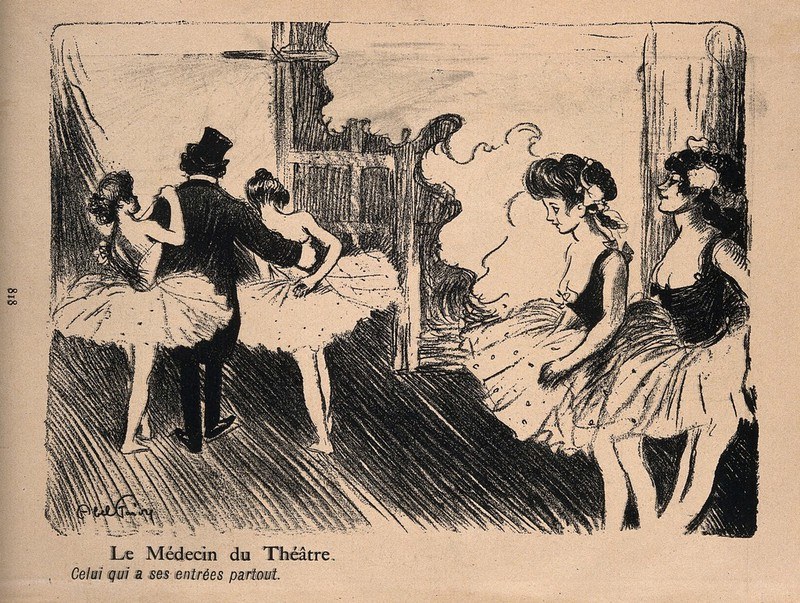
A doctor goes off gallivanting with two young dancers. Colour process print after by J-A. Faivre, 1902.
Unknown artist
- Dance:
- Ballet
- Source:
- Wellcome Collection
- Rights:
- Rights vary by item — check the source record before reusing this image. Source record ↗
- Recorded as:
- Check
This image records how dance imagery was weaponized for satirical commentary on class, gender, and institutional power in the early 20th century. For historians of ballet, it reveals the assumptions underlying how dancers were depicted when the artist was not attempting to celebrate their artistry—what the medium shows when satire rather than admiration is the intent.
What you are looking at
A satirical theatrical scene shows a doctor in formal evening dress and top hat seated between two ballet dancers in tutus. The setting is a theatre or dressing room, indicated by draped curtains and what appears to be a mirror or doorway in the background. The doctor leans forward with animated gesture, clearly the focus of attention, while the two dancers in pale tutus flank him on either side—one seated directly beside him, the other further back. A fifth figure, a woman in dark dress, watches from the right. The composition is rendered in bold black ink with dense cross-hatching, creating a sense of theatrical intimacy and moral commentary. The title 'Le Médecin du Théâtre' (The Theatre Doctor) and subtitle 'Celui qui à ses entrées partout' (He who has entry everywhere) suggest this is mocking a medical professional's privileged access to backstage ballet society.
The dancing
All five figures are seated or stationary; there is no active dancing depicted. The doctor's body language is forward-leaning and gesticulating, suggesting speech or persuasion. The nearest dancer sits passively in her tutu, her posture upright and formal. The second dancer beyond her mirrors this stillness. The composition emphasizes social interaction and hierarchy rather than movement quality. No footwork, line, or technical dance vocabulary is visible, as this is a social scene rather than a performance.
The dance depicted
While this is a theatre scene involving ballet dancers identifiable by their tutus, it is not depicting dance itself but rather a behind-the-scenes social encounter. The dancers are present as figures of attraction and vulnerability rather than as performers executing technique. The image satirizes the access and power dynamics between a medical professional and young female dancers in a late 19th-century theatre setting. This reflects period anxieties about theatre girls and predatory gatekeepers, treating ballet dancers as subjects of male desire rather than as artists.
How it was made
This is a wood engraving or ink line engraving, rendered in bold black strokes with extensive cross-hatching for shadow and modelling. The catalogue notes it is a 'colour process print after' an original by J-A. Faivre from 1902, suggesting this is a reproduction. The technique creates sharp, high-contrast drama suitable for satirical commentary in newspapers or magazines. The medium's suitability for mass reproduction implies this image circulated widely in the popular press, reaching audiences beyond the gallery.
About this work
This is a satirical engraving of late-19th-century theatre culture that uses the ballet dancer as a symbol of exploitation and access. It belongs in a gallery of dance imagery not because it shows dancing—it does not—but because it documents how ballet dancers were socially positioned and visually represented in their own era. The work reveals the gap between the public mythology of ballet as an art form and the private reality of young women's precarious status in theatre. It is a document of misogyny dressed as social commentary, and understanding it historically requires understanding what ballet dancers actually were in their social moment.
How to look at it
Read this as satirical caricature, not as documentary. The doctor's exaggerated gesture and the dancers' passive, almost complicit positioning are the point—the artist is condemning this dynamic, not endorsing it. Notice the formal dress codes: the doctor's authority is marked by his top hat and formal wear, the dancers by their tutus as costume rather than work clothes. The composition groups them intimately but unequally, with the doctor as the active subject and the dancers as passive objects of his attention. The darkness of the line work reinforces the satirical tone—this is not a celebration.
The artist
J-A. Faivre (1849–1901) was a French caricaturist, painter, and illustrator known for satirical works targeting Parisian society. He contributed regularly to publications including Le Charivari and La Vie Parisienne, using sharp ink work to mock manners, morality, and social hypocrisy. His practice was aligned with the tradition of French satirical printmaking that used theatre and its personnel as subjects for social critique.
The period
The early 1900s saw the height of the Romantic and Classical ballet repertory, yet ballet dancers remained socially marginal figures whose access depended on powerful men's patronage. The theatre doctor—a real figure with medical authority and backstage privileges—became an icon of this power imbalance. Simultaneously, illustrated periodicals and satirical prints were the dominant media for public commentary, making this kind of image far more widely circulated than any painting. The work reflects fin-de-siècle anxieties about modernity, morality, and the theatre's role in corrupting young women.
Where it lives
The work is held in the Wellcome Collection, which specializes in the history of medicine, science, and society. It is catalogued as an artwork, but its presence in a medical collection reflects its subject matter (the theatre doctor) rather than any scientific intent. The attribution to Faivre and notation of 1902 as date are reliable; the medium and printing history indicate this was a mass-circulation satirical print.
Dance in this work
Questions about this work
Why is a satirical engraving in a collection about dance?
Because it documents how ballet dancers were visually and socially positioned in their historical moment. Dance history is not only about technique and performance; it includes how dancers were represented, perceived, and used as social commentary. This image shows dancers at their most vulnerable and least valorized—as objects rather than artists.
Are the figures actually dancing?
No. This is a theatre scene set behind the stage or in a dressing room, not a performance. All figures are seated or still. The dancers are identified by their tutus, but the image is not depicting ballet technique or choreography—it is depicting social encounter and power dynamics.
What does 'colour process print after' mean?
It means this is a reproduction of an original work by Faivre, printed using a mechanical colour process. The original may have been a drawing, watercolour, or painting; this version is a mass-produced print, likely from a newspaper or periodical. The process allowed satirical images to reach large popular audiences.
Is this anti-ballet or anti-doctor?
It is anti-corruption of young women within theatre institutions. The doctor is the villain—a man with power and access who exploits the dancers' economic and social vulnerability. The dancers are depicted as trapped, not as willing participants. The satire is aimed at the system that enables this predation.
More Ballet artwork