49 works in this view — arrow keys or swipe to move between them.
Dance in Art
Russian Ballet
Max Weber
- Dance:
- Ballet
- Era:
- 1900-1920 (Ragtime/Early Jazz)
- Source:
- Internet Archive
- Rights:
- Rights vary by item — check the source record before reusing this image. Source record ↗
- Recorded as:
- Check
This work documents the moment when the Ballets Russes catalyzed a modernist reimagining of dance in visual art. It shows how painters borrowed from choreography—the idea of the body as a form to be fragmented and recombined—and how dancers and visual artists collaborated to forge a new aesthetic. For historians of dance and modernism alike, it is evidence of dance's centrality to the formation of European abstraction.
What you are looking at
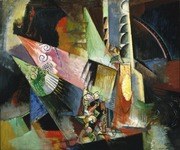
A geometric abstraction of violent, energetic movement fills the canvas in Weber's 1916 *Russian Ballet*. Fragmentary figures in costume—visible in truncated arms, torsos, and the suggestion of fabric in greens, oranges, and flesh tones—appear mid-leap or mid-turn against a dark, mottled background. The composition is fractured and layered, with intersecting planes of color and line that suggest multiple bodies and moments of action compressed into a single image. Light picks out edges and angles; the overall effect is one of explosive kinetic energy rather than a coherent narrative moment. The work reads as an interpretation of dance as pure motion and formal complexity rather than as a representation of bodies in a ballroom or stage.
The dancing
The figures are barely legible as such: what emerges from the abstraction are fragments—a raised arm in orange, what may be a leg or torso in green, suggestions of drapery in lighter tones. The composition suggests multiple dancers occupying the same space in rapid sequence, creating a blur of movement. Weber has prioritized the line of motion and the geometry of the body's arc over anatomical clarity. The overlapping, intersecting planes and the lack of a stable ground or orientation suggest bodies in flight, perhaps caught between positions rather than in a held or finished pose.
The dance depicted
The work is titled *Russian Ballet* and dates to 1916, a moment when Diaghilev's Ballets Russes were at the height of their influence and cultural urgency in Western art circles. The abstraction prevents identification of a specific ballet or choreography, but the dynamism and the compositional strategy—fragmentation, overlaid planes, the compression of motion into simultaneity—reflect the modernist fascination with ballet as a form of pure movement and formal innovation. This is not a representation of ballet as a spectacle but an attempt to capture the idea of balletic movement as radical aesthetic rupture.
How it was made
The work appears to be oil or gouache on canvas, executed in a Cubist-Futurist idiom with strong Orphist influences. The layering of translucent and opaque color, the faceting of form, and the dynamic angularity suggest Weber's engagement with European modernism, particularly Cubism and the color abstractions of artists like Delaunay. The technique of fragmenting and flattening the figure, scattering it across the picture plane, was well-suited to reproducing in prints and reproductions, and helped disseminate modernist interpretations of dance to a broader audience.
About this work
Max Weber's *Russian Ballet* (1916) is a modernist interpretation of dance as pure motion and formal abstraction. Rather than depicting a recognizable ballet or ballroom scene, Weber fractures the dancing figure into geometric planes and arresting color—a strategy drawn from Cubism and Orphism—to suggest the sensation of movement and the body in space. The work is part of a broader early-twentieth-century project among visual artists to represent dance not as narrative or spectacle but as a radical formal rupture. It belongs in this gallery as evidence of how the visual avant-garde saw ballet and how they attempted to translate choreographic innovation into the vocabulary of painting.
How to look at it
Approach this work not as a window into a ballroom or stage but as a diagram of motion itself. Notice how the eye is drawn along lines and angles rather than around a scene; there is no single vantage point, no stable ground. The fractured planes suggest the body at multiple moments in its arc of movement, compressed into simultaneity. The color—particularly the warm oranges and greens against the dark ground—creates the sensation of bodies catching and reflecting light as they move. What matters is not what is being danced but the formal language Weber has invented to represent the sensation of dancing.
The artist
Max Weber (1881–1961) was a Russian-born American painter and sculptor who emigrated to the United States in 1891. He studied in Paris (1905–1909) and absorbed Cubism, Fauvism, and the color theories of the Orphists before returning to New York, where he became a central figure in the American modernist movement. Weber was fascinated by the Ballets Russes and by the problem of representing motion and temporal sequence in a static medium. His work from this period alternates between figuration and abstraction, often using dance and the body as a vehicle for exploring formal innovation.
The period
In 1916, Diaghilev's Ballets Russes had been touring Europe and the United States for seven years, introducing European and American audiences to modernist choreography and design. Artists including Picasso, Matisse, and Léger had created sets and costumes; the company was understood as a laboratory for modernist collaboration. Simultaneously, European and American painters were grappling with Cubism, Futurism, and abstraction—all concerned with representing motion, simultaneity, and the fragmentation of perspective. Ballet, with its formal vocabulary of line, movement, and spatial transformation, was a natural subject for artists exploring these problems. Weber's *Russian Ballet* sits at the intersection of these currents.
Where it lives
The work is held in the Internet Archive digital collection. The catalogue record provides minimal information on medium, dimensions, and current holding institution, indicating it has likely circulated as a reproduction rather than as a frequently exhibited or intensively documented object.
Dance in this work
Questions about this work
Is this actually about the Ballets Russes?
The title and date strongly suggest it is responding to Diaghilev's company and their work in New York and Paris. However, the abstraction is so complete that no specific ballet can be identified. Weber is working with the *idea* of Russian ballet—its association with modernism, dynamism, and formal innovation—rather than illustrating a particular choreography or moment.
Can you see the dancers?
Only fragments: raised arms, suggested torsos, hints of costume and fabric. The fragmentation is deliberate and central to the work's meaning. Weber is using Cubist and Futurist techniques to represent the body not as a coherent form but as something shattered by motion and formal abstraction.
What technique did Weber use?
The work appears to be oil or gouache on canvas, rendered in a Cubist-Orphist style with layered, translucent color and dynamic angular forms. The effect is one of formal complexity and chromatic intensity rather than descriptive clarity.
Why would a painter be so interested in ballet?
Ballet offered modernist painters a visual model for abstraction: the body as a pure form to be fragmented, recomposed, and set in motion across space. The Ballets Russes were also a site of collaboration between painters, designers, composers, and choreographers, making dance central to modernist culture.
More Ballet artwork