49 works in this view — arrow keys or swipe to move between them.
Dance in Art
Dancers 1950s
Unknown artist
- Source:
- Internet Archive
- Rights:
- Public domain — free to use, share and adapt.
- Recorded as:
- http://creativecommons.org/publicdomain/zero/1.0/
This photograph documents how ballet was visually presented and celebrated in 1950s America at a moment when the art form was gaining institutional legitimacy and popular reach. For dance historians and practitioners, the image offers concrete evidence of costume construction, body carriage, and aesthetic values in mid-century classical ballet — details that reveal how the tradition was actually taught and performed rather than how it is remembered.
What you are looking at
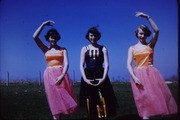
Three female dancers are posed against a twilight sky, arranged in a loose triangular composition. The central figure wears a dark sleeveless costume and stands with arms raised in a classical pose, while the two outer dancers flank her in matching pale pink tulle skirts with fitted bodices, their arms also raised. All three have their bodies angled toward the camera with controlled, upright carriage. The lighting is dramatic, with the dancers silhouetted against a deep blue evening sky that gradates from darker at the top to lighter at the horizon. The outdoor setting and ethereal quality suggest a theatrical production or professional photoshoot rather than a candid moment. The pink tutus and classical arm positions evoke the conventions of mid-twentieth-century ballet imagery.
The dancing
All three dancers stand in an upright, elongated line with raised arms in a pose suggesting classical ballet vocabulary — the central figure's arms frame her head in an elegant oval, while the flanking dancers mirror this position with slight variations. Their bodies show the lifted, extended carriage characteristic of trained ballet dancers, with engaged core and pulled-up posture from heel to crown. The spacing suggests they are meant to be read as a unified ensemble rather than as dancers in relationship. Weight appears centered and controlled, with no indication of active footwork or momentum.
The dance depicted
This appears to be a theatrical ballet ensemble, most likely from a mid-20th-century production or photographic study. The matching tutus, classical arm vocabulary, and formal pose are consistent with the conventions of Romantic or Neoclassical ballet as practiced in the 1950s. The three-dancer grouping and the outdoor theatrical photography suggest a professional ballet company, though the specific work cannot be identified from the image alone. The styling — pink tutus with fitted bodices, the sleeveless construction, the upright épaulement — aligns with ballet as it was being performed and documented in the American dance world during the 1950s.
How it was made
This is a color photograph, likely Kodachrome or Ektachrome film stock given the saturation and color palette typical of 1950s color photography. The image shows careful studio lighting against a painted or natural sky backdrop, suggesting a professional photoshoot commissioned for promotional or documentary purposes. The technical control — the crisp focus, balanced exposure, and composed framing — indicates this was made by a trained photographer with access to professional equipment and printing technology. Color photography of dance was still relatively expensive and uncommon in the early 1950s, so this document likely served publicity, archival, or educational purposes within the ballet world.
About this work
This is a color photograph of three female ballet dancers posed in classical ballet positions against a twilight sky, made in or around the 1950s. The image documents a moment in mid-twentieth-century American ballet practice, when theatrical ballet was a flourishing and heavily documented art form. The dancers' bodies, costumes, and poses reflect the aesthetic conventions of the era — a particular ideal of line, proportion, and feminine grace that ballet companies were actively cultivating and promoting through photography. The work sits at the intersection of dance documentation and commercial promotion, capturing both the actual practice of ballet and the image the art form wished to project.
How to look at it
Observe the careful positioning of the three bodies in relation to each other and the sky: the artist has chosen a moment of stillness and pose rather than action, presenting the dancers as sculptural forms rather than as bodies in motion. The framing from approximately waist-height and the low angle of the camera make the dancers appear monumental against the sky, emphasizing their verticality and control. Notice the precision of the arm positions and the uniformity of their posture — this is not a moment of improvisation or individual expression, but rather a codified ensemble statement. The pink and dark color contrast creates visual rhythm and hierarchy, with the central figure in dark costume anchoring the composition. The twilight setting evokes the theatrical, artificial world of ballet rather than naturalistic dance, a key convention of how ballet photography worked in this era.
The period
The 1950s were a pivotal decade for ballet in the United States. American ballet companies were establishing themselves as major cultural institutions, touring extensively and receiving significant institutional support. The art form was promoted through publicity photography, magazine features, and documentary films as a marker of cultural sophistication and American cultural achievement during the Cold War. Color photography was still a luxury medium, making professional color photographs of dance relatively rare and valuable for promotional purposes. The aesthetic conventions visible in this image — the emphasis on classical line, elongation, and ethereal femininity — reflect the particular version of ballet that had become dominant in the American imagination, shaped by the Ballets Russes legacy, George Balanchine's influence, and the values of postwar American culture.
Where it lives
The work is held in the Internet Archive digital collections, suggesting it was digitized from an institutional or private archive. Without fuller documentation, the original photographic print's location and custodian cannot be determined from the available record.
Dance in this work
Questions about this work
What ballet is this from?
The specific ballet cannot be identified from the image alone. The costume style and photographic conventions are consistent with professional American ballet productions of the early-to-mid 1950s, but without additional documentation such as a caption, photographer's credit, or institutional marking, the work's title and company affiliation remain unknown.
Why are only two dancers wearing pink tutus?
In classical ballet ensembles, different roles often wear different costumes to establish hierarchy and narrative function. The central figure in dark costume likely represents a soloist or principal role, while the flanking dancers in matching pink tutus represent the corps de ballet or secondary ensemble roles. This costume differentiation was a standard convention of mid-century ballet staging.
Is this a studio or stage photograph?
This appears to be a professional outdoor photoshoot using a painted or actual sky backdrop, rather than a documentation of a live stage performance. The controlled lighting, posed composition, and the absence of other performers or scenery suggest this was made for publicity, archival, or educational purposes — a common practice for ballet companies to commission color photographs during this era.
More dance artwork