34 works in this view — arrow keys or swipe to move between them.
Dance in Art
The Waltz
Anders Zorn (Swedish, 1860–1920)
- Dance:
- Waltz
- Era:
- Late 1800s (Victorian Ballroom)
- Source:
- Internet Archive
- Rights:
- Public domain — free to use, share and adapt.
- Recorded as:
- https://creativecommons.org/publicdomain/zero/1.0/
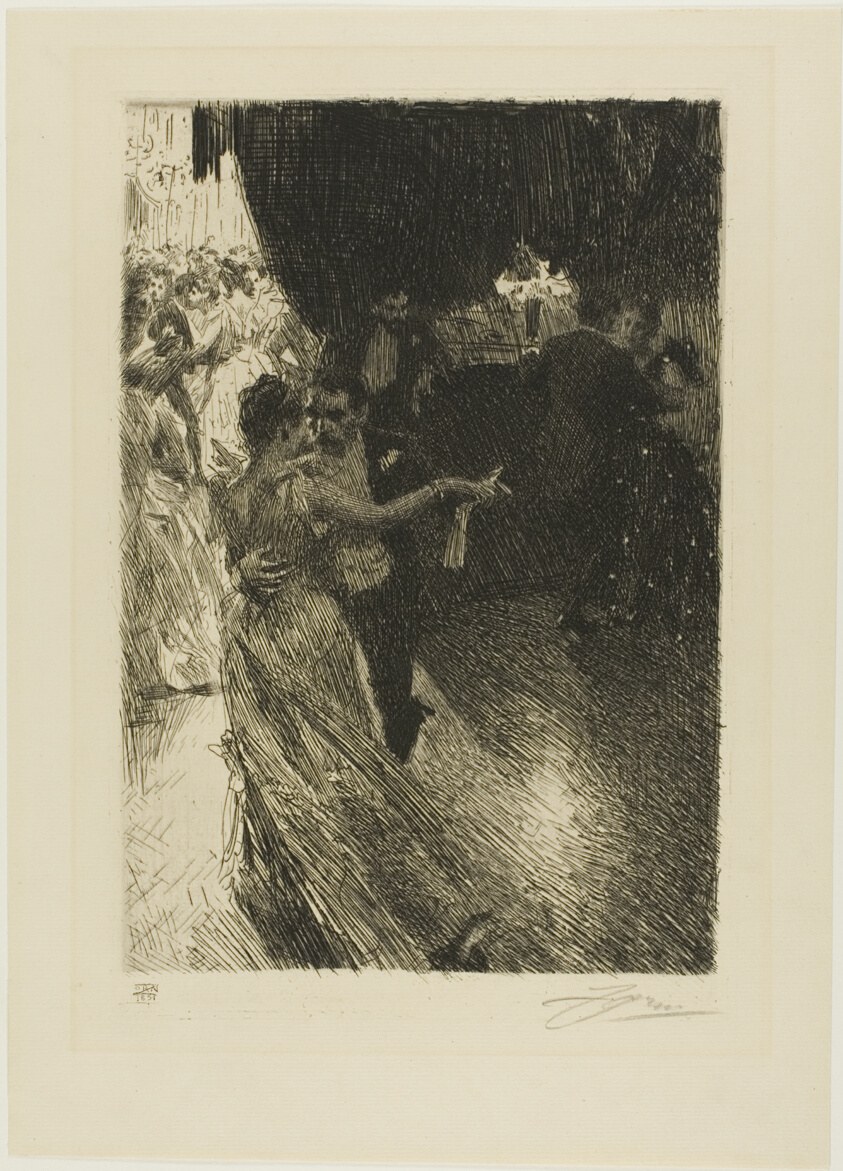
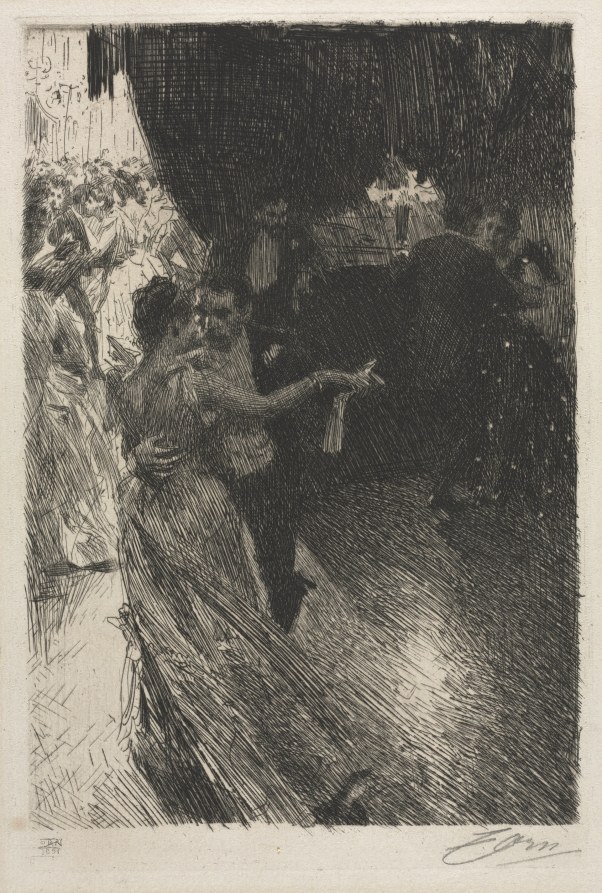
This image captures the waltz at the exact moment when it had become the dominant expression of respectable heterosexual courtship in Western Europe and North America. For historians of dance, manners, and gender, it shows how the dance was actually held, how close partners stood, and how the woman's costume functioned in movement. For art historians, it demonstrates Zorn's mastery of tonal printmaking and his interest in contemporary social subjects—dance, not as a classical or theatrical subject, but as lived social practice.
What you are looking at
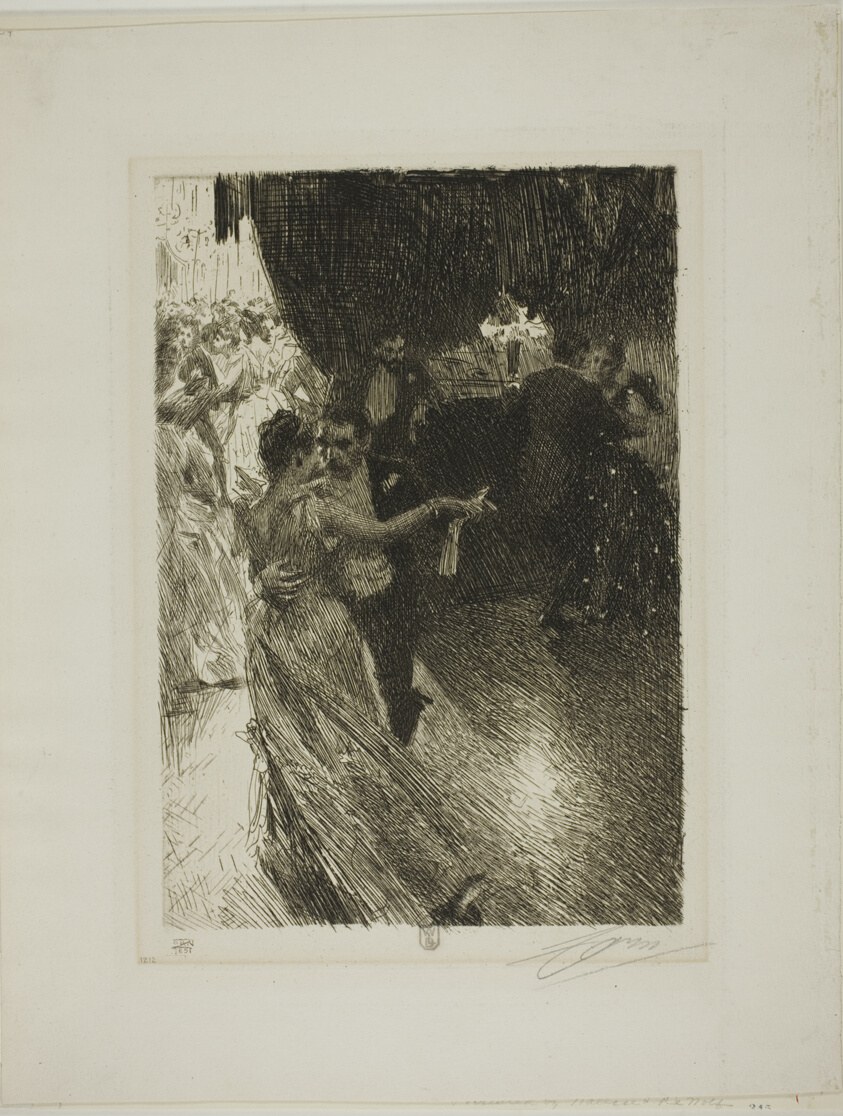
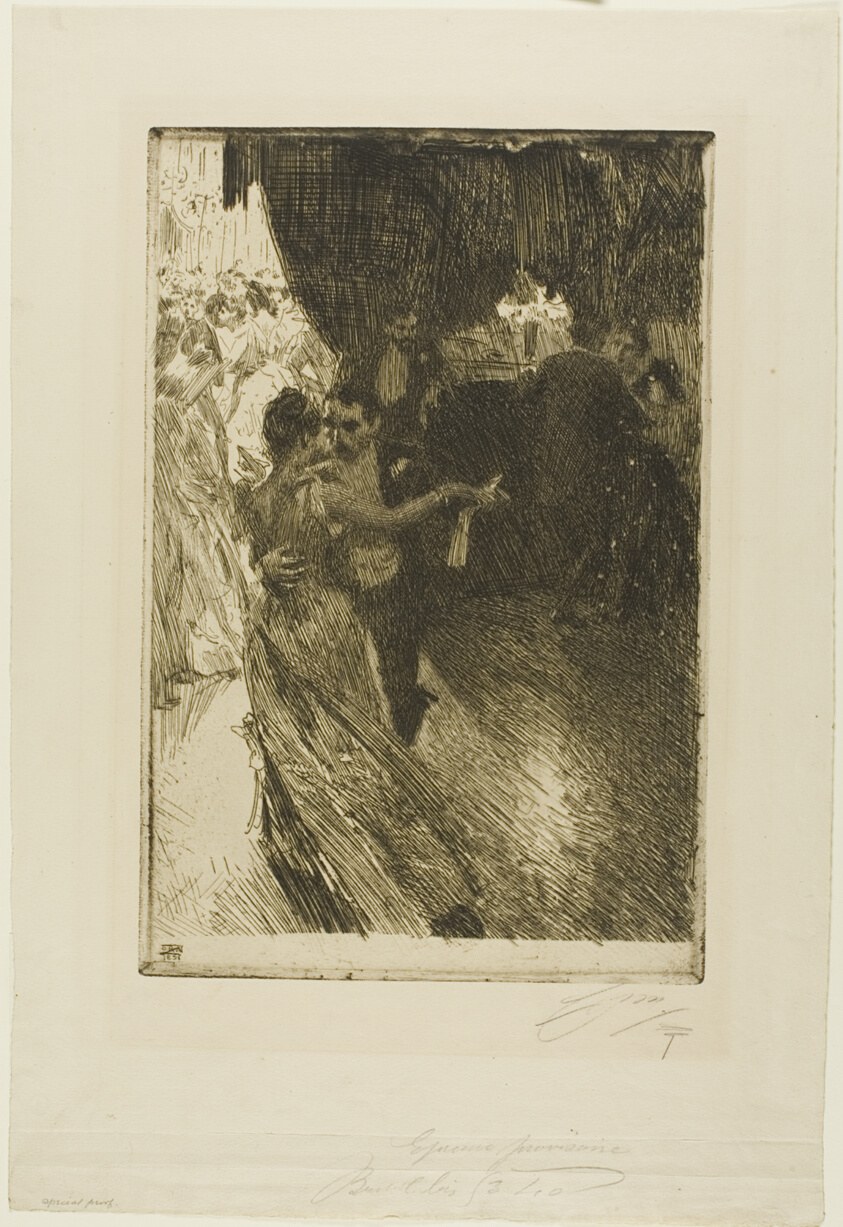
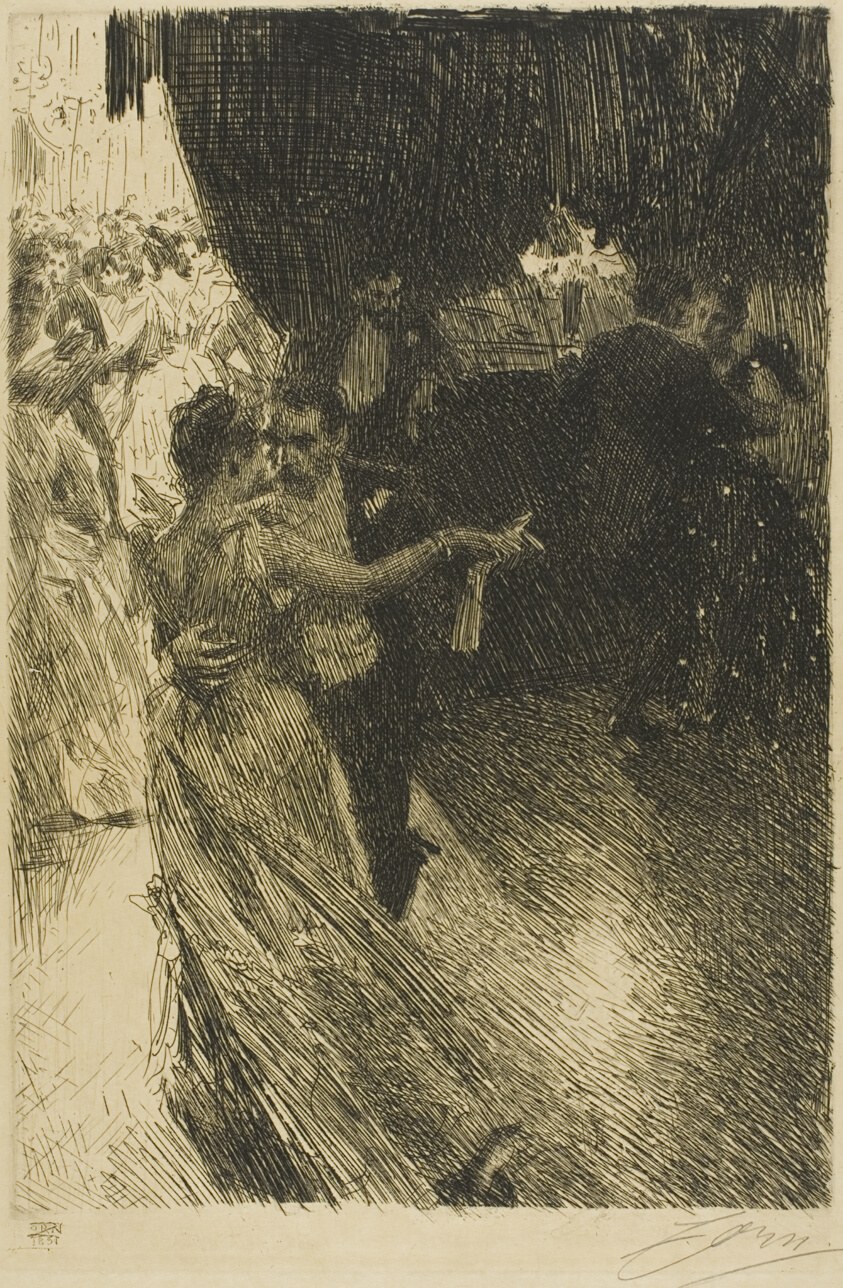
A couple dances in an intimate interior space lit by soft, diffused light that creates deep shadows and highlights the figures in chiaroscuro. The woman, in a full-skirted gown with her hair up in the fashion of the 1890s, is held close by her partner in dark formal dress. Their bodies are angled into the composition; her skirt swirls in a graceful arc around them, caught mid-movement. The setting appears to be an elegant drawing room or ballroom, suggested by architectural elements and other figures visible in the shadowed background—the scene captures the charged, private intensity of a waltz even within a public social space. The print technique has created a velvety texture that softens contours and emphasizes the romantic mood of the moment.
The dancing
The male dancer supports his partner in a closed ballroom hold, his right hand at her waist, her left hand resting on his shoulder. Their bodies are positioned in the characteristic frame of late-nineteenth-century waltz: close, upright, with a slight forward inclination. The woman's weight appears settled into her partner's support; her skirts billow outward in the rotational motion of the dance, suggesting mid-turn. The hold is proprietary and intimate—this is social dance at a moment of physical and emotional closeness that contemporary observers found both thrilling and mildly transgressive.
The dance depicted
This is unambiguously a waltz, the dominant couple dance of the nineteenth century and the subject of the work's title. The closed hold, the formal evening dress, the intimate proximity of the bodies, and the woman's swirling skirts are all diagnostic of the waltz as it was performed in ballrooms of the 1880s–1890s. The waltz had been controversial in its early decades for the closeness of the hold; by 1891, when Zorn made this work, it was the standard social dance of the European and American upper classes. The image captures not the technical virtuosity of the waltz but its emotional tenor—the private conversation conducted between partners in public.
How it was made
This is a print—most likely an etching or engraving, given the tonal range and the linear handling visible in the background. The catalogue record does not specify the medium, but the technique is evident: the artist has used fine parallel lines and cross-hatching to build form and atmosphere, creating the deep blacks and subtle grays that give the image its romantic moodiness. The velvety surface texture and the ability to render both sharp detail and soft shadow suggest etching, which allowed Zorn to achieve the atmospheric effects typical of his work. This is a reproductive print, circulated to a broad educated audience interested in contemporary social life.
About this work
Zorn's *The Waltz* is a document of late-nineteenth-century courtship and social dance at the moment when the waltz had become not a scandal but the normal expression of romantic partnership in public. The work shows the dance not as spectacle or technical feat, but as intimate encounter—two people in formal dress, in a room full of witnesses, completely absorbed in each other. The print medium allowed Zorn to circulate this image to audiences far beyond the ballrooms themselves, making visible the private emotion contained within the public ritual. The work exemplifies the Romantic era's fascination with dance as a vehicle for feeling rather than mere movement.
How to look at it
Attend to the exact moment Zorn has chosen: mid-turn, with the woman's skirt in full billow around the couple. Notice how the artist has used light and shadow to isolate the dancing pair from the background figures—the waltz as a private conversation conducted in public. Look at the hand positions and the closeness of the bodies; this tells you how the waltz was actually held, without artifice or exaggeration. The soft, velvety texture of the print surface is not a limitation of the medium but an artistic choice—Zorn is using the technique of printmaking itself to create the romantic mood of the ballroom.
The artist
Anders Zorn (1860–1920) was a Swedish painter, printmaker, and sculptor known for his virtuoso handling of light and his interest in contemporary Scandinavian and European social life. He was equally accomplished in oil painting, watercolor, and printmaking, and his prints—etchings and engravings—were widely collected and admired. Zorn often chose subjects from everyday life and high society: intimate domestic scenes, peasant celebrations, and ballroom occasions. He brought to printmaking a painter's sensitivity to tone and atmosphere, making his prints feel more like tonal drawings than conventional engravings. His work circulated internationally and influenced printmakers of the succeeding generation.
The period
By 1891, the waltz was in its second generation as a social dance—no longer the shocking innovation it had been in the 1810s–1820s, but the established form of couple dancing in ballrooms across Europe and America. The Romantic era had elevated the waltz as the supreme expression of feeling between partners; by the fin de siècle, it was becoming codified and formalized, moving toward the standardized International Waltz of competitive ballroom dancing. Visually, the 1890s saw renewed interest in depicting contemporary social life in high art—Impressionists and post-Impressionists were painting dance halls, theaters, and ballrooms. Zorn's print belongs to this moment of artistic interest in modern social subjects.
Where it lives
The work is recorded in the Internet Archive digital collection. It is a print, almost certainly an etching or engraving, created for circulation beyond the artist's studio—a work meant to be seen and owned by educated audiences interested in contemporary life and high-quality printmaking.
Dance in this work
Questions about this work
Is this a real moment or an imagined one?
Both. Zorn worked from observation—he attended ballrooms and made sketches—but he composed and refined his images in the studio. This is not a portrait of a specific couple but a type scene, an idealized representation of the waltz as Zorn and his audience understood it. The intimacy is real; the specific moment is the artist's creation.
Why is the woman's skirt doing that?
The woman is turning, and her full skirt—made of silk or similar fabric—is responding to the centrifugal force of the rotation. Zorn has captured the moment when the skirt is maximally displaced, which is both visually beautiful and practically accurate to how the waltz actually looked. This was one reason the waltz was so visually spectacular in the ballroom.
What does this tell me about how the waltz was actually danced?
It tells you that partners held each other closely and upright, with the man's right hand at the woman's waist. It shows that the woman's weight was supported by her partner, allowing her to move with grace and apparent effortlessness. It demonstrates that the dance involved continuous rotation and that the woman's costume—a full skirt—was integral to the visual effect of the dance.
Why would this subject matter to a fine artist like Zorn?
The waltz was the defining social ritual of his era—a moment when class, gender, courtship, and feeling intersected. For an artist interested in contemporary life, it was as important as any historical or mythological subject. Moreover, the interplay of light on moving fabric and human bodies offered technical and aesthetic challenges that appealed to Zorn's interests in tone and atmosphere.
More Waltz artwork