41 works in this view — arrow keys or swipe to move between them.
Dance in Art
[PICTURES] JHIJHIYA | Folk Dance Of Mithila (Ghar Ghar K Lokgeet)
rohini
- Dance:
- Folk/Country
- Source:
- Internet Archive
- Rights:
- Reusable with conditions: credit the creator; share any adaptation under the same license. Source record ↗
- Recorded as:
- https://creativecommons.org/licenses/by-sa/4.0/
Jhijhiya is an important women's folk tradition in eastern India that is under-documented in Western dance scholarship and visual culture. This artwork makes visible a regional dance practice that often lacks formal recording, helping to sustain awareness of India's diverse folk repertoire beyond classical forms. The digital medium and online circulation ensure the work reaches audiences beyond academic dance historians.
What you are looking at
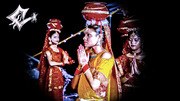
The image shows a stylized, digitally rendered scene of three female figures in vibrant traditional dress against a black background, arranged in a triangular composition. The central figure wears a yellow garment with red accents; the figure to the left is in red and gold; the figure to the right is in burgundy. All three wear ornate jewelry and traditional adornments. The figures are positioned in dynamic, animated poses suggesting movement and celebration. A white star or sparkle appears in the upper left corner, adding a decorative, contemporary digital quality to the image. The overall aesthetic is that of modern graphic design or digital illustration, with bold colors and a theatrical presentation.
The dancing
The three figures stand in asymmetrical poses, each with arms raised or extended in gestures that suggest joy and vitality. Their stances are upright and buoyant, with weight appearing to be distributed equally, not strongly weighted to one side in a way that suggests active stepping. The poses are generalized celebratory gestures rather than technically specific dance positions. Their clothing is full and voluminous, which would obscure precise footwork even if it were visible beneath the hems.
The dance depicted
This work depicts Jhijhiya, a folk dance of the Mithila region (also called Ghar Ghar ke Lokgeet, or 'songs of every household'). Jhijhiya is a social and devotional dance traditionally performed by women in the Mithila belt of Bihar, India, often during monsoon festivals and at auspicious occasions. The dance is characterized by swaying movements, rhythmic footwork in a circle, and songs that accompany the movement. The celebratory poses and the explicit title identifying this as Mithila folk dance confirm the subject. The stylization of the figures emphasizes the festive, communal spirit of the tradition rather than documenting specific choreographic detail.
How it was made
This is a digital illustration or graphic artwork, as evidenced by the smooth, airbrushed quality of the figures, the flat black background, the saturated colors, and the decorative star element. The technique allows for bold, simplified forms and theatrical color combinations that prioritize visual impact over anatomical detail. The work is likely created in a digital painting or vector graphics software, and its clean, poster-like quality suggests it was made for digital circulation and screen viewing rather than print.
About this work
This is a contemporary digital celebration of Jhijhiya, the women's folk dance of Mithila in Bihar. The artist, credited as 'rohini,' uses bright colors and animated figures to convey the joy and energy of this regional tradition. The work serves as a visual document of a living cultural practice, emphasizing its celebratory nature and social importance. While it does not aim for choreographic precision, it captures the spirit of communal women's dancing that defines Jhijhiya. The piece represents the digitization and popularization of regional folk traditions in contemporary media.
How to look at it
Attend to the color choices: the artist uses saturated primary and warm colors against black, a technique that maximizes visibility and celebratory mood over naturalistic representation. Notice how the three figures are positioned at different heights and angles, suggesting movement through space even though they are frozen in pose. The ornamental jewelry and detailed rendering of traditional dress indicate that the artist's priority is cultural specificity and pride in regalia rather than capturing a single moment of footwork.
The artist
The artist is credited as 'rohini' with no further biographical information in the available record. The style and subject matter suggest an artist interested in celebrating Indian regional culture through contemporary digital media. The work appears to be part of internet-accessible digital collections focused on folk culture documentation.
The period
This work dates to 2022, a moment of renewed global interest in documenting and celebrating non-classical regional dance traditions, particularly through digital platforms and social media. The early 2020s saw increasing efforts to record and promote folk practices that had been marginalized by classical dance hierarchies. Jhijhiya, like many South Asian women's folk dances, has experienced renewed documentation and celebration as dancers and artists work to preserve and raise visibility for traditions at risk of erasure through modernization.
Where it lives
This work is held in the Internet Archive digital collection. It is a born-digital artwork, made for and circulated through online platforms, reflecting the modern shift toward internet-based documentation of cultural practices.
Dance in this work
Questions about this work
What is Jhijhiya?
Jhijhiya is a traditional women's folk dance from the Mithila region of Bihar in northeastern India. It is performed at monsoon festivals, weddings, and other celebrations, typically in circles with swaying, rhythmic movements and accompanying devotional or celebratory songs. The dance is a communal social practice, usually performed by groups of women together.
Is this artwork a photograph or documentation of actual dancers?
No. This is a digital illustration created as a stylized celebration of the tradition rather than a direct record of dancers performing. The artist has created idealized figures in traditional dress to represent the spirit and energy of Jhijhiya rather than capturing specific choreography.
Why does the catalogue record say this is from the 1920–1950 'Swing Era'?
The era label in the original record appears to be an error. The work is dated 2022 and is a contemporary digital artwork. The 'Swing Era' label does not reflect either the creation date or the cultural tradition depicted, and suggests a cataloguing mishap in the original record.
More Folk/Country artwork