38 works in this view — arrow keys or swipe to move between them.
Dance in Art
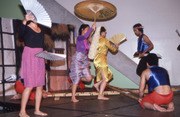
Student perform singkil, a Philippine folk dance
Visual Communications
- Dance:
- Folk/Country
- Era:
- 1950-1980 (Rock & Roll / Disco)
- Source:
- Internet Archive
- Rights:
- Rights vary by item — check the source record before reusing this image. Source record ↗
- Recorded as:
- Check
This photograph is a crucial record of how Asian diaspora communities, particularly Filipino Americans, were documenting and preserving their own cultural practices in the 1980s—a moment before digital documentation became universal. It shows singkil not in its original ceremonial context but as living practice in an American school, capturing both the dance and the specific work of cultural transmission that defines diaspora communities. For researchers studying folk dance pedagogy, Philippine American history, or documentary photography practices, this image provides concrete evidence of when, how, and in what form these traditions were being actively maintained.
What you are looking at
Six female students in a gymnasium or studio space perform singkil, a Philippine folk dance, arranged in two groups within a cleared floor area. The dancers wear coordinated costumes: colored skirts (pink, yellow, and purple visible) paired with white short-sleeved blouses. The setting appears to be an institutional space with wooden wall paneling, a clock visible on the wall above, and what looks like gymnasium equipment or storage in the background. The composition captures the dancers mid-movement, with some figures holding bamboo poles (the characteristic props of singkil) horizontally at knee height, while others step and weave between them. The photograph captures the coordinated timing required by the dance, with bodies in various positions relative to the moving poles—some dancers have just passed through or are about to step between the bamboo, creating a sense of rhythmic coordination. The lighting is institutional and even, typical of mid-twentieth-century documentary photography.
The dancing
The dancers stand upright in an open, casual frame rather than a closed or partnered hold. Their arms hang naturally at their sides or are used for balance as they navigate the foot patterns. The footwork appears quick and precise, with dancers stepping in and out of the spaces created by the horizontal bamboo poles being clapped together by the two pole-handlers (visible at the sides of the frame). The movement is fundamentally solo rather than partnered, with each dancer executing the same basic stepping pattern individually. Weight appears light and on the balls of the feet, necessary for the quick, nimble footwork singkil demands.
The dance depicted
This is singkil (also spelled cingkil or tsing-kil), a folk dance originating in the Maranao Muslim culture of Mindanao, Philippines, though it has been adopted and adapted throughout Philippine communities. The dance is performed to the rhythm of clapping bamboo poles (similar to the Filipino tinikling but with a distinct choreography and cultural context). The documentation here shows the dance in an educational setting—students learning and performing the choreography together—rather than in a ceremonial or traditional community context. The image demonstrates the basic structure: pole-operators create a rhythm by striking bamboo against the ground and together, while dancers step in and out of the spaces, their timing synchronized to the percussion pattern. This appears to be a standardized school version of the dance, preserved and transmitted through institutional performance.
How it was made
This is a color photograph, likely taken in the 1980s based on the saturation and grain characteristic of that era's color film stock. The institutional setting and documentation style suggest this was created as educational or archival material rather than fine art. The photograph captures a moment of live performance or rehearsal, freezing the action in a way that reveals both the overall composition of the dance group and the individual effort of each dancer. The color photography allows the costumes to read clearly and documents the specific appearance of a student folk dance performance at a particular moment in time.
About this work
This photograph documents a student performance of singkil, a Philippine folk dance, in what appears to be a school gymnasium in 1980. The work preserves the appearance of how this traditional dance was being taught and performed in an American educational context—in this case through Visual Communications, an organization focused on documenting Asian American cultural expression. The image shows six dancers executing the characteristic stepping patterns between bamboo poles, wearing simple school performance costumes. It belongs in a dance gallery because it records not just the dance itself but also the process of cultural transmission: how a traditional form moves into new contexts, how it appears when learned in a group setting, and what visual and kinetic information survives that translation.
How to look at it
Pay attention to the relationship between the pole-operators and the stepping dancers—the photograph captures the dance as a coordinated system where timing is everything, and you can see this in the varied positions of the dancers relative to the bamboo. Notice how the costumes and gymnasium setting frame this as an educational performance rather than a ceremonial one; the formality of matching outfits and the institutional space mark this as a deliberate, organized presentation of the dance. The composition distributes the dancers across the frame in a way that shows both the group formation and the individual execution of the footwork, letting you read both the overall design of the performance and the specific movement quality required.
The artist
Visual Communications is a Los Angeles-based Asian American media collective founded in 1970, dedicated to documenting and presenting the histories and contemporary lives of Asian American communities. The organization's practice centers on community-based documentation and media production, often capturing cultural events, performances, and everyday life as part of their mission to counter marginalization and invisibility of Asian Americans in mainstream media. This photograph of singkil performance fits within their broader archive of cultural documentation, particularly their interest in folk traditions and their transmission within diaspora communities.
The period
The photograph dates to 1980, a period when Asian American cultural activism was increasingly focused on documentation and archival work as a form of self-representation. The 1970s and 1980s saw a surge in Filipino American community organizing in Los Angeles and other West Coast cities, with cultural performance (dance, music, theater) becoming a key site of identity affirmation and community building. In the same period, folk dance was being incorporated into American school curricula, often as a way to recognize cultural diversity, though frequently in simplified or standardized forms. This image sits at the intersection of institutional dance education and community cultural documentation.
Where it lives
This photograph is held in the Internet Archive's collection of Visual Communications materials. Visual Communications' archive documents decades of Asian American cultural and community life, with this image serving as one record among many of how traditional dances were being performed and preserved in diaspora contexts.
Dance in this work
Questions about this work
Is singkil the same as tinikling?
No. While both are Philippine folk dances that involve bamboo poles being struck rhythmically, they have distinct origins, music, and movement patterns. Tinikling originated among Tagalog rice farmers and is now known worldwide. Singkil is rooted in Maranao Muslim culture of Mindanao and has a different choreography and musical context, though both have entered global folk dance repertoires.
How do dancers learn to time their steps to the poles?
Singkil requires dancers to listen closely to the rhythm created by the clapping bamboo and step in and out of the spaces created by that rhythm. The footwork is relatively consistent—a basic in-and-out pattern—but the coordination demands practice. Dancers typically learn by watching, listening, and performing repeatedly until the pattern becomes reflexive. This photograph shows students at an intermediate stage of learning.
Why would a Los Angeles media group be documenting Philippine dances?
Visual Communications was created by and worked within Asian American communities, including large Filipino American populations in Los Angeles. Documenting cultural practices like singkil was part of the organization's broader mission to represent Asian American life and history on their own terms, rather than waiting for mainstream institutions to do so.
More Folk/Country artwork