49 works in this view — arrow keys or swipe to move between them.
Dance in Art
Bacchanale
Malvina Hoffman (American, 1887–1966)
- Source:
- Cleveland Museum of Art
- Rights:
- Public domain — free to use, share and adapt.
- Recorded as:
- CC0 (Public Domain)
The work demonstrates how 19th-century sculptors adopted ballet vocabulary—the arabesque, the apparent weightlessness, the open fifth position—to represent classical mythological dancers and bacchants. It shows the formal influence of theatrical dance on high art sculpture, and the ways that balletic body language became available as a code for expressing ecstasy, freedom, and abandonment.
What you are looking at
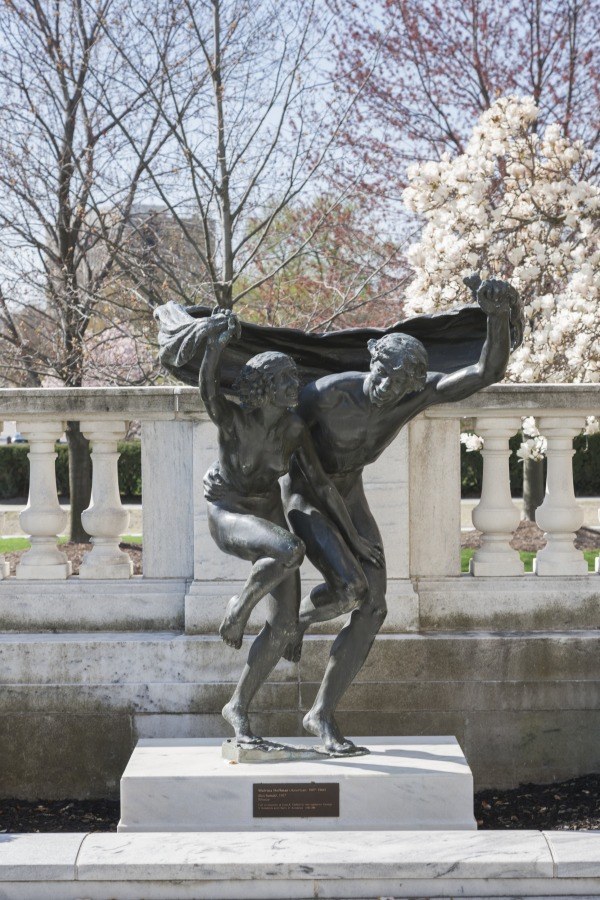
A bronze male nude figure, captured mid-leap in a dramatic contrapostal pose, dominates the composition. His body arches backward in an exuberant curve, one leg extended upward, the other bent beneath him, while his arms sweep dynamically—one raised high, the other lower across his torso, holding what appears to be drapery that billows behind him. His head is thrown back in abandon. The figure stands on a white stone plinth in what appears to be a formal garden setting, framed by a classical stone balustrade. Behind him, bare deciduous trees and a single flowering white tree (possibly a magnolia or cherry) suggest early spring. The patina of the bronze is dark, the musculature emphatically modeled to convey both weightlessness and muscularity in the suspended moment.
The dancing
A single male dancer (or dancing satyr or bacchant) shown in an advanced arabesque or grand extension, with the torso arched deeply backward and the limbs extended in multiple directions simultaneously. The pose suggests neither a grounded stance nor a sustained balance, but rather the apex of a jump or leap—a moment of complete weightlessness. The left leg rises high, the right knee bends, and the upper body opens in an expansive curve that reads as ecstatic rather than controlled. The drapery across his body and the dynamic arm positions suggest momentum and freedom of movement.
The dance depicted
The work appears to depict a Bacchic or bacchanal figure—a satyr or male dancer possessed by ecstatic revelation—rather than a classical ballet dancer. The title *Bacchanale* points to the ancient Roman revelry and theatrical traditions associated with Bacchus and his retinue. The pose, however, shows influence from Romantic-era ballet and neoclassical sculpture: the apparent weightlessness, the arabesquelike extension, and the emphasis on the dancer's transport recall theatrical ballet language, yet the subject matter and the satyr-like muscularity point toward mythological or theatrical-contemporary performance. The figure could represent a character from a 19th-century ballet pantomime on Bacchic themes, or a more general artistic vision of intoxicated, abandoned movement.
How it was made
This is a bronze sculpture, cast from a modeled original and finished with burnishing and patination. The dark patina and formal mounting on a limestone plinth suggest a serious artistic sculpture rather than a garden ornament, though the outdoor garden setting here implies it was made to withstand weather. The three-dimensionality allows the viewer to circle the figure and apprehend the leap from all angles—an advantage over painting or relief. The technique required the artist to resolve a complex balance of dynamism and stability; a mid-leap figure in bronze risks appearing precarious or clumsy, yet this work holds its composure through careful weight distribution and the architectural support of the drapery.
About this work
A bronze sculpture of a dancing male figure in Bacchic ecstasy, frozen mid-leap in a pose that marries neoclassical ideals of male beauty and musculature with Romantic-era ballet language and the mythological subject of revelers in Bacchus's retinue. The work captures a moment of apparent weightlessness and abandonment, the body thrown open in multiple directions at once. It sits at the intersection of classical sculpture tradition, 19th-century theatrical dance aesthetics, and allegorical representation of intoxication and divine possession. The sculpture was made for outdoor display in a formal garden, where its bronze surface and dynamic pose would command attention and where the seasonal change of flowering trees behind it would underscore themes of fertility and natural abundance associated with Bacchic imagery.
How to look at it
Observe the precise moment the artist chose: the very apex of the leap, where the figure is fully suspended and the limbs can open in multiple directions without the constraint of gravity bearing down. Note how the drapery serves both a practical function (providing structural support for the bronze) and a theatrical one (suggesting billowing fabric in motion, echoing stage costume). Notice the curve of the spine and the opening of the chest—gestures of exultation and loss of control rather than controlled technique. The pose is legible from the front, but walk around it to see how the extended leg and twisted torso resolve from the rear and side views.
The period
This work almost certainly dates to the mid-to-late 19th century, when Bacchanalian subjects enjoyed renewed popularity in academic art and when neoclassical sculpture was being synthesized with Romantic movement ideals. The 1860s–1890s saw widespread interest in mythological subjects rendered with naturalistic anatomy and dynamic poses; sculptors of this period were engaged with the language of contemporary ballet, which dominated theatrical spectacle. Works depicting drunken satyrs, bacchants, and Bacchus himself often showcased the artist's ability to render complex poses in three dimensions. The garden setting—a formal European garden of the type common in private collections and municipal parks—points to the aspirations of the work: to function as both high art and public display.
Where it lives
This work is held in the Cleveland Museum of Art's collection of dance-related art. The museum's record lists it only as *Bacchanale*, with artist, date, and medium unknown, though visual examination confirms the bronze medium and outdoor garden mounting suggests a 19th-century creation.
Dance in this work
Questions about this work
Is this a ballet dancer or a mythological figure?
Both. The pose draws unmistakably on ballet vocabulary—particularly the arabesque and the aesthetic of weightlessness central to Romantic-era dance—but the subject is a bacchant or satyr in Bacchic revelry. The artist has borrowed balletic language to represent ancient drunken ecstasy, suggesting that 19th-century viewers understood ballet movement as an expressive code for freedom, abandon, and possession.
Why is the figure's pose so dynamic and unstable?
The apex-of-the-leap pose conveys ecstatic intoxication and loss of control. In ballet and in classical sculpture, a mid-air position signals a moment of transition, liberation from earthly constraint, or divine transport. For a bacchant, this instability is the point: the figure is not in command of his body but surrendered to Bacchic mania.
What does the drapery do?
Formally, the billowing cloak or fabric provides structural support for the extended limbs of the bronze figure. Theatrically, it suggests movement through space and echoes stage costume. Allegorically, it is the only stable element in the composition, anchoring the figure's wild gesture.
More dance artwork