49 works in this view — arrow keys or swipe to move between them.
Dance in Art
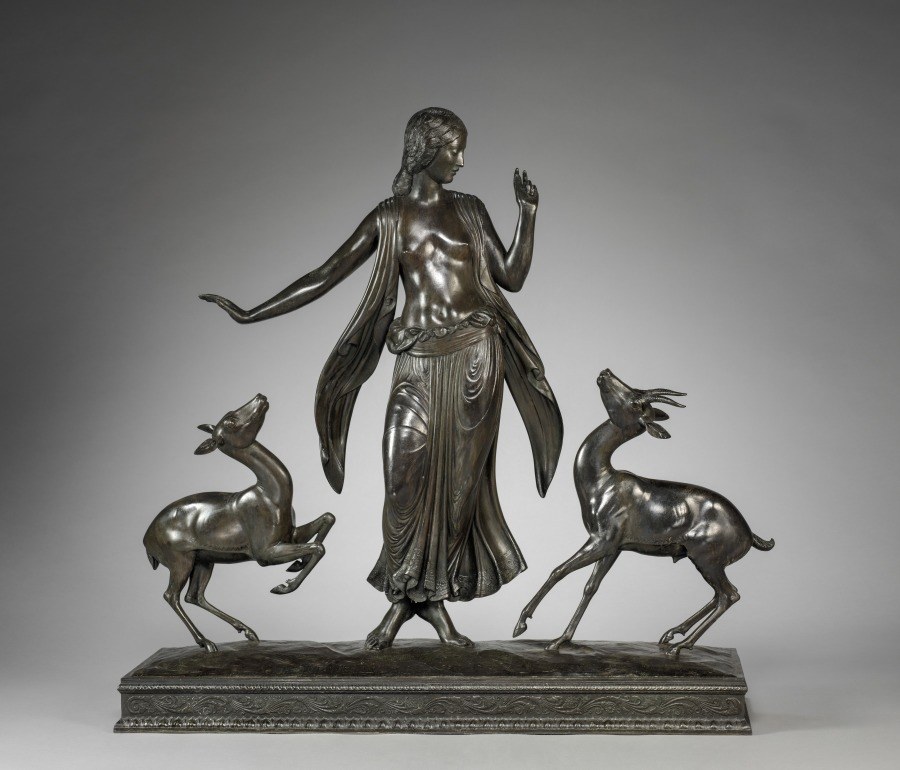
Dancer and Gazelles
Paul Manship (American, 1885–1966)
- Source:
- Cleveland Museum of Art
- Rights:
- Public domain — free to use, share and adapt.
- Recorded as:
- CC0 (Public Domain)
The sculpture shows how classical dance vocabulary—the language of contrapposto, expressive gesture, and composed bearing—could be translated into static form to suggest human refinement and control. For dance historians, it documents the persistence of classical body ideals and the notion that a trained human body, especially a woman's, could be represented as inherently communicative and authoritative. The work also captures the Romantic era's fascination with the possibility of perfect sympathy or command between human and animal.
What you are looking at
A bronze sculptural group depicts a classical female figure in contrapposto stance, wearing a flowing chiton or draped garment that falls to her knees. She is bare-chested in the classical manner, her weight shifted onto one leg in a graceful S-curve. Her arms are extended outward in gestures of command or invitation—the right arm raised and bent at the elbow with palm open, the left arm extended more horizontally. Flanking her on either side are two leaping gazelles or antelopes, their bodies captured mid-leap with front legs bent and back legs extended, their heads turned toward the central figure. The animals' dynamic energy contrasts with the woman's composed stillness. The entire group is mounted on a rectangular base with decorative detailing. The patina suggests age and the work appears to be a finished bronze sculpture rather than a model or maquette.
The dancing
The central figure demonstrates classical contrapposto: one leg supporting the body's weight while the other relaxes, creating an elegant diagonal line through the torso. Her torso is upright and dignified, her breasts bare in the classical Greek tradition. Both arms are engaged in expressive gesture—neither arms-down nor symmetrically raised, but rather in communicative positions suggesting she is either conducting, summoning, or responding to the animals. The two gazelles are positioned as responsive presences; their musculature is rendered with anatomical precision, their leap suggesting obedience or attraction to the woman's gesture.
The dance depicted
The work depicts choreographed interaction with animals rather than conventional human dance, though the woman's posture and gesture language suggest the classical vocabulary of ancient Greek or neoclassical theatrical convention. This likely represents a scene from classical mythology—possibly Artemis (Diana) with her sacred animals, or a similar subject of divine command over nature. The woman's stance and arm positions draw on the trained, composed bearing of classical ballet or neoclassical theatre rather than naturalistic movement. The gazelles' coordinated leap suggests a moment of perfect attunement between human and animal, rendered as if it were a choreographed instant.
How it was made
This is a bronze sculpture, evidently cast from a model. The patina—a greenish-brown oxidation visible across the surface—indicates age and exposure to atmospheric conditions over years or decades. The level of anatomical detail, particularly in the animals' musculature and the woman's classical proportions, suggests a skilled academic sculptor working from careful observation and classical study. Bronze allows for the dynamic poses of the leaping gazelles and the cantilevered extension of the woman's arms without structural compromise. The work appears to be a finished independent sculpture intended for display, not a preparatory model.
About this work
This bronze group sculpture represents a moment of classical or neoclassical theatrical imagining—a woman in the composed stance and gesture of ancient Greek art commanding or conversing with two wild animals. The work sits at the intersection of sculpture and dance, not because the figures are performing steps, but because the woman's body demonstrates the trained bearing and expressive arm positions of classical theatrical convention. Her contrapposto and extended gestures belong to the vocabulary of classical dance and mime. The synchronized leap of the two gazelles, framed as a response to her gesture, suggests choreography—a moment of perfect attunement rendered in bronze.
The subject—human grace and authority in relation to natural beauty—was a favorite of neoclassical and Romantic-era artists. The work demonstrates the period's investment in rendering human bodies as instruments of refined expression, capable of dignified communication across the boundary between civilization and nature.
How to look at it
Observe the woman's weight and balance—note how one leg truly supports her while the other is relaxed, creating the classical contrapposto that dancers train to achieve. Watch how her arms are not merely decorative but seem to be communicating or conducting: the right arm open and raised, the left extended, together creating an asymmetrical but balanced composition. Then follow the direction of the gazelles' leap: they spring toward and around her, their bodies aligned with her gesture as if responding to an invisible command or invitation. The artist has frozen a moment that only works if you understand that the woman's body language is trained, intentional, and masterful.
The period
This work likely dates to the late 18th or 19th century, when neoclassical and Romantic aesthetics dominated European sculpture. The idealized female form, the mythological subject, and the emphasis on grace and refined gesture reflect the period's simultaneous reverence for classical antiquity and interest in Romantic themes of nature, emotion, and transcendence. The rendering of the woman's body draws on the academic study of classical sculpture and the theatrical conventions of ballet, which had become the dominant form of spectacle across Europe. The gazelles' naturalism reflects the period's growing interest in zoological accuracy and the representation of wild nature.
Where it lives
This work is part of the Cleveland Museum of Art's holdings related to dance and theatre in visual culture. The museum's catalogue record provides minimal documentation, which is typical for works entered into collection before the mid-20th century or acquired without full provenance research.
Dance in this work
Questions about this work
Is this actually a dance sculpture?
Not in the sense of depicting steps or choreography. Rather, it shows a human figure whose body language—contrapposto stance, expressive arm gestures—derives from classical dance and theatre convention. The woman's bearing is trained and composed, demonstrating the kind of bodily control and expressiveness that ballet and classical theatre require. The leaping gazelles respond to her as if to a choreographed cue, creating a tableau of perfect attunement.
Who is the figure supposed to be?
The record does not identify the subject. The woman's authority over the animals, her classical nudity, and the sacred character of gazelles in classical mythology suggest she may represent Artemis (Diana), the goddess of the hunt. Other classical scenes of divine command over nature are possible. The sculpture's interest lies in representing human grace and authority rather than telling a specific story.
When was this made?
The record provides no date. The style, patina, and aesthetic suggest late 18th or 19th-century manufacture, but without documentation or signature, a precise date cannot be established. The neoclassical ideals and Romantic interest in nature and refined gesture point toward the era spanning roughly 1780–1880.
What is the bronze made from and how was it cast?
The bronze appears to be a lost-wax or sand casting, a standard technique for the period. The patina—the greenish oxidation visible on the surface—developed over decades or centuries of exposure to air and moisture. The level of detail in the anatomical rendering suggests the original model was carefully sculpted and the casting was executed with skill to preserve fine lines in the drapery and musculature.
More dance artwork