49 works in this view — arrow keys or swipe to move between them.
Dance in Art
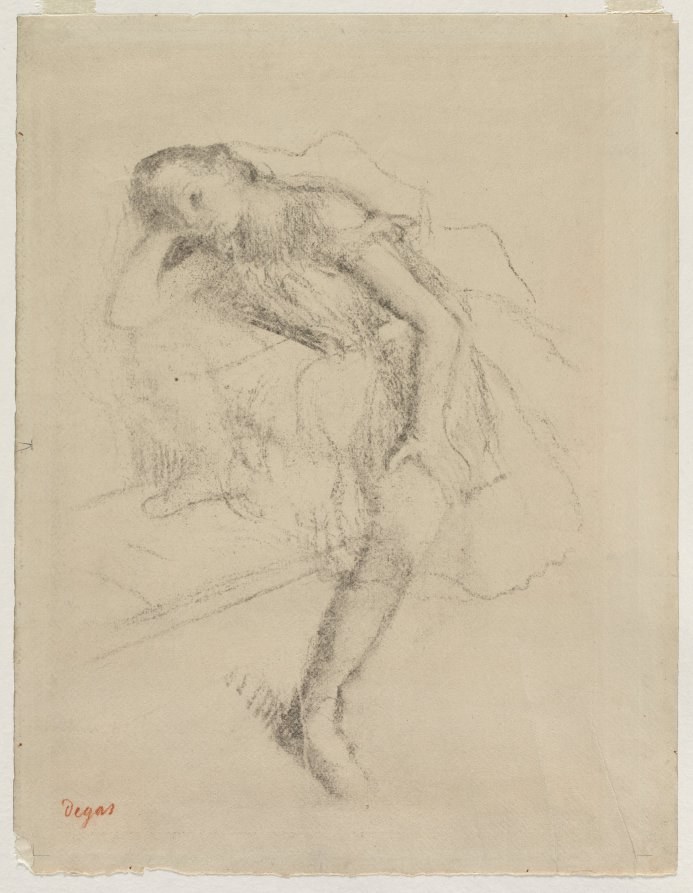
Dancer at Rest
Edgar Degas (French, 1834–1917)
- Source:
- Cleveland Museum of Art
- Rights:
- Public domain — free to use, share and adapt.
- Recorded as:
- CC0 (Public Domain)
This drawing preserves direct observational record of nineteenth-century ballet training and the female dancer's body at a moment when ballet was establishing its classical vocabulary. For dance historians and dancers, such studio sketches are more reliable evidence of actual practice than finished paintings or photographs, and this one captures the fundamental attitudes and line that defined Romantic ballet technique.
What you are looking at
A single female dancer is rendered in graphite sketch, captured mid-movement in a pose of arrested motion. Her body curves in a graceful arc, weight shifted onto one leg with the other extended behind her in an attitude, her torso inclined forward from the hips. Her head tilts back slightly, the face sketch-indicated with delicate modeling. She wears what appears to be a simple, fitted bodice and a full skirt or tunic that falls to mid-calf, the drapery suggested with quick, confident strokes. The drawing technique is loose and economical—the artist has suggested form through hatching and shading rather than contour, particularly evident in the musculature of the legs and torso. The figure inhabits an empty, neutral ground; no stage setting or accompaniment intrudes. The work conveys immediate, observational study: a moment of rest or suspension rather than climactic motion.
The dancing
The dancer's weight is thrown decisively onto her downstage leg, the supporting limb straight and tensioned. Her other leg extends behind in a high attitude derrière, the knee bent and lifted. Her upper body folds forward from a flexible spine, arms positioned asymmetrically—one drawn into the body, the other extending or resting. The drawing registers a body of considerable training in turnout and line, with particular attention to the extension and curve of the working leg. The pose suggests classical ballet vocabulary, though rendered with the sketchy immediacy of life study rather than formal idealization.
The dance depicted
This appears to be a ballet study, most likely Romantic-era ballet given the pose, costume, and the artist's evident engagement with the body's technical capacity. The attitude derrière was a foundational position of nineteenth-century classical vocabulary. The informal, observational nature of the drawing—and the signature visible in the lower left—suggests this is a studio sketch made during rehearsal or from a live dancer. The work captures not performance moment but the architectural clarity of a balletic position, stripped of narrative or theatrical context.
How it was made
Graphite pencil on laid or wove paper, worked with varying pressure to create tonal modulation and volumetric form. The artist has used hatching and cross-hatching to suggest musculature and drapery, with areas of the body left relatively bare paper. The sketch is economical and selective—details are omitted in favor of capturing the essential geometry and weight of the pose. This technique is characteristic of studio practice and indicates a work made for study or reference rather than exhibition, likely circulated within dance and artistic communities in restricted form.
About this work
This is a life study—a working sketch of a ballet dancer in a fundamental classical position. The work belongs to a long tradition of rehearsal and studio drawings made by artists observing dance training and performance, a record of how bodies moved and how artists understood their movement. The drawing's economy and directness suggest an artist with practiced skill in rendering human anatomy under tension, able to capture in a few lines and areas of tone the weight, extension, and control that characterize trained classical technique.
For historians of ballet and dance practice, such sketches are invaluable documents of how dancers actually moved, trained, and held their bodies in a specific period. They capture assumptions about grace, extension, and the female dancer's body that shaped nineteenth-century ballet aesthetics. The work is modest in scale and intention, but it is evidence—precise, observed, and dated by style—of how artists and dancers understood the discipline.
How to look at it
Observe the exact angle of the supporting leg and the extension of the working leg—the artist has conveyed the feel of the pose, the centered balance and the arc of effort. Notice how the torso's forward fold is balanced against the lifted leg behind: this is the fundamental Romantic ballet vocabulary, and the drawing captures its essential geometry. The sketchiness of the execution is not weakness but a deliberate choice to suggest movement and breath rather than frozen perfection. Look at how lightly the head is rendered compared to the legs and torso: Degas prioritized what the body was doing over physiognomy.
The artist
The artist is identified in the lower left corner as Degas, confirming attribution to Edgar Degas, the French painter and printmaker who made dance one of his central subjects throughout his career. Degas was uniquely positioned to observe ballet training and performance in Paris during the Second Empire and Third Republic, attending rehearsals at the Opéra and making thousands of drawings, pastels, and paintings of dancers. His approach to the dancer's body was neither purely decorative nor narratively illustrative; he sought to capture the physicality of training, the geometry of movement, and the peculiar grace of the professional dancer's technique. His dance works are among the most precise artistic records of nineteenth-century ballet practice.
The period
This work belongs to the height of Romantic ballet in France, the mid-to-late nineteenth century when Paris was the capital of European dance and the Opéra the center of the art form. Ballet technique was being systematized and formalized during this period; the codified vocabulary of positions and attitudes was becoming standardized through pedagogical writing and practice. At the same time, the 1870s–1880s saw revolutionary changes in theatrical lighting, stage machinery, and music that transformed ballet as spectacle. Degas's drawings were made during this period of rapid technical and aesthetic change, capturing dancers as living practitioners rather than as allegorical or narrative figures.
Where it lives
The work is held in the Cleveland Museum of Art. It is part of the museum's collection of dance-related works and comes from a collection record that identifies it as belonging to the museum's broader engagement with the visual culture of dance.
Dance in this work
Questions about this work
Is this a finished work or a sketch?
This is a working sketch or study, made from life observation in a rehearsal or studio setting. It was not intended as a finished exhibition piece, but rather as a record and tool for the artist's own practice. Such sketches were valued by nineteenth-century artists as the most direct and truthful records of movement and anatomy.
What ballet position is the dancer in?
The pose is an attitude derrière—one of the foundational positions in classical ballet vocabulary, characterized by the supporting leg straight and turned out, with the other leg lifted behind in a bent position. The upper body's forward inclination is characteristic of Romantic ballet interpretation of this pose.
Why is there so much empty space around the figure?
The neutral ground focuses attention entirely on the dancer's body and its geometry. This was a deliberate choice by artists seeking to isolate and study movement without narrative, theatrical, or decorative context. It emphasizes the drawing as a technical study.
How do we know this is by Degas?
The signature in graphite in the lower left corner reads 'Degas,' and the style, technique, and subject matter are consistent with thousands of documented dance drawings by Edgar Degas in institutional collections worldwide.
More dance artwork