49 works in this view — arrow keys or swipe to move between them.
Dance in Art
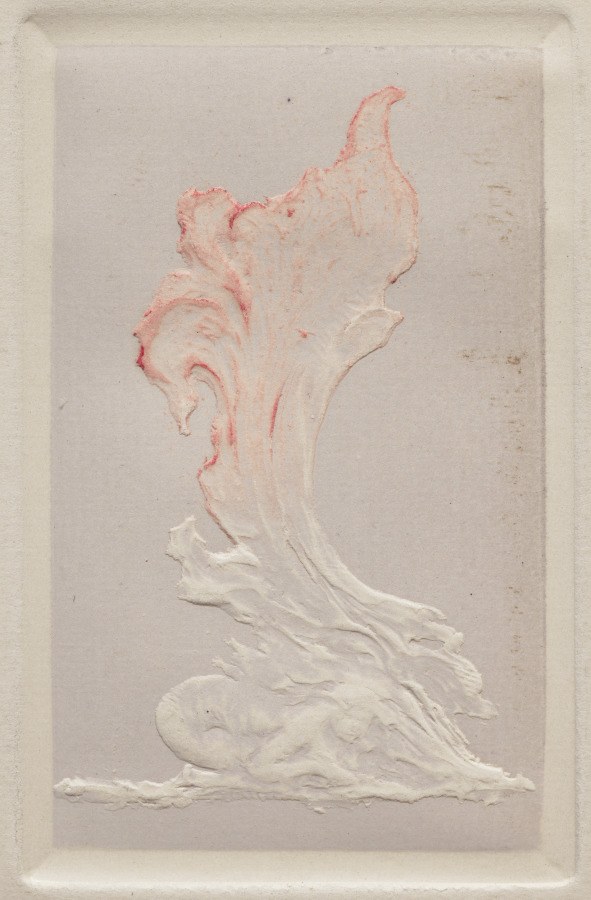
Dancing Woman in Kneeling Position Enveloped in Drapery
Pierre Roche (French, 1855–1922)
- Source:
- Cleveland Museum of Art
- Rights:
- Public domain — free to use, share and adapt.
- Recorded as:
- CC0 (Public Domain)
This relief demonstrates how ballet became a subject for serious sculptural study in the 19th century, and how artists used the medium to capture the essence of classical technique—the supported arch, the open frame, the impression of effortless control. The work is visually valuable as evidence of what balletic grace meant to artists of its period: not the spectacle of the stage, but the refinement of the body in motion.
What you are looking at
A single female figure in kneeling pose is rendered in relief against a neutral ground. The dancer kneels with her torso upright and gracefully arched backward, her upper body weight supported by the extension of her arms. She is enveloped in voluminous drapery that flows from her shoulders and pooling at the base, creating cascading folds that dominate the lower half of the composition. The drapery is modeled in white or cream, appearing soft and heavy, while the figure's upper body and head are picked out in reddish-pink tones that suggest either the warm terracotta of the underlying material or an intentional color variation. The relief creates subtle shadow and suggests three-dimensionality through the play of surface texture against the flat ground plane.
The dancing
The dancer's body forms a gentle backward curve—a supported arch or cambré—with both arms extended to the sides in a graceful, open frame. Her head is tilted slightly back, elongating the line of the neck and chest. The pose suggests balletic vocabulary: the extended port de bras and the fluid, supported back bend indicate trained classical technique. Her kneeling position establishes grounding while the arch of the torso creates an impression of lightness and control, as though she might be mid-movement rather than resting.
The dance depicted
The pose and vocabulary are consistent with Romantic-era ballet, where the combination of a supported back bend, open arm frame, and ethereal drapery were convention. The figure's controlled arch and the emphasis on fluid line suggest classical ballet training of the 19th century. Without inscription, artist attribution, or additional context, the specific dance cannot be named, but the balletic vocabulary and the romantic mood—particularly the enveloping drapery evoking weightless fabric in motion—place this squarely in the theatrical ballet tradition.
How it was made
This is a relief work, most likely a cast or molded plaque in plaster or ceramic material. The two-tone effect—reddish-pink in the figure and white in the drapery—may result from intentional surface treatment or from the material's natural patina. Relief technique allows the artist to create dramatic shadow and to catch light across the contours of the body and cloth; here it emphasizes the dancer's arched form and the texture of the flowing fabric. The shallow depth and the refined modeling suggest this was an object for display, possibly a decorative plaque or a study for a larger commission.
About this work
This is a relief plaque depicting a single kneeling figure in a pose drawn from classical ballet vocabulary. The figure's controlled backward arch, extended arms, and the enveloping drapery all point to the Romantic ballet tradition of the 19th century—a moment when artists across media were fascinated by dancers' grace and the visual drama of flowing fabric in motion. The work is undated and without recorded artist attribution, but its style and subject place it within the broader 19th-century European tradition of dance imagery in decorative arts.
The piece belongs in a dance collection because it embodies both a specific dance technique (classical ballet) and a particular aesthetic moment: the emphasis on ethereal, weightless movement expressed through the interplay of the dancer's body and her costume. For historians and dancers, it offers a window into how ballet was visualized and valued as fine art during the Romantic era.
How to look at it
Notice the line of the figure's body, from the crown of her head through the arch of her back to her knees: it reads as a single continuous curve, suggesting the balletic ideal of fluid extension. Observe how the drapery, though static in the relief, is composed to echo and enhance that curve, creating the impression that the fabric moves with the body. The relief technique allows the artist to catch light on the ridges of cloth and the contours of the figure, reinforcing the sense of three-dimensional motion frozen in space.
The period
The relief belongs to the 19th-century tradition of dance imagery in decorative arts, a period when ballet underwent radical transformation from court entertainment to theatrical spectacle. Romantic ballet (circa 1820s–1840s) elevated female dancers to supernatural beings—sylphs, spirits, creatures of air—and the vocabulary of the ballet reflected this: emphasis on weightlessness, vertical line, and the visual poetry of fabric in motion. Artists working in sculpture and applied arts responded to this fascination, creating small-scale works like this plaque for domestic display. The backward arch and the enveloping drapery are visual signatures of this era's aesthetic.
Where it lives
Held in the Cleveland Museum of Art as part of the museum's dance-related art collection. The object is catalogued as a work from an unknown era by an unknown artist, suggesting it entered the collection without full documentation of its origins or creation date.
Dance in this work
Questions about this work
Is this actually a dancer, or just a woman in fancy dress?
The pose and body language are specific to trained classical ballet. The supported backward arch (called a cambré), the extended and open arm frame (port de bras), and the elongated line of the neck and torso are all vocabulary of balletic technique, not generic graceful posture. The artist understood ballet and chose to depict a moment that shows that training.
Why is the figure kneeling? Was that part of the dance?
Kneeling appears in ballet as both a position of rest and as a moment within movement—the dancer can transition from kneeling into other shapes. Here, the kneeling grounds the figure while the arch of the upper body creates lift and suggests momentum. It may represent a specific moment in a known ballet, but without more information, we can only say it was a meaningful pose for the artist to choose.
What is the dress made of?
The drapery appears to be light, flowing fabric—possibly muslin, silk, or cotton—typical of 19th-century balletic costume. In Romantic ballet, this kind of voluminous, translucent fabric was essential to the visual effect: it allowed the dancer's line to be seen while creating an ethereal, weightless impression.
Who made this and when?
The artist is not recorded. The style, subject matter, and relief technique all point to the 19th century, likely the mid-to-late Romantic period (1820s–1880s), but without documentation or signatures visible in the image, no firm date or attribution can be given.
More dance artwork