49 works in this view — arrow keys or swipe to move between them.
Dance in Art
Dancing Woman in Running
Pierre Roche (French, 1855–1922)
- Source:
- Cleveland Museum of Art
- Rights:
- Public domain — free to use, share and adapt.
- Recorded as:
- CC0 (Public Domain)
This work documents the 19th-century aesthetic of the dancing body—the idealization of weightlessness, extension, and classical line that defined Romantic ballet and shaped visual culture for a century. It is evidence of how seriously 19th-century sculptors and artists took dance as a subject worthy of formal and sustained inquiry, not as a mere decoration or social anecdote. For historians of ballet and of dance aesthetics, it reveals how the dancing body was understood and valued at a moment when it was becoming the dominant symbol of female beauty and aspiration.
What you are looking at
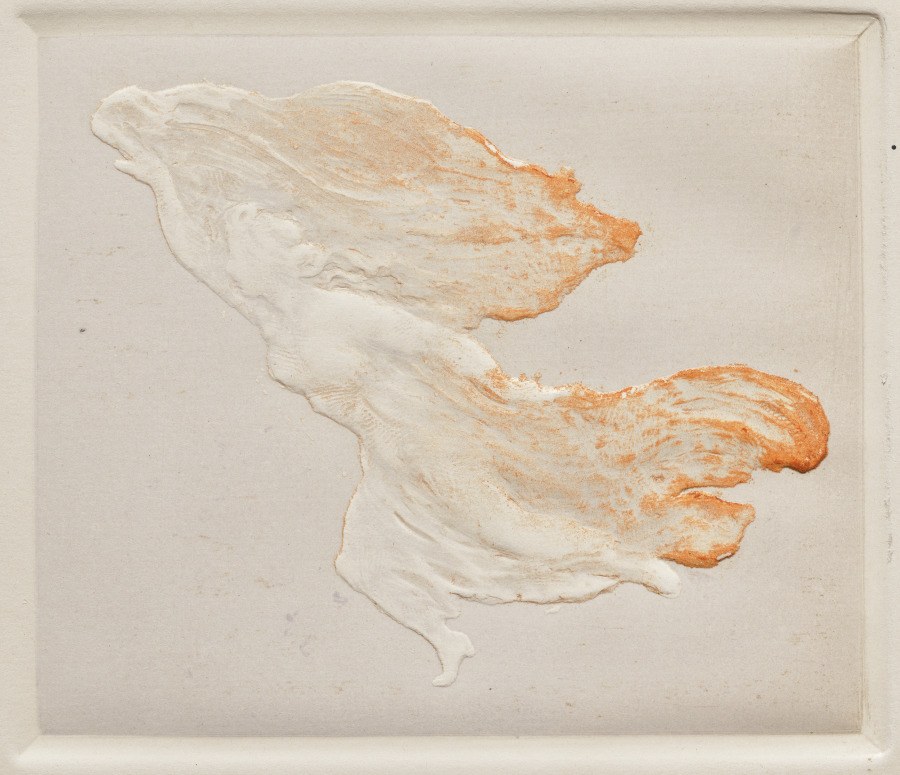
Two female figures are rendered in white and warm ochre relief against a pale ground, their bodies captured mid-leap or suspension. The upper figure extends horizontally, one arm stretched forward and the other swept back, her torso arched and legs trailing behind in a gesture of flight or propulsion. Below her, a second figure twists in a more compact but equally dynamic pose, with limbs gathered close and the body folded into a spiral. Both wear what appears to be classical or neoclassical dress—simple, columnar garments that cling to the body—and both are barefoot. The modeling is soft and plastic, with no hard edges; the ochre pigment is applied with restraint to suggest volume and shadow on the upper surfaces of the forms. The composition is vertical and interlocking, suggesting a sequence or progression of movement rather than a static moment.
The dancing
Both dancers are portrayed with weight lifted and off the ground, suggesting jump, leap, or aerial suspension rather than ground-based movement. The upper figure displays a classic allongé or extended line—the body fully stretched along a diagonal, with pointed feet and elongated arms creating a sense of flight or momentum. The lower figure is more contracted, with the spine curved and the limbs pulled inward, the body rotating around a central axis. Neither wears pointe shoes; both are barefoot, which suggests either classical Greek or Romantic-era theatrical convention. The two poses are complementary in energy but opposite in shape—one extended, one gathered.
The dance depicted
The work most likely depicts Romantic ballet or classical theatrical dance of the 19th century, either in its Greek-inflected idiom or in the academic ballet tradition. The barefoot dancing, the neoclassical dress, and the emphasis on weightlessness and geometric line all point to the aesthetics of Romantic-era theatrical dance, particularly the cult of the ethereal female dancer. The choice to show two figures in contrasting poses—one in full extension, one in contraction—suggests either a sequence from a narrative ballet or a deliberate exploration of dynamic opposites. The relief format and the soft modeling imply this is a study or sculptural interpretation rather than a document of a specific performance.
How it was made
This is a shallow relief, most likely in plaster or ceramic, with the figures modeled in white clay or plaster and selectively tinted with warm ochre pigment. The technique is additive modeling rather than carving; the forms emerge from and remain attached to the ground plane. The soft, almost liquid appearance of the contours suggests the work was executed with great delicacy and sensitivity to the play of light across the forms. The use of color is restrained and functional—the ochre picks out the upper, weight-bearing surfaces and suggests musculature without modeling it literally. This technique was common in art education and exhibition in the 19th century, particularly for studies from the live model or explorations of movement.
About this work
This work is a relief sculpture in plaster or clay, apparently a study of female dancers in flight, executed in the idiom of 19th-century Romantic ballet. The two figures are rendered with grace and anatomical sensitivity, their bodies captured in poses that emphasize weightlessness, extension, and the classical idealization of the dancing female form. The work belongs to a tradition of sculptural studies of dance that flourished in the 19th and early 20th centuries—a time when the ballet aesthetic dominated visual culture and when artists sought to capture the ephemeral beauty of the dancer's body in space. The technique is modest and the scale intimate, suggesting this is a workshop study or a gallery piece made to explore movement, not a public monument.
How to look at it
Look at the contrast between the two poses: the upper figure is fully extended and linear, the lower figure compressed and spiral. This juxtaposition—not a narrative moment but a study of opposite dynamic possibilities—was typical of 19th-century dance sculpture. Notice how the ochre pigment is applied only to the upper, 'active' surfaces of the forms, allowing the white plaster to recede and creating a subtle modeling that reads only in raking light. The barefoot dancing and the simple, clinging dress are conventions of classical ballet as it was performed and imagined in the Romantic era. The artist has chosen not to show a recognizable step or familiar ballet pose, but rather to abstract the essence of dancing bodies in flight.
The period
This work was made in an era when the Romantic ballet was at its height or still fresh in cultural memory—roughly 1850–1910. In this period, sculptors and painters across Europe were fascinated by dancers, particularly female dancers, as subjects for serious artistic study. The cult of the ballet dancer, and particularly the ethereal, weightless female form, shaped visual culture profoundly. Artists worked from live dancers or from the memory of performances, seeking to capture not narrative or social content but pure movement and the aesthetic ideal of the suspended, extended body. Relief sculpture was a particularly popular medium for such studies because it allowed the artist to explore the silhouette and the play of light across the form without the commitment of full three-dimensional carving.
Where it lives
The work is part of the Cleveland Museum of Art's dance-related art collection. It is catalogued as an artwork from the museum's holdings, with artist and date unknown. The museum records its source as 'cma' (the CMA catalogue system), but no accession number, medium description, or dimensions are recorded.
Dance in this work
Questions about this work
What kind of dance is this?
The barefoot dancing, the classical dress, the emphasis on weightlessness and extension, and the overall aesthetic all suggest Romantic ballet or classical theatrical dance of the 19th century. The artist has not rendered a specific, named step or pose, but rather explored the ideal of the dancing body in flight as it was understood in that era.
Why are there two dancers?
The two figures are posed in contrasting attitudes—one extended and linear, the other gathered and spiral. This is likely a deliberate study of opposite dynamic possibilities, not a narrative scene of two dancers interacting. It is typical of 19th-century dance sculpture to explore movement through contrast and variation.
Is this a copy of a marble sculpture or an original work?
The soft, delicate modeling and the restrained use of color suggest this is an original work in plaster or ceramic, not a copy or reduction of a larger marble. The technique and scale are consistent with a studio study or a gallery piece made to explore movement rather than a public monument.
Who made this?
The artist is unknown. The work has no recorded artist name in the Cleveland Museum of Art's catalogue. The style and technique suggest a sculptor working in the 19th or early 20th century, but without more information it is impossible to be more specific.
More dance artwork