49 works in this view — arrow keys or swipe to move between them.
Dance in Art
Dancing Woman with Arms Lowered
Pierre Roche (French, 1855–1922)
- Source:
- Cleveland Museum of Art
- Rights:
- Public domain — free to use, share and adapt.
- Recorded as:
- CC0 (Public Domain)
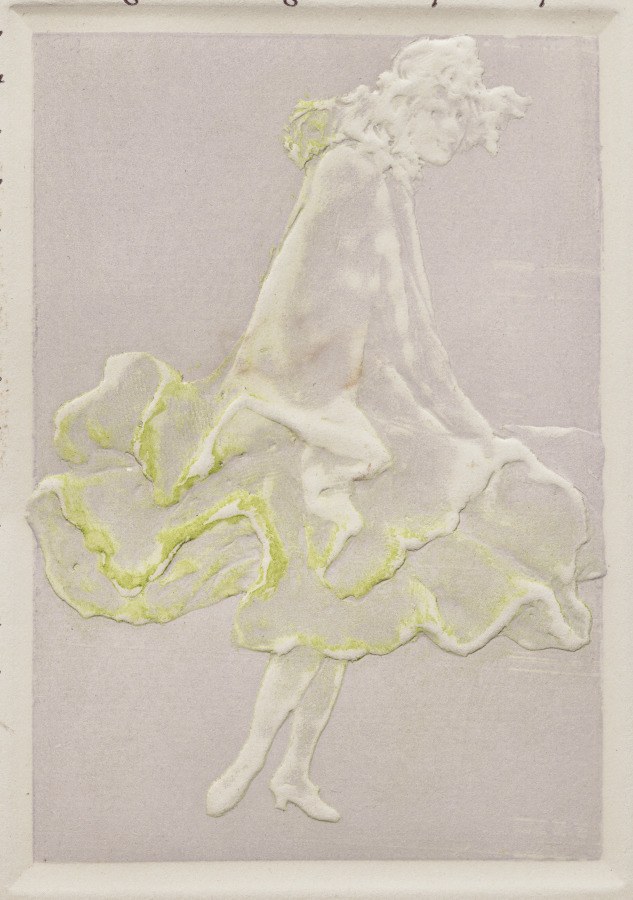
This image documents the visual culture of theatrical dance at a pivotal moment—the turn of the 20th century, when ballet and music-hall dance were becoming increasingly codified and professionalized. The emphasis on the flowing skirt as the primary visual interest reflects the gendering of dance performance and the centrality of costume to the spectacle. For dancers and historians, the work also serves as evidence of how artists understood and represented the moment of extension and release in turn-based movement.
What you are looking at
A single female dancer is shown in a moment of exuberant movement against a soft, neutral lavender-grey background. She stands on one leg with her body tilted dramatically forward, her torso nearly horizontal. Her free leg extends behind her in a high, dynamic line. Most striking is the treatment of her costume: a voluminous skirt with deep, sculptural folds rendered in pale cream and soft yellow-green highlights dominates the composition. The skirt is caught mid-motion, its layers billowing outward and upward in a way that suggests rapid spinning or a sharp directional change. Her upper body and arms are simplified, almost sketch-like, while the skirt receives obsessive formal attention—each fold is modeled with careful attention to light and shadow, creating a three-dimensional effect that makes the fabric appear to have substance and weight. The overall impression is of a moment of abandon, the body released into motion.
The dancing
The dancer is shown in a single-leg balance with pronounced forward tilt—a position that suggests either the climax of a spin or the moment of release from a turn. Her arms are lowered and appear to be trailing behind her body line, following the momentum of the movement. The extended rear leg is held high and straight, supporting the impression of speed and control. Her head is up and turned slightly, tracking the direction of travel. The proportions are somewhat stylized: the dancer's limbs and torso are slender and elongated, emphasizing grace and extension, while the skirt is given monumental, almost sculptural presence.
The dance depicted
This appears to depict a moment from theatrical or concert dance of the late 19th or early 20th century, most likely a solo from the ballet or music-hall repertory of that era. The style of the costume—the voluminous skirt with decorative trim—and the romantic sensibility of the composition suggest late Romantic ballet or theatrical dance from roughly 1890–1920. The artist has chosen to emphasize the moment of maximum extension and motion, a convention of dance illustration that privileges grace, speed, and the dramatic potential of the female body in flight. The specific dance vocabulary is not precisely identifiable from the image alone, but the emphasis on rotational movement and the soaring quality of the pose suggest a waltz, a spinning piece in the classical repertory, or a showpiece designed to display virtuosity and control.
How it was made
This is a watercolor or gouache on paper, working in soft, muted tones. The artist has used translucent or semi-translucent layers to build the form, allowing the paper to show through in places and creating an ethereal quality. The skirt receives the most labor: the folds are built up with repeated washes and highlights, creating a dimensional, sculptural effect that contrasts with the more summary treatment of the figure itself. The technique is characteristic of fashion illustration and theatrical design drawing from the early 20th century—economical in line, generous in color and modeling, and focused on the narrative potential of fabric and motion rather than anatomical precision.
About this work
This is a theatrical dance illustration, most likely from costume design or promotional art for a European music hall or ballet company, dating to approximately 1900–1920. The image captures a singular moment of motion—a dancer at the height of a spin or turn, her body fully extended, her costume the dominant visual subject. The work exemplifies the aesthetic priorities of early 20th-century dance imagery: the body as an instrument for the display of skill and grace, and fabric as a sculptural element that amplifies the drama of motion. For viewers and historians of dance, the work is significant as a record of how theatrical dance was visualized and promoted in its early modern period, and of the primacy given to the female dancer's body as the vehicle of spectacle.
How to look at it
Attend first to the moment the artist has chosen: the dancer is caught at the point of maximum extension, where the body is fully stretched and the skirt is fully deployed. This is a conventional choice in dance illustration—the artist selects the moment of greatest visual impact rather than attempting to show a sequence. Notice how the skirt is rendered with far more care and detail than the body; this reflects the priorities of theatrical design, where the costume is often as important as the dancer. The lowered arms and trailing posture suggest a moment of surrender to the momentum of the turn, rather than a moment of control or tension. Finally, observe the use of color and light: the soft yellow-green highlights on the skirt suggest stage lighting, and the pale, washed ground evokes the ethereal quality valued in early 20th-century dance imagery.
The period
This work dates to the era of late Romantic and early neoclassical ballet, when the female dancer had become the dominant figure in European theatrical dance. The Romantic era (roughly 1830–1880) had established the pointe shoe, the ethereal tutú, and the figure of the sylph as the visual ideal; by 1900, these conventions were well established and were being refined and elaborated by companies like the Ballets Russes and the London music halls. The early 20th century saw an explosion of interest in dance as a subject for visual art—painters, designers, and illustrators became fascinated by capturing the energy and grace of the moving body. This work is consistent with the design and promotional art produced for theatrical companies of the period, when high-quality illustration was used to market performances to middle and upper-class audiences.
Where it lives
The work is held in the Cleveland Museum of Art and is part of the museum's dance-related art collection. The source attribution is marked 'cma', indicating that it comes to the Gallery of Dance in Art through the CMA's records. No artist name, date, or medium information is recorded in the museum's catalogue.
Dance in this work
Questions about this work
What dance is this?
The specific dance is not identifiable from the image or catalogue information. However, the costume, pose, and style suggest a solo from late Romantic or early neoclassical ballet, or possibly a music-hall number, dating to approximately 1900–1920. The emphasis on rotational movement and the soaring quality of the pose suggest a waltz or other showpiece designed to display speed and control.
Why is the skirt so much more detailed than the body?
This reflects the priorities of early 20th-century theatrical design and illustration. The costume was understood as essential to the spectacle and the identity of the role; the skirt's movement and appearance were as important as the dancer's body. The artist has lavished attention on rendering the folds, texture, and play of light on the fabric, making it the dominant visual element of the composition.
Is this a finished artwork or a design sketch?
The work has the finish and polish of a completed illustration rather than a working sketch, but its primary purpose was likely theatrical design or promotion—it was made to be reproduced or distributed as advertising or costume documentation. The delicate color work and careful modeling suggest it was valued as a finished object in its own right.
More dance artwork