49 works in this view — arrow keys or swipe to move between them.
Dance in Art
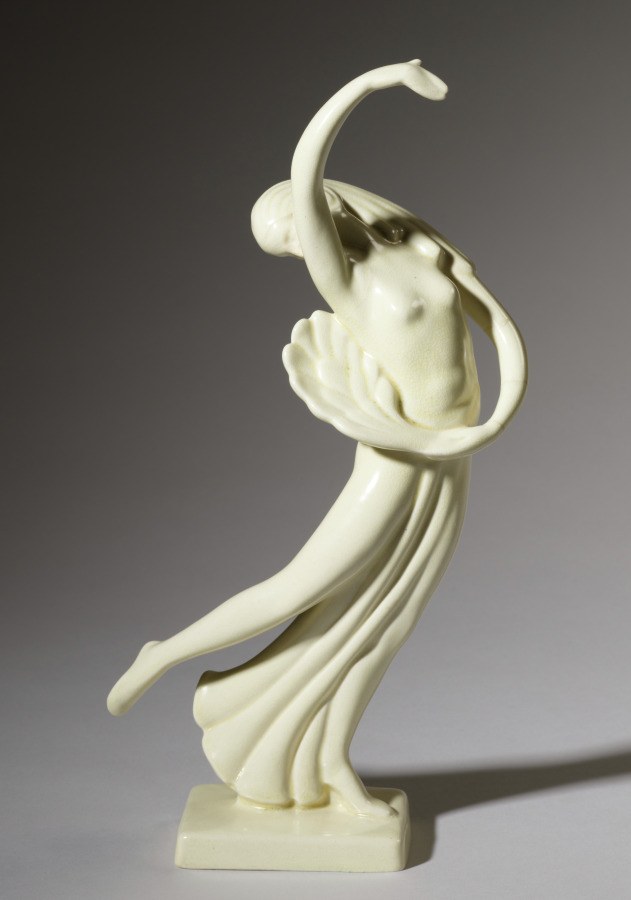
Fan Dancer
Waylande Gregory (American, 1905–1971)
- Source:
- Cleveland Museum of Art
- Rights:
- Public domain — free to use, share and adapt.
- Recorded as:
- CC0 (Public Domain)
Fan dancing is a crucial and understudied chapter in American performance history, and this sculpture documents the movement vocabulary of a form that survives today largely through photographs and written description. For dancers, the work demonstrates how a visual artist understood and translated the grammar of fan dance—the reach, the balance, the use of the torso and gaze—into sculptural form. For historians, it is evidence that fan dancing, however stigmatized, was considered worthy of fine art representation and was being documented in major museum collections.
What you are looking at
A cream or ivory-colored marble or plaster sculpture depicts a single female figure in a dynamic, upright pose. The dancer stands on a rectangular base and wears flowing drapery that cascades from her hips to her feet in elegant folds. Her upper body is nearly bare, with classical contrapposto stance, and her left arm extends upward in a graceful arc. Her right arm curves across her body. The figure's head tilts slightly back, following the line of the raised arm. The pose suggests movement frozen mid-gesture—not a static moment but a suspended peak of motion. The smooth, finished surface and classical proportions suggest this is a formal sculptural work, likely created for display in a gallery or institutional setting.
The dancing
The single dancer occupies the full height of the composition, balanced on her legs with weight distributed evenly on the rectangular base. Her raised left arm traces an elegant line from shoulder to fingertips, curved and open. Her right arm drops and curves inward, creating a counter-movement that emphasizes the twist through her torso. The head follows the line of the raised arm, creating a continuous flow from feet through fingertips. The contrapposto weight distribution and the articulation of the limbs suggest a dancer with training in classical movement; the body reads as controlled and purposeful rather than rigid.
The dance depicted
The title 'Fan Dancer' is a direct naming of the practice, which flourished as a theatrical specialty in the early 20th century, particularly in American vaudeville and nightclub performance. The gesture—one arm raised while the other curves inward—is characteristic of the fundamental movements of fan dancing, where the fan itself (not visible here) would be extended or manipulated to frame and reveal the body in carefully choreographed patterns. The near-nakedness of the torso and the emphasis on fluid arm extension and body line are consistent with the visual language of fan dance as it appeared in photographs and performance documentation from the 1920s–1940s. Without clothing or a fan present, this sculpture captures the essential physical vocabulary rather than the specific prop work.
How it was made
This is a three-dimensional sculptural work, likely carved from marble or cast from plaster, given the smooth surface, pale color, and classical finish. The material and technique allowed the artist to render the figure from all sides and to create the illusion of movement through careful attention to weight, balance, and the direction of the limbs and gaze. The scale—a life-sized or near-life-sized single figure—emphasizes the monumentality of the pose and suggests this was created for museum or institutional display rather than domestic display. Sculpture allows the viewer to move around the work and experience the figure from multiple angles, which is particularly effective for capturing the three-dimensional vocabulary of dance.
About this work
This sculpture captures the essential physical poetry of fan dancing, a popular form of theatrical performance in early 20th-century America. The artist has chosen to represent not the technical prop work with the fan but the underlying movement vocabulary: the elongated lines of the arms, the twist of the torso, the lift of the gaze, and the careful balance that makes fluid motion possible. By rendering the figure in stone or plaster, the artist has preserved a fleeting performance art in a durable form, elevating a commercial entertainment to the status of fine art sculpture. The work is part of the Cleveland Museum of Art's dance-related collection, joining other artworks that document how visual artists have represented dance across media and centuries.
How to look at it
Look at the line created by the raised arm and the follow-through of the head and gaze—the artist has frozen the figure at the moment of fullest extension, when the body is most open and the line is longest. Notice how the lower body (covered in drapery) anchors the figure in balance, while the upper body (nearly bare) extends upward and outward. The contrapposto stance and the twist through the torso suggest that this pose would be followed by a reversal of direction; the sculpture captures one instant in a flowing sequence. The absence of the fan, despite the title, encourages the viewer to see the fan dancer not as a prop manipulator but as a virtuoso of body control and line.
The period
Fan dancing emerged as a commercial entertainment in American vaudeville and nightclub performance during the 1920s and 1930s, reaching a peak of popularity in the 1930s–1940s. The form was often performed by women, sometimes semi-nude, and occupied an ambiguous space between high theatrical art, cabaret, and burlesque. This period saw the rise of the modern dance movement in concert halls, led by figures like Martha Graham and Isadora Duncan, who also emphasized the body and fluid, expressive movement. Simultaneously, commercial performance—jazz dance, tap, fan dancing—was flourishing in entertainment venues. Visual artists, including sculptors, were documenting and engaging with dance as a subject during this period, treating movement and the body as worthy subjects for fine art.
Where it lives
The work is part of the Cleveland Museum of Art's collection and is identified in institutional records as a dance-related artwork. The sparse catalogue record—artist, date, and medium unknown—suggests it may have been acquired as a representation of a dance form rather than as a work by a documented artist, or that documentation has been lost.
Dance in this work
Questions about this work
What is fan dancing?
Fan dancing is a theatrical performance style in which a dancer, usually a woman, manipulates large feathered or fabric fans to create patterns and images while moving across the stage. The form flourished in American vaudeville and nightclub entertainment during the 1920s–1940s and became associated with semi-nude or nude performance. Famous fan dancers include Sally Rand, who performed at the 1933 Chicago World's Fair. The dance requires precise control of the body, timing, and the fans themselves, and dancers trained extensively in the technique.
Why is the figure not holding a fan?
The sculptor has chosen to represent the essential movement vocabulary of fan dancing rather than the prop itself. By eliminating the fan, the work emphasizes the dancer's body position, arm extension, weight, and balance—the physical foundation that makes fan dancing possible. This choice elevates the form from a novelty act to a serious subject worthy of fine art representation.
Who created this sculpture?
The artist is not recorded in the available documentation. The work may have been acquired by the Cleveland Museum of Art without full provenance information, or the artist's identity may have been lost over time. If you have information about the artist, the museum would welcome that documentation.
More dance artwork