49 works in this view — arrow keys or swipe to move between them.
Dance in Art
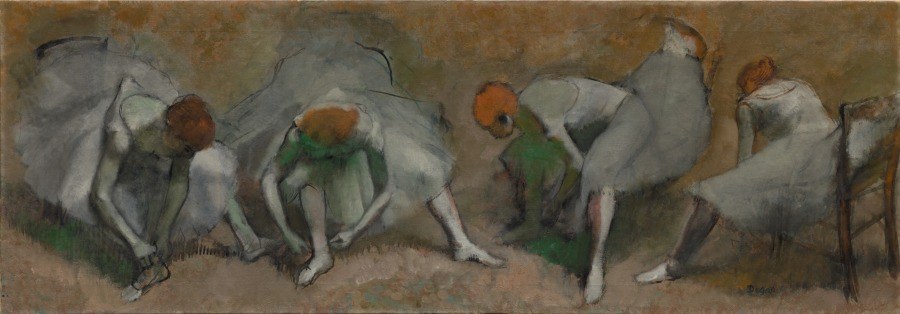
Frieze of Dancers
Edgar Degas (French, 1834–1917)
- Source:
- Cleveland Museum of Art
- Rights:
- Public domain — free to use, share and adapt.
- Recorded as:
- CC0 (Public Domain)
This work represents a significant departure from nineteenth-century conventions of dance imagery, which typically emphasized spectacle, narrative, and the public body in motion. By depicting five dancers in an unglamorous, repetitive posture of repose, the artist shifts focus to the dancer's private or preparatory states—to exhaustion, introspection, or the everyday physicality that ballet pedagogy demands. For historians of modern dance and modern art alike, it offers rare evidence of how the dancer's body began to be reimagined as a subject of formal and philosophical interest rather than theatrical display.
What you are looking at
Five female dancers in white shifts or chemises are arranged in a frieze across a warm, earthy background. Each figure bends forward from the hips in a repeated pose of intimate self-attention—some adjusting or examining their clothing, others in postures of fatigue or repose. The composition reads left to right like a narrative sequence, though the women do not interact with one another. Their reddish-brown hair contrasts sharply with their pale skin and white garments. The setting is undefined; there is no stage, no studio, no theatrical apparatus—only the neutral ground that allows the bodies themselves to dominate. The paint is handled with a muted, almost monochromatic palette of grays, whites, and browns, giving the work an austere, studiedly unglamorous quality.
The dancing
All five dancers share a single posture: a deep forward bend from the hip with the torso folded over the thighs, the head dropped, the arms hanging or placed on the legs. There is no arabesque, no turnout, no lifted spine. The repetition creates a visual rhythm rather than a coordinated dance—each figure inhabits the same attitude but in isolation. The weight appears fully committed to the bent position; there is no sense of suspended motion or balletic lightness. This is a body at rest or in inward concentration, not in the act of dancing.
The dance depicted
This is not a representation of dancing in the conventional sense. The repeated bent-forward pose resembles the preliminary positions taught in ballet pedagogy—the body folding to stretch, or the pose of recovery between efforts. It may also evoke the physical posture of exhaustion, introspection, or the private moment before or after performance. The absence of any coordinated interaction, formal hold, or dramatic tableau suggests the artist was interested in documenting the body's neutral states rather than capturing dance in motion. The work sits ambiguously between rehearsal, study, and a more philosophical meditation on the dancer's body at rest.
How it was made
The technique appears to be oil paint on canvas, executed in a restrained and nearly monochromatic idiom. The surface is worked with broad, assured strokes that prioritize form and posture over decorative detail or narrative incident. The muted palette—ochres, grays, and cool whites—and the absence of anecdotal setting suggest a modernist or proto-modernist approach to the figure, oriented toward formal composition rather than theatrical spectacle. This restraint of means and effect implies a gallery work rather than an illustration or decorative panel, and places it in conversation with early twentieth-century art-historical enquiry into the body.
About this work
This is a painted frieze of five dancers in white shifts, each bent forward in an identical posture of repose or inward focus. The work abandons narrative or spectacle in favor of formal repetition and the study of a single bodily state. The palette is austere, the setting bare, and the composition deliberately denies the viewer the conventional pleasures of balletic spectacle or coordinated ensemble work. Instead, it offers a meditative image of the dancer's body in a state of private concentration or rest—a subject rarely addressed in dance imagery before the twentieth century. The work belongs in a gallery of dance art not because it depicts dancing, but because it takes the dancer's body as its sole subject and asks what that body might mean when stripped of performance, costume glamour, and narrative purpose.
How to look at it
Attend to the absolute stillness of these figures and the absence of any suggestion of motion or transition. The artist has chosen not a moment within a dance, but a moment outside or between dances—a state of rest, recovery, or private concentration. The repetition of the pose five times invites the eye to read the image as a formal pattern rather than a narrative scene. Notice too the careful attention to the weight and mass of the body in the bent position: there is no lightness, no illusion of weightlessness or control. This is the body as a physical, material thing, not as a vehicle for beauty or virtuosity.
The period
The work dates from an era when dance was beginning to be reconsidered both as a subject for fine art and as a form of bodily and philosophical inquiry. The early twentieth century saw the rise of modern dance pioneers like Isadora Duncan, who rejected classical ballet's artifice in favor of natural movement and emotional authenticity. Simultaneously, visual artists were turning away from academic painting toward more experimental investigations of form, the figure, and the body. The palette and compositional approach of this work—its austerity, its repetition, its refusal of anecdote—align it with broader modernist interests in abstraction, reductionism, and the interrogation of representational convention.
Where it lives
The work is recorded in the Cleveland Museum of Art collection. It is catalogued as part of the museum's dance-related art collection, though the artist remains unrecorded and the date and medium are not documented in the catalogue entry.
Dance in this work
Questions about this work
Is this actually a dance scene?
Not in the conventional sense. There is no choreography visible, no interaction between the figures, and no sense of motion or performance. Instead, it documents a single posture—the bent-forward position common in ballet warm-up and recovery. The work is interested in the dancer's body at rest or in private concentration rather than in the act of dancing.
Why repeat the same pose five times?
The repetition creates a visual rhythm and invites the viewer to read the image as a formal composition rather than a narrative scene. It emphasizes the pose itself as the subject, not the individual dancers. This strategy aligns with modernist interests in pattern, seriality, and the reduction of subject matter to essential formal elements.
What period does this appear to be from?
The style, palette, and approach to the figure suggest the early twentieth century, when artists were beginning to investigate the body in new ways and modern dance was challenging classical ballet's conventions. The work's austerity and formal reduction place it in conversation with modernist painting, though the precise date is unknown.
Why would a dancer care about an image of people not dancing?
Because it documents a crucial but rarely celebrated part of the dancer's life: the states of preparation, recovery, and private concentration that are as important to the dancer's craft as performance itself. It offers a philosophical meditation on what the dancer's body means when it is not being watched or judged.
More dance artwork