49 works in this view — arrow keys or swipe to move between them.
Dance in Art
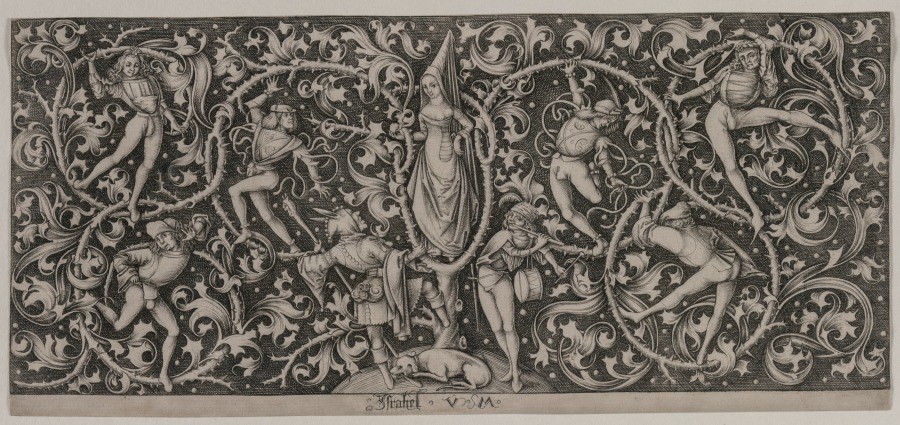
Ornament with Dance of the Lovers
Israhel van Meckenem (German, c. 1440–1503)
- Source:
- Cleveland Museum of Art
- Rights:
- Public domain — free to use, share and adapt.
- Recorded as:
- CC0 (Public Domain)
For dance historians, this work documents how Renaissance and early baroque culture imagined the relationship between dance, courtship, and bodily desire. The print circulated as a design source and collector's item, influencing how educated Europeans thought about and depicted dancing bodies. The work also reveals the role of printmaking in disseminating images of dance to a broad audience, long before photography.
What you are looking at
This is a densely populated ornamental engraving depicting amorous couples and putti (cherubs) engaged in dancing and embracing across the entire composition. The figures are arranged among elaborate scrolling acanthus foliage and cartouche-like frames that fill every available space. Multiple pairs of lovers are shown in various stages of courtship and dance—some upright and partnered, others reclining or suspended among the vines. The central area features a standing female figure in classical drapery, possibly representing Venus or Cupid, around whom the other figures cluster and gyrate. The surface is alive with movement: some figures twist in mid-leap, others are caught mid-embrace, and several appear to float or hover weightlessly within the ornamental structure. The engraving employs strong contrast between the densely hatched background foliage and the white bodies of the dancers, creating rhythm and visual energy throughout.
The dancing
The dancers display a range of poses typical of Renaissance and early baroque courtly dance and erotic imagery. Some couples hold in an embrace or face-to-face position suggestive of intimate dance or flirtation; others are shown in more acrobatic attitudes—one figure appears to be airborne or in a dramatic recline. The bodies are elongated and idealized in Renaissance fashion. Arm gestures are varied: some figures reach outward, others wrap around partners or grasp at the surrounding foliage. The weight and balance of many figures is defied by the ornamental frame, suggesting these are imagined or allegorical movements rather than documentation of actual choreography. Multiple figures occupy overlapping planes, creating a sense of playful chaos and continuous motion.
The dance depicted
The work depicts allegorical and courtly dancing rather than a specific documented dance style. The subject appears to be the dance of lovers—a theme common in Renaissance and early baroque art, often associated with Venus, Cupid, and the triumph of love. Such imagery typically draws on classical sources and courtly culture rather than representing a particular historical dance form. The composition suggests multiple simultaneous dances or a single chaotic celebration of amorous desire rendered as ornamental pattern. The emphasis on floating, flying, and impossible poses indicates this is fancy and decoration rather than instruction in actual technique. The work belongs to the tradition of Northern European ornamental prints, which often mixed classical allegory with contemporary courtly life.
How it was made
This is an engraving, a technique identifiable from the fine parallel hatching lines (cross-hatching) that model form and create tone throughout the composition, and from the crisp, precise line work characteristic of Renaissance and early baroque printmaking. Engravings were made by incising lines into a copper plate with a burin, then inking and printing the plate. This technique allowed for fine detail and wide distribution—engravings were portable, reproducible, and affordable compared to paintings, making them central to the circulation of artistic ideas and patterns across Europe. The artist's initials appear in the lower right corner of the plate, suggesting a signed work by a known printmaker. The composition and technique indicate this was intended as a design template or collector's print for a cultivated audience familiar with classical allegory and courtly culture.
About this work
This ornamental engraving depicts the dance of lovers as an allegory, filling the composition with intertwined couples, cherubs, and floating figures among elaborate foliate scrollwork. The work combines classical allegorical subject matter with the formal language of Northern European Renaissance ornamental printmaking. It belongs to a tradition of designs that circulated among aristocratic and merchant collectors, offering both artistic sophistication and erotic pleasure. The dense, all-over composition and the impossibly graceful poses of the dancers indicate this is fantasy rather than documentation—a vision of love and desire rendered as ornamental pattern and movement.
How to look at it
Observe the layering of the composition: the eye moves from the clear poses of the nearest couples outward into the increasingly dense foliage and overlapping figures. Notice how the artist uses scale and overlap to suggest depth and continuous movement, even though the composition is fundamentally flat and decorative. Pay attention to the individual poses—some are graceful and stable, others deliberately impossible or floating—which signals that this is imagination and allegory rather than instruction. The work rewards slow, detailed looking; each section of foliage contains new figures, gestures, and moments of courtship or dance.
The artist
The work is signed with initials in the lower right. Without being able to confirm the name from the signature alone, attribution remains uncertain; however, the style and composition are consistent with Northern European ornamental printmaking of the 16th century, possibly German or Flemish. The tradition of elaborate foliate ornament combined with allegorical figures and dancing bodies was well established among court artists and printmakers of this period. Such works often served as pattern books for metalworkers, embroiderers, and interior decorators as well as autonomous works of art.
The period
In the 16th century, allegorical depictions of dancing and courtship proliferated in Northern European prints, drawings, and paintings. This period saw intense interest in classical sources—Ovid, Neoplatonism, courtly romance—rendered through contemporary courtly and artistic practice. Dance was central to court culture, particularly in Italy and the Low Countries, and printmakers frequently depicted dancing as an emblem of courtly refinement, pleasure, and social order. Simultaneously, ornamental prints with densely interlocking figures and foliage—often called 'strapwork' or elaborate arabesque designs—were at the height of fashion. This engraving synthesizes both trends: it is at once a classical allegory and a virtuoso display of ornamental design.
Where it lives
This work is held in the Cleveland Museum of Art as part of its dance-related art collection. It is recorded as an artwork from the museum's holdings, though catalogue details remain sparse.
Dance in this work
Questions about this work
What dance is actually depicted here?
No single documented dance is shown. Instead, the work presents an allegorical vision of courtly dancing and amorous play, using dance as a metaphor for courtship and desire. Multiple couples occupy the composition in varied and often impossible poses, suggesting fantasy rather than any specific choreographic form.
Why are some figures flying or floating?
The floating and aerial poses indicate that this is allegorical and ornamental rather than realistic. The work draws on Renaissance neoplatonic philosophy and classical sources in which Cupids and lovers were imagined as weightless, divine, or suspended between earthly and heavenly realms. The impossible poses also serve the overall ornamental design, filling the composition completely.
Who would have owned or used a print like this?
Ornamental engravings were collected by wealthy merchants, nobles, and artists. They served multiple purposes: as collector's items prized for their artistic sophistication and erotic charm, as design sources for metalworkers, embroiderers, and architects, and as markers of taste and education. The work would have circulated widely across Northern Europe through the print market.
How do we know this is an engraving?
The technique is identifiable from the fine parallel hatching and cross-hatching lines throughout the composition, which are characteristic of copper-plate engraving. The crisp, precise linework and the overall formal quality also confirm this is a print rather than a drawing or painting.
More dance artwork