49 works in this view — arrow keys or swipe to move between them.
Dance in Art
Russian Dancer
Alexander Blazys (American, born Russian Empire [now Lithuania], 1894–1963)
- Source:
- Cleveland Museum of Art
- Rights:
- Public domain — free to use, share and adapt.
- Recorded as:
- CC0 (Public Domain)
This sculpture represents a moment in art history when dance was considered worthy of monumental treatment—when a dancer's body could be cast in bronze for permanent exhibition, rather than simply reproduced in photographs or paintings of ensemble scenes. The emphasis on a single performer, captured in an ecstatic moment of turning and emotion, reveals what qualities of dance European audiences and artists of this period valued: drama, individuality, and the expression of feeling through physical form.
What you are looking at
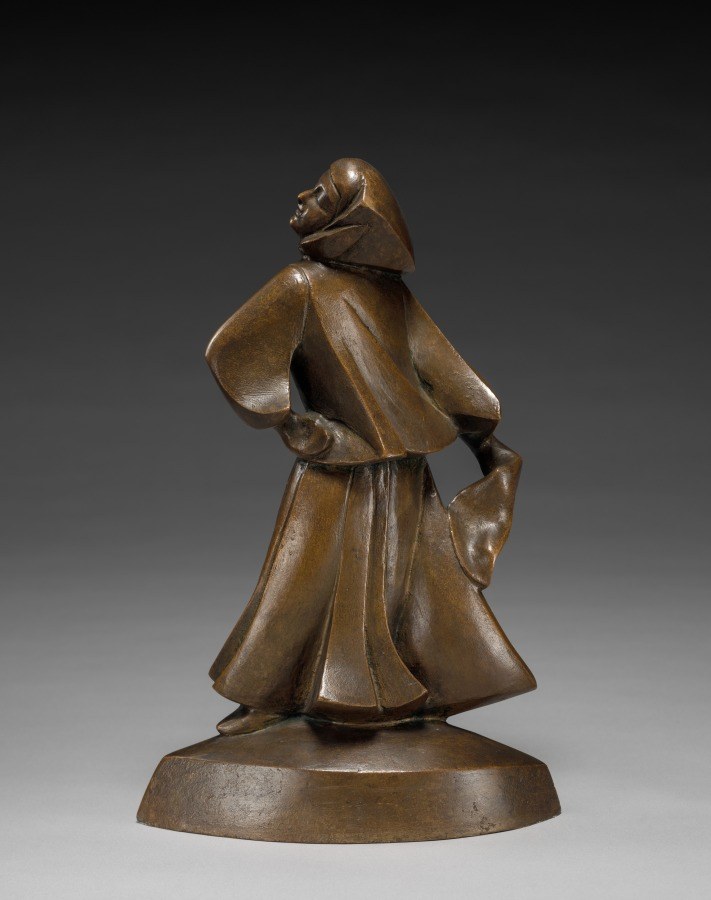
A bronze figurative sculpture depicts a single dancer in a moment of theatrical performance, captured mid-movement. The figure stands on a low circular base, wearing voluminous costume elements—a cape or cloak with exaggerated proportions swings dramatically from the shoulders, and the lower body is swathed in flowing skirts rendered as bold vertical folds. The dancer's head is tilted back and turned sharply, the face rendered in profile with stylized features. The arms are held with the left one extended outward at shoulder height while the right appears bent, with the hand positioned near the torso. The overall posture suggests a moment of rotation or spiraling motion, with the costume's weight creating a sense of dynamic lift and momentum. The burnished brown patina of the bronze suggests age and classical treatment.
The dancing
A single figure in a classical contrapposto-inflected stance, but tilted and rotated to suggest rapid weight transfer. The head's sharp backward tilt and the extended arm create a spiraling vector through the body. The flowing costume obscures the legs and feet, making precise footwork impossible to assess, but the upper body's tension and arm position suggest trained theatrical movement rather than folk or social dance. The exaggerated drapery of the skirts implies either a costume for scale or a deliberate aesthetic choice to amplify the sense of motion.
The dance depicted
This appears to represent a Romantic-era theatrical dance, most likely classical ballet of the mid-to-late 19th century, though Russian Imperial ballet or concert interpretive dance of the early 20th century are possible. The title 'Russian Dancer' suggests either a performer from the Russian Imperial Ballet, or—if the title dates from a later era—possibly a solo concert performer from Russia's theatrical tradition. The exaggerated costume and the sculptural emphasis on the head and torso rather than footwork is consistent with how theatrical dance was understood and represented in sculpture: as a moment of dramatic expression and emotional intensity rather than technical virtuosity.
How it was made
This is a bronze sculpture, cast from a modeled original. The artist has used the particular strengths of the medium—the ability to capture flowing drapery in three dimensions and to render the play of light across burnished surfaces—to suggest costume motion and the momentary quality of dance. Bronze's permanence and the work's scale and finish suggest it was made for public or institutional display rather than private collection. The patina indicates age; the style of casting and surface treatment is consistent with late 19th or early 20th century art practice.
About this work
This bronze sculpture isolates a single moment from a theatrical dance performance—a moment of spiraling motion and emotional intensity. The title identifies the subject as Russian, and the costume, pose, and artistic approach point toward the Romantic ballet tradition or the Russian Imperial Ballet of the 19th or early 20th century. The sculptor has chosen to emphasize the expressive, architectural qualities of the body in motion rather than specific steps, rendering the figure as a study in dramatic form. The work belongs in this collection because it documents how dance was understood and valued as fine art: not as technical accomplishment but as theatrical gesture, human emotion, and the transformation of the body through costume and performance.
How to look at it
The viewer should attend to the spiral axis created by the tilted head and extended arm, which gives the figure its sense of rotation and momentum despite the frozen medium. Notice how the drapery is carved to suggest lightness and motion rather than weight—the folds billow outward, not drape downward. The backward tilt of the head and closed eyes (or nearly closed) suggest a moment of emotional surrender or ecstatic abandon, a key value in Romantic dance. The face, though stylized and somewhat mask-like, is the compositional center; the body serves its expression rather than displaying technical virtuosity.
The period
This work dates from an era when Russian Imperial Ballet was at the height of its international prestige and influence. The late 19th and early 20th centuries saw an explosion of interest in dance as a subject for visual art across Europe, driven partly by the celebrity of individual performers (especially Nijinsky and the Ballets Russes after 1909) and partly by the Romantic movement's valorization of emotion, movement, and the exotic. Sculpture of dancers was a particular feature of this moment; dance offered sculptors a subject that challenged them to capture not static beauty but kinetic energy and psychological intensity. The particular style here—the emphasis on costume, the dramatic tilt of the head, the spiral composition—is consistent with the theatrical and somewhat mystical attitudes toward dance that characterized both academic and modern art of this period.
Where it lives
The work is held in the Cleveland Museum of Art collection, catalogued as part of the museum's dance-related art holdings. No artist, date, or medium is currently recorded in the catalogue.
Dance in this work
Questions about this work
How do I know this is a Russian dancer?
The title provided in the catalogue identifies the subject as a 'Russian Dancer.' The style of the sculpture—its dates and theatrical values—is consistent with the international prestige of the Russian Imperial Ballet in the late 19th and early 20th centuries, though the sculpture itself could have been made by any European artist of that period.
What dance is this supposed to be?
The sculpture does not depict a specific choreographed dance or recognizable step, but rather captures a moment of theatrical performance—likely from classical ballet, given the era and the costume. The emphasis is on dramatic expression and the emotional intensity of the performer rather than on technical detail.
Why can't I see the dancer's feet?
The voluminous skirt completely obscures the lower legs and feet. This was a deliberate artistic choice: by hiding the feet, the sculptor emphasizes the upper body's expressiveness and the costume's theatrical grandeur rather than the footwork that would typically demonstrate a dancer's technique.
When was this made?
The date is not recorded in the catalogue. However, the style of the sculpture, the casting technique, and the patina suggest a work from the late 19th or early 20th century, consistent with the era of the Russian Imperial Ballet's greatest international influence.
More dance artwork