49 works in this view — arrow keys or swipe to move between them.
Dance in Art
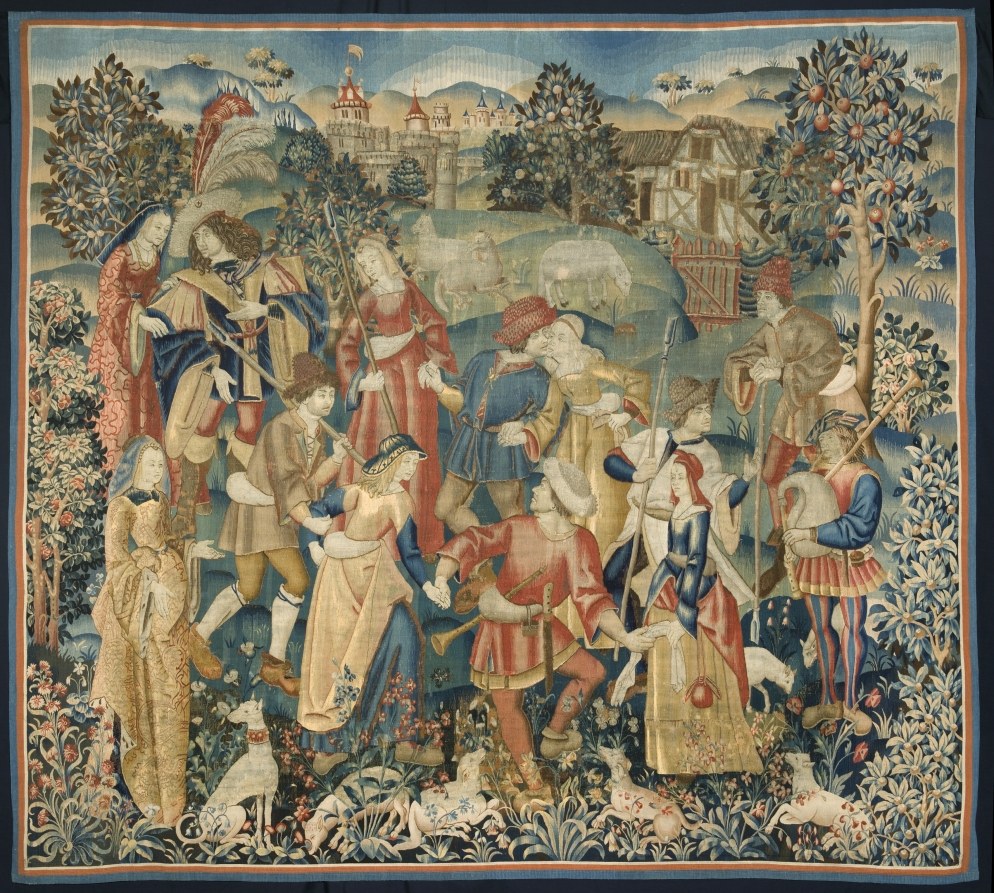
Shepherds in a Round Dance
Unknown artist
- Source:
- Cleveland Museum of Art
- Rights:
- Public domain — free to use, share and adapt.
- Recorded as:
- CC0 (Public Domain)
This work is essential evidence for understanding medieval and Renaissance round dances—their formation, posture, social context, and cultural value. For historians, it documents the visual language courts used to represent dancing as a marker of courtly sophistication and leisure. For dancers and choreographers interested in historical reconstruction, it provides rare detail about the group formation, body posture, and integration of music and dance in actual performance.
What you are looking at
A richly colored scene set in a pleasure garden or palace courtyard, with figures in medieval or early Renaissance dress engaged in a round dance. The composition is crowded with activity: nobles and attendants in jewel-toned robes—reds, blues, golds—occupy the center, while flowering trees and exotic plants frame the composition on all sides. The background shows a castle or fortified city with multiple towers and spires. The foreground includes detailed naturalistic plants and flowers, rendered with the precision typical of Northern European manuscript illumination. Musicians play instruments at the periphery. The light is even and decorative rather than naturalistic, characteristic of the illuminated tapestry or manuscript tradition. The scene has the quality of a medieval feast or courtly entertainment, with dozens of figures in various states of social interaction and dance.
The dancing
Multiple figures participate in what appears to be a circle or round formation, though the composition is too crowded to trace a single unified holding pattern. Most dancers are upright with arms raised or extended, in the open postures characteristic of medieval round dances. The figures wear long, full gowns and fitted tunics; women's dresses have the high waistlines and flowing skirts of 15th-century fashion. Weight distribution is generally upright rather than grounded. Children appear among the adult dancers. The poses suggest gentle, processional movement rather than vigorous footwork, with bodies arranged to display dress and courtly bearing.
The dance depicted
This depicts a round dance, almost certainly a carole or similar courtly circle dance from the medieval or early Renaissance period. The title 'Shepherds in a Round Dance' suggests a pastoral or courtly pastoral setting, though the figures' rich dress indicates nobility rather than actual shepherds. Round dances were a staple of courtly entertainment and appear frequently in Northern European art of the 15th century. The formation—figures in approximate circle, upright posture, arms raised or linked—matches documentation of how such dances were performed. The presence of musicians and the garden setting are both typical of how round dances were depicted. This is likely a representation of social, recreational dance within a court or aristocratic context rather than any formal theatrical performance.
How it was made
This appears to be a hand-colored woodcut or engraving from the 15th or early 16th century, rendered in the Northern European tradition. The technique shows characteristics of the Northern Renaissance: meticulous attention to botanical detail, hierarchical perspective, and the flattened, decorative space typical of illuminated manuscripts translated into print. The hand-coloring—applied to create the jewel tones and gold accents—suggests this was a luxury object intended for a wealthy patron. The use of fine line work in the figures and crisp detail in the background indicates engraving rather than woodcut. The medium allowed for mass production while retaining the richness associated with manuscript illumination, making it an important format for disseminating courtly ideals.
About this work
This is a Northern European engraving or woodcut, likely from the 15th or 16th century, depicting a round dance at court or in a noble garden. The composition is crowded and festive, filled with figures in rich medieval dress, musicians, and elaborate botanical ornament. It documents both the visual culture of courtly dancing and the artistic conventions used to represent such scenes in the Renaissance North. The work belongs in a dance gallery as a primary visual record of how round dances—among the most popular social dances of the medieval and Renaissance periods—were performed, imagined, and valued in elite circles.
The image reveals several important aspects of period dance culture: the participation of men, women, and children in mixed-gender social dance; the presence of live musicians; the association of dancing with gardens and courtly leisure; and the display function of dress within dance. The careful rendering of costume and setting suggests this was a prestigious, carefully commissioned work meant to celebrate aristocratic refinement and the pleasures of court life.
How to look at it
Observe the formation: despite the crowded composition, the figures do seem to arrange themselves roughly in a circular or curved line, which is the fundamental characteristic of a round dance. Notice the posture—most figures stand upright with arms extended or raised, not in the closed partnered hold of later ballroom dances. Look at the musicians at the periphery, and note how they are integrated into the scene rather than separated from it. Pay attention to the contrast between the naturalistic rendering of plants and the more stylized, decorative treatment of human figures—this tension between botanical precision and courtly idealization is characteristic of Northern Renaissance taste. The composition's crowdedness and the wealth of ornamental detail reflect how such scenes were meant to celebrate abundance and courtly refinement.
The period
Round dances and carol dances were among the most widespread social dances in medieval and Renaissance Europe, documented in literary sources from at least the 12th century onward. By the 15th century, when this image likely dates, round dances had become a standard feature of courtly entertainment, appearing in the festive scenes that punctuated court life. Northern European printmakers of the 15th and 16th centuries frequently depicted such dances, reflecting both their popularity and their symbolic value as markers of courtly order and refinement. The impulse to document dancing in visual form reflects a broader Renaissance interest in recording and codifying social customs and courtly behavior. This image likely dates to a period of increasing artistic sophistication in Northern Europe, when the marriage of print technology and manuscript aesthetics created new possibilities for circulation of courtly imagery.
Where it lives
This work is held in the Cleveland Museum of Art's collection. The museum catalog provides minimal information, including no recorded medium, artist, or date, suggesting it arrived at the institution as an orphaned object or was acquired through a general collection purchase.
Dance in this work
Questions about this work
What is a round dance?
A round dance is a social formation in which dancers stand in a circle or curved line, typically facing inward, and move together while holding hands or with arms raised. Round dances—including the carole, piva, and English carol—were among the most widespread social dances in medieval and Renaissance Europe. Unlike later ballroom dances, they require no fixed partner and no closed hold; they emphasize group participation and ornamental display of dress. Musicians typically played while dancers sang and moved.
Why does the title say 'Shepherds' when the figures look wealthy?
The title may reflect a courtly pastoral tradition, in which noblemen and women dressed as or played the role of shepherds for entertainment. This was a common fantasy at Renaissance courts. Alternatively, the title may be a later misattribution or misnomer applied to the object. The figures' rich dress—velvets, jeweled colors, elaborate headdresses—clearly indicates nobility rather than actual shepherd labor.
How do we know this is really how people danced?
Round dances are extensively documented in medieval literary sources, including references in poetry, romances, and chronicles dating back centuries. They appear in numerous visual sources—manuscripts, prints, paintings—across Europe from the 14th through 16th centuries. This consistency of representation across different media and regions suggests the images reflect actual practice. However, images like this also had an idealized, celebratory function; they showed dancing as courtly refinement, not everyday reality.
What was the function of these dances?
Round dances served multiple functions: they were recreational entertainment, a display of courtly accomplishment, a way to structure social interaction in a ritual form, and a means of celebrating important occasions. They appear in accounts of feasts, celebrations, and courtly festivities. The presence of music, the ornamental setting, and the mixed-gender participation all suggest dancing was valued as a refined social pleasure, not a utilitarian or sacred act.
More dance artwork