49 works in this view — arrow keys or swipe to move between them.
Dance in Art
Spanish Dancer
Alexandre Lunois (French, 1863–1916)
- Source:
- Cleveland Museum of Art
- Rights:
- Public domain — free to use, share and adapt.
- Recorded as:
- CC0 (Public Domain)
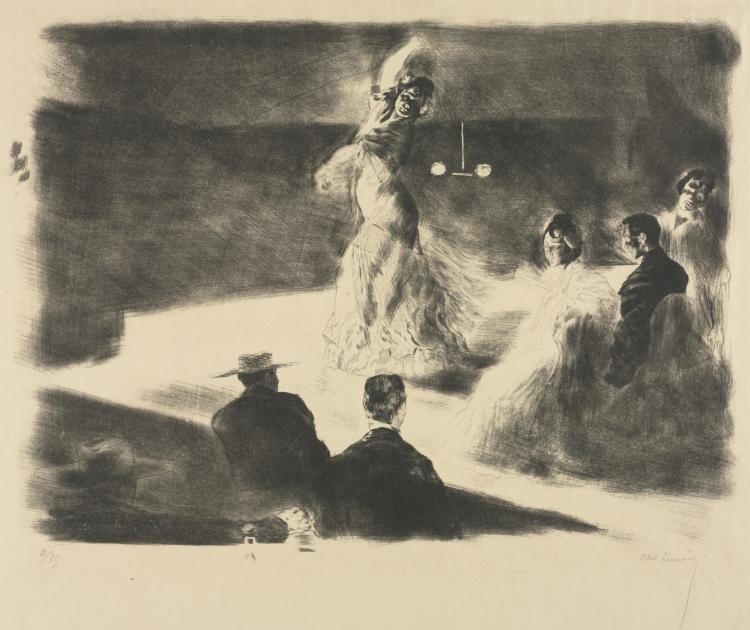
The tension between the title (Spanish Dancer) and the visual evidence (balletic vocabulary and European theatrical convention) exposes how nineteenth-century theatrical culture represented non-European or regional dance through the lens of its own aesthetic vocabulary. The extreme backbend also documents an historical moment when balletic flexibility and unnatural body positions were prized as markers of virtuosity and artistic ambition—quite different from contemporary ballet practice.
What you are looking at
A theatrical scene rendered in dark tones with high dramatic contrast. In the foreground, two figures in formal dark dress sit with their backs to the viewer, their shoulders hunched in absorbed attention. The stage or performance space before them is dominated by a single tall female figure in a billowing white costume, her body arched in an extreme backbend or dramatic pose, one arm raised. Her face is turned upward and away. Flanking her are three additional figures in lighter clothing, positioned as attendants or fellow performers. The setting is sparse and atmospheric—the background dissolves into shadow, with only a bare architectural element visible at top, perhaps a doorway or alcove. The light concentrates on the central dancer's white costume and upturned face, making her the visual anchor of the composition. The engraving technique creates deep blacks and theatrical chiaroscuro that emphasizes the drama and artificiality of the scene.
The dancing
The central figure displays an extreme arched pose—a deep backbend with one arm extended upward, the body stretched and elongated in an artificial, balletic line. Her head is thrown back, the face dramatically lit. The two foreground spectators sit in formal posture, fully engaged as audience members. The three background figures, more lightly rendered, appear static and posed rather than in active motion—one seems to gesture or present the central figure. The composition privileges verticality and extension; the central dancer's elongation and arch dominate the spatial composition. This is not a naturalistic movement vocabulary but rather a theatrical display of extreme flexibility and bodily control.
The dance depicted
The extreme arch and upward arm raise, the formal theatrical setting with spectators, and the presentation of a solo female performer suggest romantic-era theatrical dance—likely ballet from the mid-to-late nineteenth century. The backbend, while extreme, recalls the exaggerated positions sometimes captured in Romantic ballet imagery, though the pose is pushed beyond typical ballet vocabulary. The title Spanish Dancer creates ambiguity: the theatrical setup and balletic body position conflict with what one would expect of flamenco or Spanish regional dance. Either the title is misleading (common in period theatrical prints), or this depicts a Europeanized theatrical interpretation of Spanish dance. The central figure's isolation, the formal audience, and the balletic extension suggest this is theatrical ballet or dance-theatre rather than an authentically performed Spanish idiom.
How it was made
This is an engraving or lithograph, executed with a tonal technique that creates dramatic light and shadow through layered marks and washes. The medium is evidently print rather than original drawing—the parallel hatching, the tonal control, and the even distribution of the image suggest a reproductive print process. The contrast between the white of the paper (the dancer's costume and faces) and the deep blacks created through extensive mark-making produces a dramatic chiaroscuro characteristic of nineteenth-century theatrical prints. This technique would have made the work reproducible and relatively affordable, meaning it likely circulated among theatre audiences, print collectors, and the general public interested in theatrical imagery.
About this work
This print depicts a theatrical dance scene centered on a single female performer in an extreme arched pose, watched by spectators and attendants in a formal interior setting. The engraving technique and dramatic lighting create a work designed for theatrical promotion or documentary—a record of a stage moment, whether real or imagined. Though titled Spanish Dancer, the formal balletic body vocabulary, theatrical presentation, and composition suggest a European theatrical dance tradition rather than an ethnographic or regional Spanish idiom. The work sits within the nineteenth-century tradition of theatrical prints documenting dance performance, appealing both as a record of stage practice and as dramatic imagery in its own right.
How to look at it
Attend to the moment of suspension: the dancer is caught not in motion but in an artificial, held position—the extreme arch cannot be sustained and the viewer knows this. This is a moment of display, not of dance. The two spectators provide a frame; they model how to watch, and their rapt attention elevates the performer's pose from acrobatic to theatrical and meaningful. The lighting emphasizes the performer's white costume against shadow, a convention that made performers visible and glamorous on gaslit stages. Note how the title promises Spanish dance but the body language—the balletic extension, the passive arch—speaks only the language of European theatrical ballet.
The period
The nineteenth century saw intense European fascination with Spanish and exotic dance forms, which were typically filtered through European theatrical conventions and balletic technique. Romantic ballet was at its height, with its cult of the ethereal, the extreme, and the feminine. Theatrical prints flourished as a major medium for documenting and promoting stage performances, especially dance—they functioned as posters, souvenirs, and documentary records. The technical refinement of reproductive printmaking made such images accessible beyond the theatre itself. Within this context, a work titled Spanish Dancer but executed in balletic language reflects the common nineteenth-century practice of absorbing or appropriating non-European dance into European theatrical forms.
Where it lives
Part of the Cleveland Museum of Art's dance-related art collection. This is a work documented and preserved as a record of nineteenth-century theatrical culture, suggesting it was either a professional theatrical print or a secondary print circulated for a general audience interested in stage imagery.
Dance in this work
Questions about this work
Why does the title say Spanish Dancer when the body position looks like ballet?
This reflects a common nineteenth-century practice: European theatres marketed exotic or regional dance forms under such titles, but staged them using the balletic vocabulary and body ideals of the day. What made something recognizable as Spanish—a costume element, perhaps, or a dramatic context—might be invisible to us now. Alternatively, the title may be a later attribution or a deliberate fictionalization. The print itself testifies only to what the artist actually drew: a balletic body in a theatrical setting.
Is this a record of a real performance or an imagined scene?
We cannot tell from the image alone. Nineteenth-century theatrical prints ranged from documentary records of actual performances to imaginative creations inspired by theatre. The formal composition, the dramatic lighting, and the artificial pose suggest theatrical fantasy or idealization rather than documentary capture, but theatrical prints often styled real performances this way too. The absence of an artist attribution and date makes it harder to contextualize.
What technique was used to create this image?
The image appears to be an engraving or lithograph—a reproductive print technique that allowed the image to be printed many times. The tonal control, the parallel hatching visible in shadow areas, and the contrast between deep blacks and white paper are characteristic of nineteenth-century theatrical print production. This means the work was designed for circulation and relatively broad audience reach, not as a unique object.
More dance artwork