49 works in this view — arrow keys or swipe to move between them.
Dance in Art
The Dancer
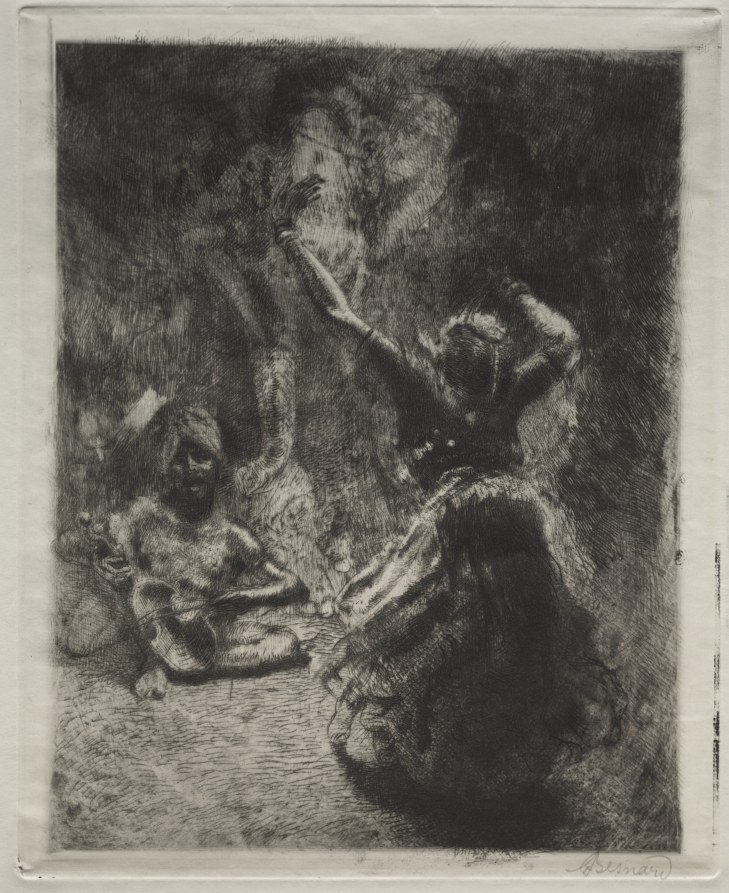
Albert Besnard (French, 1849–1934)
- Source:
- Cleveland Museum of Art
- Rights:
- Public domain — free to use, share and adapt.
- Recorded as:
- CC0 (Public Domain)
This work shows how printmaking artists of the 18th or 19th century used intimate physical contact and thrown-back postures to convey passion and theatrical drama. It demonstrates the intersection of dance, theatre, and printmaking, and how gesture and proximity could stand in for narrative and emotion without explicit documentation of steps.
What you are looking at
This is an etching or engraving rendered in fine, dense hatching that builds form from shadow. The composition centers on three figures in what appears to be an interior space. Two principal figures dominate the upper portion: a woman with her head tilted back and a man leaning toward her, their faces close. The woman wears what appears to be a feathered or textured headdress and has one arm raised. A third figure, rendered more darkly, sits or crouches in the lower left, partially obscured. The lighting is dramatic and theatrical, with sharp contrasts between illuminated faces and surrounding shadow. The technique creates an atmosphere of intimacy and movement, though the specific setting remains ambiguous—the background dissolves into dark, sketched passages that suggest either architectural space or deep shadow.
The dancing
The two upper figures are locked in close physical contact, their bodies angled toward each other at roughly 45 degrees. The woman's head is thrown back in what reads as abandon or ecstasy, her raised arm extended but not fully; the man's posture curves forward, his face nearly touching hers. This is not an upright ballroom hold. The seated or crouching figure below appears to be a musician or servant, rendered in darker tones and smaller scale, outside the primary action. The overall composition suggests a moment of intimate physical intensity rather than formal partnered dancing.
The dance depicted
The identity of this dance cannot be determined with confidence from the image alone. The close physical contact, the woman's thrown-back head, and the man's forward-curving posture resemble conventions in depictions of Romantic-era theatrical ballet or theatrical contemporary dance, but the ambiguous setting and the presence of a third attendant figure complicates this reading. The work may depict a scene from a narrative ballet, a music-hall performance, or even a social dance captured in an intimate moment. The technique and compositional choices suggest the artist was interested in emotional intensity and physical closeness rather than in documenting specific steps or positions.
How it was made
This is an etching or engraving executed with fine parallel hatching lines that create tone and form through density of line rather than shading. The technique allows for precise rendering of faces and drapery while maintaining the ability to dissolve background into shadow through variation in line spacing. The quality of the line and the control of the medium suggest this is a work of considerable technical skill, likely created for print circulation rather than as a unique artwork. The composition's dramatic chiaroscuro and intimate scale suggest it was intended for a cultured audience familiar with theatrical and artistic conventions.
About this work
This etching or engraving depicts a moment of physical intimacy between two figures—a woman with her head thrown back and a man leaning close—attended by a dimly rendered third figure, likely a musician or servant. The work belongs to a tradition of theatrical or narrative imagery rather than dance documentation. It engages with conventions of Romantic-era representation of passion and drama, using the close physical contact and gesture of the dancers to convey emotional intensity rather than to illustrate specific steps or positions.
The work's inclusion in a dance collection rests on the physical engagement of the two principal figures and their apparent participation in a theatrical or performative moment. Whether this depicts an actual dance, a ballet scene, or a more general representation of intimate performance remains unclear from the image alone. The work demonstrates how etching and engraving could capture the emotional and physical dimensions of performance for a print audience.
How to look at it
Attend to the precise moment the artist chose: not the beginning or end of an action, but a moment of maximum physical and emotional intensity, where the two figures' faces and bodies meet. Notice how the hatching technique creates drama through the contrast between the carefully rendered faces (especially the woman's expression and the play of light on her features) and the dark, sketched background. The raised arm, the tilted head, and the forward-leaning posture all work together to create a sense of movement and emotion that transcends the static nature of the print medium.
The period
The etching technique and compositional style suggest this work dates to the 18th or 19th century, when fine printmaking was a major vehicle for disseminating theatrical and artistic imagery. The Romantic emphasis on emotion, intimacy, and the thrown-back head as a gesture of abandonment or ecstasy was widespread in theatrical art of this period. Narrative ballet and theatrical performance were popular subjects for printmakers, who used them both to document actual performances and to create imaginative interpretations of theatrical subjects for educated audiences.
Where it lives
This work is held by the Cleveland Museum of Art and appears to be part of their dance-related art collection. The museum's records provide minimal cataloguing information, but the work belongs to a tradition of theatrical and narrative printmaking.
Dance in this work
Questions about this work
Is this a scene from a specific ballet?
The image alone does not provide enough evidence to identify a particular ballet or performance. The composition uses conventions associated with Romantic theatrical imagery, but without documentary or inscriptional evidence, the specific source remains uncertain.
Who are the three figures?
The two principal figures appear to be dancers or performers engaged in a moment of physical intimacy. The third, dimly rendered figure is likely a musician or attendant. Their specific identities cannot be determined from the image.
What is the technique?
This is an etching or engraving created with fine parallel lines (hatching) that build tone and form. The artist uses variation in line density to create dramatic lighting effects and to dissolve the background into shadow.
What does the raised arm tell us about the dance?
The raised arm, combined with the thrown-back head, suggests a moment of emotional release or abandonment rather than a formal or ballroom position. This gesture is consistent with theatrical or narrative dance rather than social dancing.
More dance artwork