43 works in this view — arrow keys or swipe to move between them.
Dance in Art
After the Ballet
Constantin Guys
- Dance:
- Ballet
- Source:
- Art Institute of Chicago
- Rights:
- Public domain — free to use, share and adapt.
- Recorded as:
- CC0 (Public Domain)
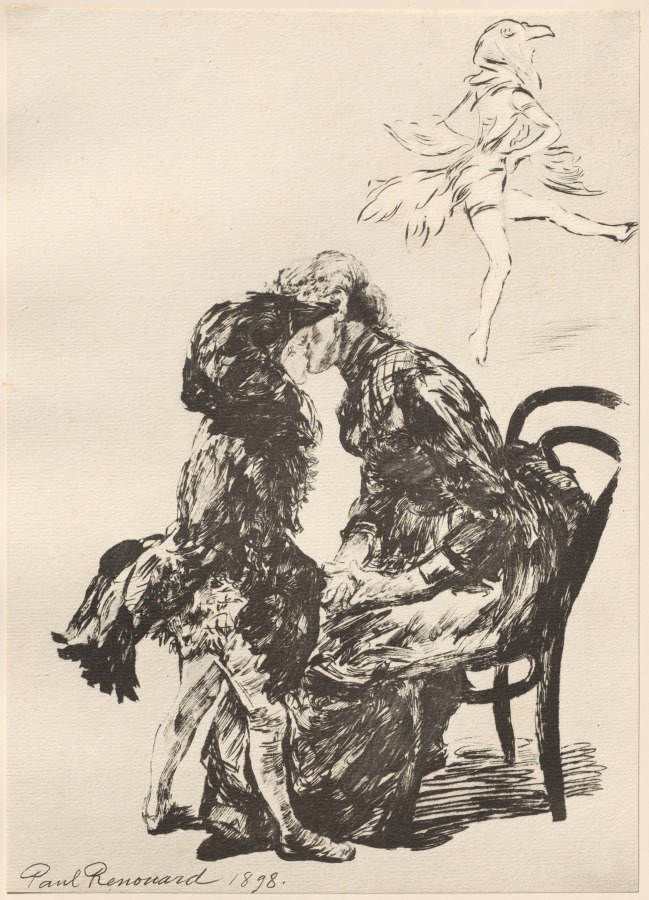
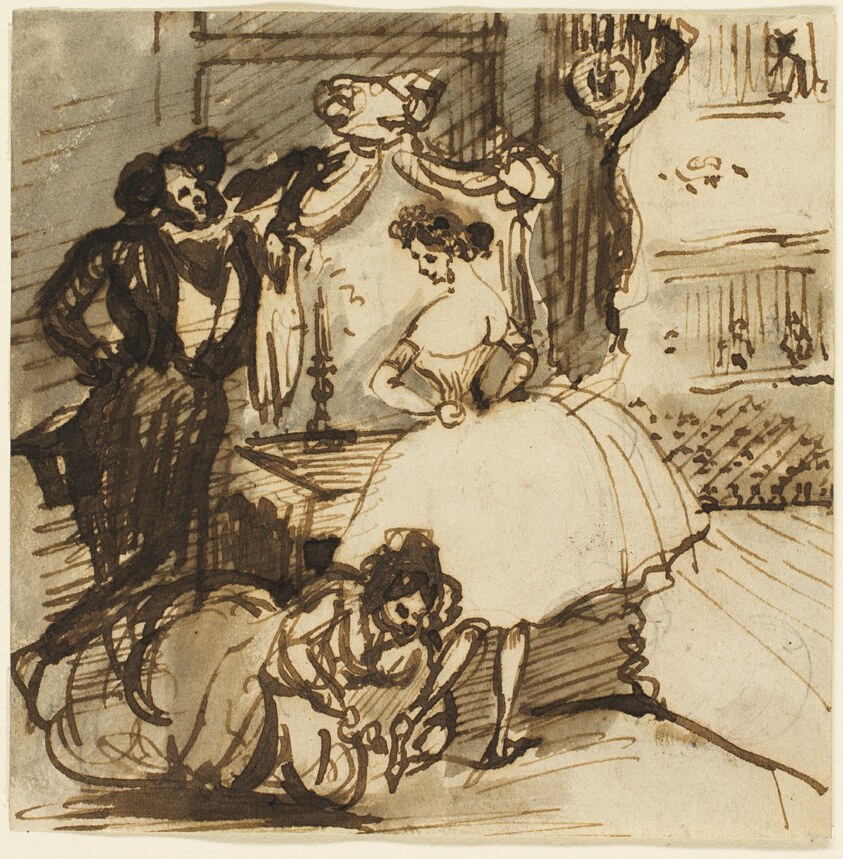
This image documents a crucial moment in ballet's cultural history—the transformation of the art form into a site of female display and sexual attention in aristocratic and upper-middle-class society. For dancers and historians, it reveals how the period understood the relationship between performance and social life, and how the female dancer's body was publicly consumed. The image is also formally masterful in its use of print technique to convey both the glamour of the scene and its slightly salacious undertone.
What you are looking at
A woman in a pale, full-skirted ballroom dress sits or reclines in the center-right of the composition, her body angled away from the viewer. Her dark hair is styled up and adorned with what appears to be feathers or decorative elements. She gazes downward with an air of exhaustion or contemplation. To her left stand two figures in dark evening dress—men or figures in masculine formal wear—leaning inward toward her with animated, conversational postures. Their faces are rendered with exaggerated expression. In the lower left, a small figure (possibly a child, attendant, or cherub-like form) crouches or bends forward, also rendered in dark tones. The setting appears to be an interior space with architectural elements—paneled walls, a doorway or window frame visible on the right. The composition uses strong chiaroscuro, with the woman's pale dress and face emerging from shadow. The sketch-like quality and loose handling suggest this is a preparatory study or print rather than a finished painting.
The dancing
The central female figure is posed in a passive, reclining attitude—weight settled, body arranged for display rather than movement. The two standing figures lean toward her with animated upper bodies, their postures suggesting conversation or flirtation rather than dance partnership. The small figure at lower left operates in a different spatial and social register, possibly a servant or supernatural attendant. None of the figures display the upright carriage, extended limbs, or dynamic weight transfer characteristic of active dance; the mood is one of social rest or aftermath rather than choreographed movement.
The dance depicted
Despite the title 'After the Ballet,' this image depicts a social scene of courtship or gallantry rather than dance itself. The woman appears to be a dancer recovering or on display after performance—her elaborate dress, upswept hair, and central positioning suggest she has been the object of attention. The two men attending her may be admirers or patrons. The image captures a moment of social interaction in a theatrical or ballroom context, documenting the custom of male attention to female performers after a public display. The dance itself is absent; we see its social aftermath.
How it was made
This appears to be an etching or engraving, executed in brown or sepia ink on cream paper. The technique is evident in the fine parallel hatching used to build shadow and volume, the varied line weight that suggests both rapid sketching and deliberate modeling, and the way the white of the paper is preserved to suggest the woman's pale dress and face. The medium's capacity for fine detail and tonal gradation through hatching was ideal for capturing both the formality of evening dress and the more intimate, anecdotal quality of the interaction. The sketchy, unfinished quality of areas (particularly the upper left and architectural elements) suggests this may be a working study or print intended for a cultivated audience familiar with the print medium.
About this work
This is a social scene from the world of professional ballet in the late 18th or early 19th century, captured in the moment after performance. The title promises an image of dance but delivers instead an image of the cultural and sexual dynamics surrounding ballet—the display of the female dancer's body, the attention of male admirers, the hierarchies of the ballroom and theater. It is a work about the social life of dance rather than dance itself, and it reveals the assumptions of its era about the dancer's role: she is admired, attended, passive, and the object of courtship. The print medium allowed this intimate scene to circulate among the educated public, creating a shared visual language around ballet and its place in courtship and social performance.
How to look at it
Observe the contrast between the animated, leaning postures of the standing men and the settled, display-like pose of the seated woman. The artist has chosen a moment of social stasis rather than movement—a pause in which the woman is the focus of attention. Notice how the woman's gaze is averted, her expression unreadable; she is present but not engaged in the interaction. The architectural setting and the formal evening dress establish this as a world of upper-class leisure and performance. The etching technique—particularly the use of shadow and the delicate rendering of the woman's face—creates an mood of intimate observation, as if the viewer is witnessing a private moment made public.
The period
In the late 18th and early 19th centuries, ballet was transitioning from a court art to a professional theatrical spectacle, and female dancers were becoming celebrities and objects of intense social and erotic interest. The custom of male admirers gathering in the dressing room or backstage area after a performance was well-documented in contemporary sources. This image reflects the Romantic era's fascination with the ballerina as a figure of beauty and pathos—idealised yet commodified. The print medium was a primary vehicle for circulating such imagery, allowing subscribers and collectors to own images of celebrated dancers and theatrical moments.
Where it lives
The work is recorded as being in the Art Institute of Chicago. The catalogue record provides minimal information, labeling it only as from an unknown era and artist, with no medium specified. The image itself clearly identifies it as a print—likely an etching or engraving—suggesting it was a work of commercial circulation rather than a unique object.
Dance in this work
Questions about this work
Is this a ballet scene?
The title promises a ballet scene, but the image shows its aftermath rather than the performance itself. The central figure is a dancer in her costume and makeup, attended by admirers in a private or semi-public space. The image captures the social and erotic dynamics surrounding ballet rather than the art form itself.
Who is the woman in the center?
The catalogue provides no identification. She is represented as a professional dancer—a ballerina—recognisable by her costume, grooming, and the attentive postures of the men around her. The image treats her as a type (the celebrated dancer) rather than a named individual, though contemporary viewers may have recognised a specific performer.
What does 'after the ballet' mean?
The title indicates that we are seeing the moment after a public performance. The woman has left the stage and is now in a private or semi-private space, where she is the object of male attention and courtship. The image documents the theatre's social rituals as much as its artistic ones.
Why is the style so sketchy?
The loose, sketch-like handling is characteristic of etchings and engravings of the period, particularly study prints or prints intended for a cultivated audience. The artist uses fine parallel lines (hatching) to build form and shadow, leaving areas unfinished to suggest spontaneity and immediacy.
More Ballet artwork