49 works in this view — arrow keys or swipe to move between them.
Dance in Art
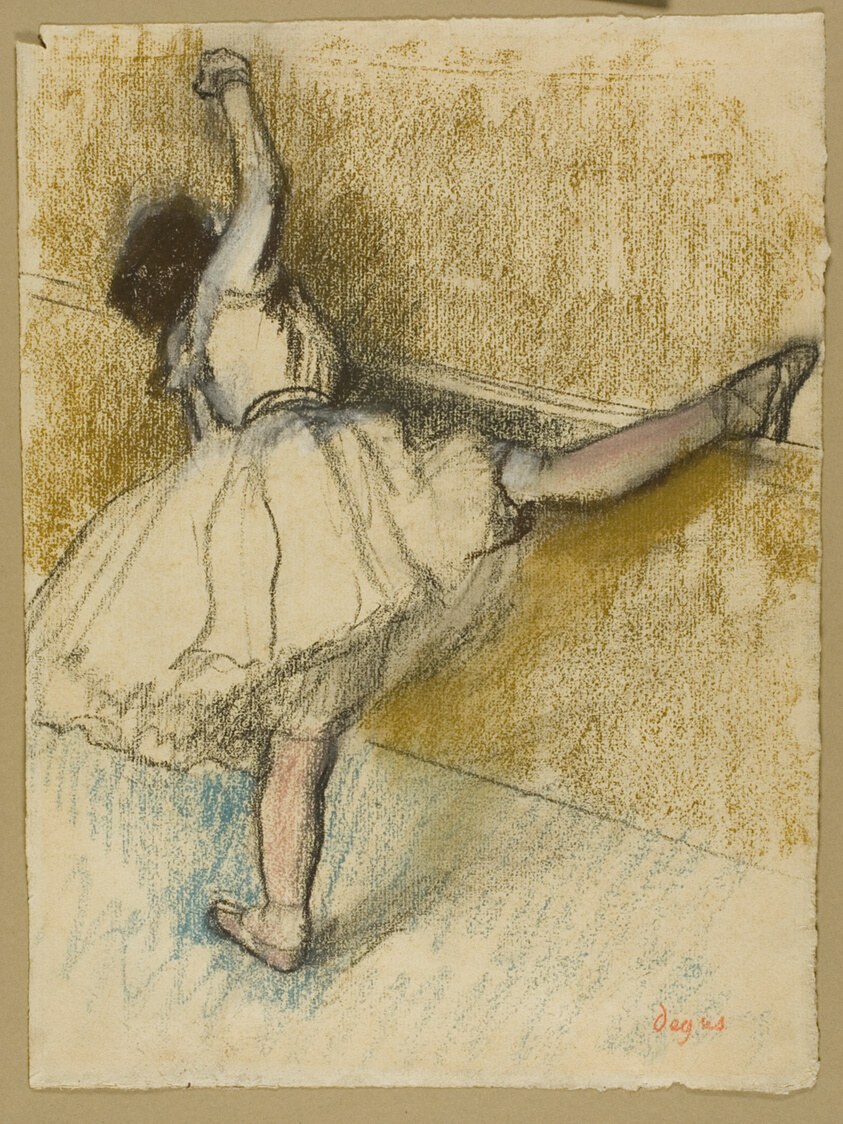
Dancer Stretching at the Bar
Hilaire Germain Edgar Degas
- Source:
- Art Institute of Chicago
- Rights:
- Public domain — free to use, share and adapt.
- Recorded as:
- CC0 (Public Domain)
This image documents the material reality of ballet training in the nineteenth century—what the dancer's body actually did in the studio, away from the stage spectacle and narrative drama that dominated ballet iconography. For dance historians, it is evidence of how the barre vocabulary was understood and practiced; for art historians, it exemplifies how the modernist avant-garde discovered aesthetic and philosophical depth in the unglamorous labour of the body.
What you are looking at
A solitary female dancer in a pale, billowing skirt is captured mid-stretch at the barre, her body angled in profile with one leg extended and raised. She leans forward from the hips with her arm lifted overhead, executing what appears to be a forward stretch or développé. The composition is intimate and focused, rendered in a soft palette of beige, cream, and ochre with touches of blue-grey shadow defining the musculature and drapery. The dancer wears what appears to be a fitted bodice and pointe shoes; the skirt, rendered in delicate linear hatching, suggests the lightweight practice tutu or rehearsal dress of classical ballet. The background is warm and atmospheric, built up with layered, feathery marks that suggest a studio or stage interior without precise architectural detail. The work's technique—loose, sketchy, tonally subtle—captures the transitory nature of a moment in training rather than performance.
The dancing
The dancer's frame reveals trained classical posture: her supporting leg is straight and turned out, her torso elongated and held upright despite the forward bend, her lifted arm extended with the fingers softly articulated. Her head follows the line of her arm in the classical épaulement. The single figure dominates the composition, isolated against the warm ground. Her weight appears centered over the supporting leg, with the extended leg held at or above hip height in a controlled manner suggesting years of disciplined training. The stretch itself is active rather than passive—the body is engaged and working.
The dance depicted
This is classical ballet, almost certainly depicted during a rehearsal or training session rather than a performance. The barre work, pointe shoes, turned-out positions, and the formal structure of the stretch all point unambiguously to Romantic or late-nineteenth-century ballet practice. The artist has chosen to show not a moment of dramatic narrative or ensemble spectacle, but the foundational, unglamorous work of the dancer's body—the daily labor of maintaining and refining technique. This focus on rehearsal as a subject in its own right is characteristic of late-nineteenth-century Parisian dance imagery.
How it was made
This appears to be a mixed-media work on paper, likely pastel, charcoal, and possibly chalk or conte crayon on prepared paper, based on the soft blending, the warm tonal ground, and the visible layering of marks. The technique is economical and observational rather than purely linear; the artist has built form through tonal variation and directional hatching rather than precise outline. This approach—sketchy, intimate, concerned with light and shadow—is consistent with rehearsal or preparatory studio studies rather than finished exhibition pieces, and suggests this may be a working study or drawing from life rather than a commissioned work for public display.
About this work
This is a studio study of a classical ballet dancer at the barre, rendered with remarkable restraint and anatomical understanding. The work captures the discipline and isolation of daily ballet training—a subject that became increasingly central to avant-garde Parisian art in the late nineteenth century, particularly through the work of Edgar Degas, whose extensive ballet studies established rehearsal and backstage labour as legitimate subjects for high art. Though the artist is unrecorded in the current catalogue, the work's sensitivity to the dancer's body, its confident understanding of classical technique, and its formal choices all place it squarely within this tradition of depicting dance as a site of physical knowledge and aesthetic investigation.
How to look at it
Observe the subtlety of the dancer's weight and balance: she is not rigid but engaged, holding her extension through active muscular control. Notice how the artist has caught the quality of the semi-transparent skirt and the solidity of the working body beneath it—the drapery is not merely decorative but reveals the form underneath. The background, rather than being a flat stage, is atmospheric and warm, placing the dancer in a real studio space. The moment chosen is neither the apex of a dramatic movement nor a static pose, but an active transition—the dancer mid-stretch, the work ongoing.
The artist
Unknown. However, the work's stylistic affinities—the tonal subtlety, the loose handling, the focus on rehearsal as subject, and the evident anatomical knowledge—suggest a training within the Parisian academic tradition of the late nineteenth century, possibly in dialogue with Realist and Impressionist approaches to figure drawing. The work may be a study or preparatory sketch rather than a finished independent piece.
The period
This work belongs to a period of intense artistic interest in ballet as a subject. Following the success of Realist and Impressionist painters in depicting modern urban life, dance—particularly the rehearsal and training of dancers—became a subject of fascination for artists working in Paris in the 1870s–1890s. This shift coincided with the rise of the ballerina as a symbol of modernity, the body as an object of scientific and aesthetic study, and the studio itself as a space of creative labour worthy of artistic attention. The late-nineteenth-century barre work shown here was itself a relatively recent systematization of ballet pedagogy, standardized through teachers like Agrippina Vaganova and the Cecchetti method.
Where it lives
The work is recorded as held by the Art Institute of Chicago and comes from their collection. It is catalogued with minimal attribution data, suggesting it may have entered the collection as part of a larger group of sketches or studies or through a donation of lesser-known works in the nineteenth-century European drawing tradition.
Dance in this work
Questions about this work
How do I know this is ballet and not another form of dance?
The pointe shoes, the turned-out positions, the barre itself, the formal lines and carriage of the body, and the pale tutus are all specific to classical ballet. No other dance tradition uses this vocabulary of the body. The artist has also shown the dancer in the characteristic pose of classical barre work—a forward stretch in turnout.
Is this a finished artwork or a sketch?
The work shows characteristics of both: it is highly resolved tonally and compositionally, with sensitive handling of light and form, but it lacks the finish and scale of a major exhibition piece. It is most likely a substantial studio study—the kind of work an artist would make from direct observation to develop their understanding of the dancer's body, possibly later to inform a larger or more finished work.
Why did late-nineteenth-century artists care so much about ballet rehearsal?
Rehearsal and training offered artists access to the body in states of concentration and vulnerability, away from theatrical spectacle and narrative. It allowed them to study the human form in motion, to explore the relationship between discipline and aesthetics, and to depict modern labour—themes central to Realism and early modernism. Ballet training also became associated with ideas of progress, technique, and the perfectibility of the body.
More dance artwork