49 works in this view — arrow keys or swipe to move between them.
Dance in Art
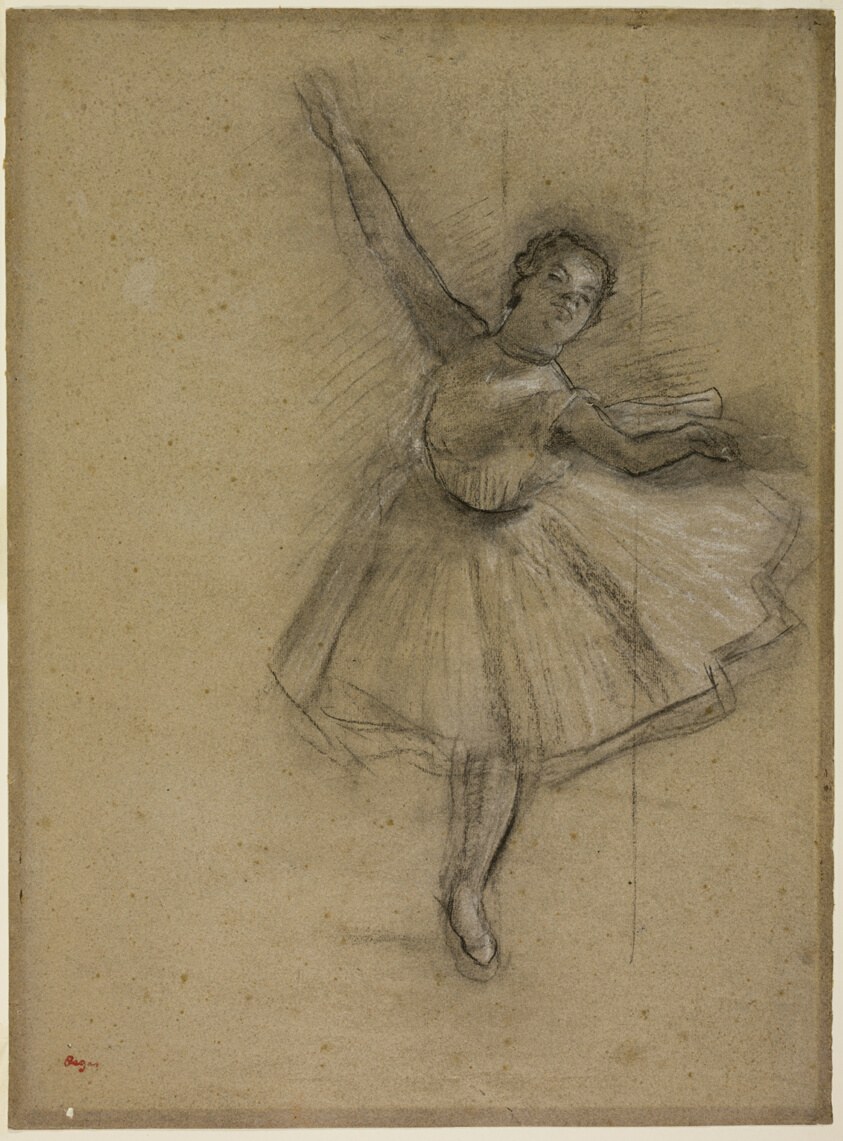
Dancer Turning
Hilaire Germain Edgar Degas
- Source:
- Art Institute of Chicago
- Rights:
- Public domain — free to use, share and adapt.
- Recorded as:
- CC0 (Public Domain)
This drawing represents a crucial historical moment in the visual culture of dance: the moment when the ballet dancer became a subject worthy of sustained artistic study, not merely as an incidental figure in a larger theatrical composition, but as the entire subject of the work. For historians of dance, it offers evidence of how the balletic body was understood and idealized by visual artists of its time. For viewers today, it demonstrates the challenge and the reward of representing motion in a static medium—the artist's decision to freeze the turn at the moment of maximum extension, making the dancer's control and training legible to the eye.
What you are looking at
A single female dancer is captured mid-turn against a pale, unmarked ground. She wears a tutu—a short, layered skirt rendered with delicate parallel hatching—and a fitted bodice. Her pose is one of sustained rotation: her body leans slightly back, weight on her supporting leg, while her raised arm extends upward and outward in a graceful arc. Her free leg is extended, and her head is tilted to follow the turn, her gaze directed toward the viewer. The sketch technique—charcoal or pencil with selective smudging and hatching—conveys both the form of the dancer and the ephemeral quality of the moment, as if the artist has caught her mid-movement before the turn completes.
The dancing
The dancer stands on one supporting leg, the other extended in the air. Her torso is upright but inclined slightly backward with the momentum of the turn. Her arm is raised above her head in a classic balletic port de bras, while her shoulders remain relatively level. The posture and extension suggest a trained, professional dancer with strong control—the kind of line associated with classical ballet technique. The turn itself appears to be a sustained pirouette or similar rotational step, held at the moment when maximum extension is visible.
The dance depicted
This is almost certainly a work from the theatrical ballet tradition, most likely from the 19th century when ballet was the dominant European dance form. The tutu, raised arm, extended leg, and the very act of capturing a sustained turn all point to classical ballet vocabulary. The pose suggests a moment of technical display—the kind of moment artists favored when representing the ballet dancer as a subject of aesthetic interest and admiration. The work does not depict a specific ballet or named figure, but rather the idealized ballet dancer in a moment of pure technical achievement.
How it was made
This is a drawing in charcoal or graphite pencil on paper, as indicated by the soft tonal modeling and the visible parallel hatching used to define form, especially in the tutu. The artist has used selective pressure and smudging to create volume and suggest the fluidity of movement—the skirt reads as weightless and in motion despite being static on paper. The technique allows for rapid capture of a figure in motion while permitting the kind of detailed study of anatomy and drapery that oil painting would require more time to achieve. This suggests the work originates in an artist's study practice, possibly in preparation for a larger composition, or circulated as an independent drawing for collectors of ballet imagery.
About this work
This is a study drawing of a ballet dancer caught in the midst of a turn, executed with considerable technical sensitivity to both the dancer's anatomy and the character of her costume. The work belongs to the 19th-century European tradition of representing the ballet dancer as a subject of artistic fascination—a figure in whom beauty, control, and the poetry of movement converge. The drawing captures not a narrative moment or a specific theatrical scene, but rather the essential visual grammar of the classical ballet body: the extension, the port de bras, the quality of effortless elevation and rotation that the training of classical ballet aims to produce.
Such studies were common currency in the art world of the later 19th century, when ballet had become a major attraction in urban theaters and dancers had become subjects worthy of serious artistic attention. The drawing's presence in the Art Institute of Chicago's collection reflects the value placed on such works as documents of both dance history and the history of the artist's eye learning to see and represent movement.
How to look at it
The viewer should attend to the moment the artist has chosen: not the beginning of the turn or its end, but the sustained middle of the rotation, when the dancer's control is most visible and her line most extended. This is a deliberately chosen moment of maximum aesthetic impact. Notice also the artist's attention to the weight and balance of the body—the slight lean backward that suggests the momentum of the turn, the positioning of the supporting leg, and the counterpoise of the raised arm. The delicate treatment of the tutu, with its sense of weightlessness and motion despite the stillness of the drawing, shows an artist who understands both the physical reality of the dancer and the visual poetry of her movement.
The period
The 19th century saw an explosion of interest in the ballet dancer as a subject for visual art, coinciding with the peak of Romantic ballet in Europe (roughly 1830–1860) and continuing into the later decades when ballet was becoming increasingly professionalized and naturalized as a feature of metropolitan cultural life. Artists from Edgar Degas onward made the dancer, and particularly the female dancer, a central preoccupation. This drawing fits that broader pattern: it documents the moment when the working ballet dancer—her body, her technique, her costume—became an object of aesthetic interest in its own right. The pose and costume suggest a date in the mid-to-late 19th century, when the tutu was fully established as the standard costume for female ballet and when the technical vocabulary of classical ballet (including the sustained turn) was at the core of professional dance training.
Where it lives
The work is held in the Art Institute of Chicago, one of the major American repositories of European art from this period. Its entry in the collection catalogue, sparse though it is, indicates it was deemed worthy of institutional preservation as a document of both dance history and 19th-century artistic practice.
Dance in this work
Questions about this work
What ballet is this from?
The drawing does not depict a scene from a specific ballet. It is a study of a dancer in a classical ballet turn, likely made either as an independent work or as a preparatory study. The pose and costume are generic to the ballet tradition of the time, not particular to any narrative or character.
How can you tell this is ballet and not another kind of dance?
The tutu, the position of the raised arm, the extended leg, and the nature of the turn itself are all signature elements of 19th-century theatrical ballet. The level of technical training visible in the dancer's carriage and the artist's clear knowledge of classical ballet vocabulary all support this identification.
Why is the drawing so lightly rendered?
The soft charcoal or pencil technique serves multiple purposes: it allows the artist to capture the impression of movement and weightlessness in the tutu, to model the dancer's form with subtlety, and to work quickly—as if drawing from life or from memory. This technique was also well-suited to circulation as a study or as a print, and it creates an elegant, refined effect that suited the aesthetic tastes of the period.
More dance artwork