49 works in this view — arrow keys or swipe to move between them.
Dance in Art
Dance at the Moulin Rouge
Henri de Toulouse-Lautrec
- Source:
- Art Institute of Chicago
- Rights:
- Public domain — free to use, share and adapt.
- Recorded as:
- CC0 (Public Domain)
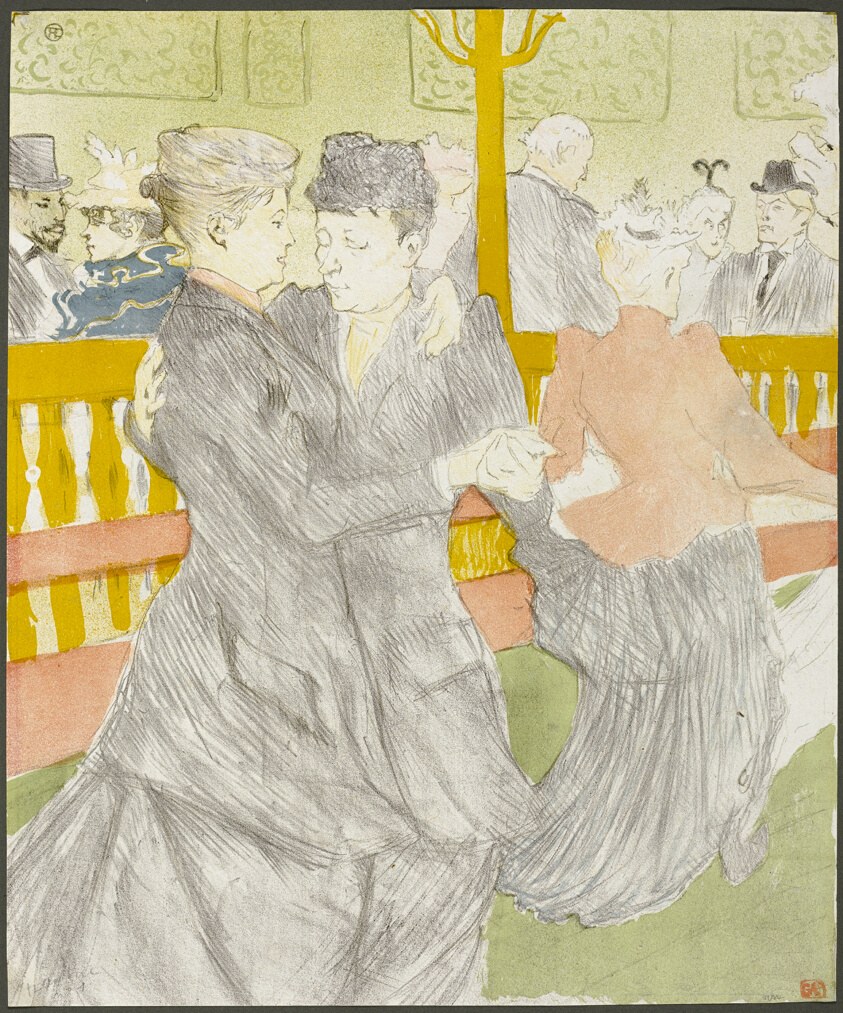
The Moulin Rouge was central to the development of modern cabaret culture and the professionalization of entertainment dancing in France. This image documents the ballroom dancing that took place in the venue's upstairs salon—distinct from the famous can-can performances on the ground-floor stage—and shows how formal ballroom technique was adapted for theatrical effect and paying audiences. For dance historians, it provides evidence of how early 20th-century waltz was actually performed, framed, and staged in a commercial context.
What you are looking at
A lively interior scene at what appears to be the Moulin Rouge, rendered in colored pencil or chalk with pen linework. The composition centers on a couple in the foreground executing a dynamic dance move: the man in a gray suit and bowler hat supports a woman in a pale gray gown who leans back dramatically, her weight transferred to him in a moment of theatrical abandon. The background is crowded with well-dressed spectators in formal evening wear—top hats, tailcoats, elaborate feathered hats—some watching intently, others conversing. The setting is defined by bold yellow and white striped railings or barriers, and a large yellow vertical architectural element (possibly a pillar or support beam) divides the composition. The palette is soft and muted—grays, pale peach tones, and sage green in the floor—with accent yellows that structure the space. The drawing style combines confident pen linework (particularly in the figures' outlines and the background crowd) with delicate watercolor or chalk wash, creating an impression of sketch-like immediacy despite the work's apparent finish.
The dancing
The central couple executes what appears to be a promenade or traveling movement with a dramatic lean: the woman's torso arches backward while maintaining contact with her partner, her body weight clearly supported by his frame. His posture is upright and controlled, his arm positioning suggesting ballroom dance technique—likely a closed or semi-closed hold adapted to accommodate the woman's backward extension. Their relative heights and the angle of their bodies suggest a practiced partnership. The background figures are rendered more summarily but with clear attention to posture and social positioning: seated and standing spectators occupy distinct spatial zones, some leaning toward the dancers, others engaged in conversation, establishing the social dynamics of a cabaret audience.
The dance depicted
This depicts social ballroom dancing in a Parisian cabaret setting, most likely a waltz or similar formal dance of the Belle Époque era. The specific movement—the dramatic backward lean with supported weight transfer—is characteristic of Viennese or American waltz technique as performed in theatrical or cabaret contexts at the turn of the 20th century, where showy extensions and exaggerated frames were part of the entertainment. The Moulin Rouge opened in 1889 and became famous for both can-can performances and ballroom dancing in its upstairs rooms. The formal dress, gender dynamics, and the presence of an attentive audience of wealthy patrons all confirm this as a performance or exhibition dance rather than an amateur social dance, though the setting suggests a working cabaret rather than a dedicated concert stage.
How it was made
The work is rendered in what appears to be colored chalk or soft pastels with pen or pencil linework, possibly crayon or gouache in the lighter areas. The technique allows for soft blending in the figures' clothing and bodies while maintaining crisp linear definition in faces, outlines, and architectural details. The yellow elements are applied with particular boldness and read as a structural device organizing the composition. This medium was common for commercial illustration and entertainment graphics of the early 20th century and suggests circulation as a magazine illustration, advertisement, or exhibition piece rather than as fine art for private collection. The drawing's combination of sketchy immediacy and finished detail is typical of fin-de-siècle Parisian entertainment graphics.
About this work
This is a genre scene of Parisian cabaret dancing, likely from the 1890s or early 1900s, capturing a moment of social and theatrical performance at the Moulin Rouge during its heyday. The artist has frozen a moment of dynamic movement—a dramatic backward lean in a waltz or similar ballroom dance—while capturing the atmosphere of a Belle Époque entertainment venue: formal dress, attentive spectatorship, and the social mingling of a paying audience drawn by the spectacle of professional dancing. The work sits at the intersection of social dance, theatrical performance, and commercial graphic art, documenting both a specific historical dance practice and the cultural contexts in which it was consumed.
How to look at it
Attend first to the moment captured: the woman's backward lean is not a collapse but a controlled extension, fully supported by her partner's frame—this is technique, not accident. Notice how the artist has used the yellow architectural elements to frame the central couple and draw the eye inward, isolating the dancers from the crowd while keeping the audience visible in soft focus. The formal dress of both dancers and spectators is essential context: this is not folk or popular dance but a commercialized version of bourgeois ballroom culture, performed for paying observers. The sketchy linework in the background figures contrasts with the more finished detail in the dancing couple, creating visual hierarchy and emphasizing what the artist wants you to watch.
The period
The Belle Époque (roughly 1870–1914) saw the emergence of dance as mass entertainment and the professionalization of performing arts in Paris. The Moulin Rouge (opened 1889) pioneered a new model of cabaret: a venue where upper-class and middle-class audiences paid to watch professional dancers perform both high-energy novelty numbers (the can-can, which became the venue's signature) and more refined social dances. Ballroom dancing was undergoing codification during this period—the English style of waltz was standardizing technique—while cabaret provided a space where formal ballroom could be performed as spectacle, with exaggerated extensions and theatrical framing. Simultaneously, the development of commercial color printing and illustration made images of dance available to a much wider audience than live performance alone could reach.
Where it lives
The work is from the Art Institute of Chicago collection and is identified only as being from an AIC source, with no artist attribution currently recorded. The specific accession information, medium, and date are not documented in the available catalogue record.
Dance in this work
Questions about this work
Why is this labeled the Moulin Rouge if it doesn't show the can-can?
The Moulin Rouge had multiple performance spaces: the ground-floor stage featured the famous can-can and other novelty acts, while upstairs rooms hosted ballroom dancing demonstrations and exhibitions for the same paying audience. This image shows the upstairs salon. The venue's reputation rests largely on the can-can, but ballroom dancing was equally central to its operations as a commercial entertainment venue.
Is this woman a professional dancer or an amateur being entertained?
Given the context—the formal setting, the attentive audience, the theatrical framing of the movement, and the man's controlled technique—this appears to be a professional or semi-professional performance. The dramatic backward lean and the precision of the frame suggest rehearsed partnering rather than social dancing. Cabaret dancers of the Belle Époque were skilled professionals who often performed both novelty acts and refined ballroom techniques.
What dance is this? Waltz?
It is most likely a waltz or a similar traveling ballroom dance (possibly foxtrot, though that emerged slightly later), adapted for theatrical performance. The movement—traveling with a dramatic supported lean—is consistent with waltz technique of the period. The specific styling, with its exaggerated extension and theatrical frame, is typical of how ballroom dances were adapted for cabaret and exhibition contexts rather than social dancing.
How do we know this is from the 1890s-1900s?
The dress, the interior styling, the formality of the scene, and the context of the Moulin Rouge (opened 1889) all point to the Belle Époque period. The illustration style—the medium, the linework, the color palette—is consistent with French entertainment graphics from roughly 1890–1910. The absence of more modern fashions or technology in the background supports this dating, though the catalogue record does not specify a precise date.
More dance artwork