49 works in this view — arrow keys or swipe to move between them.
Dance in Art
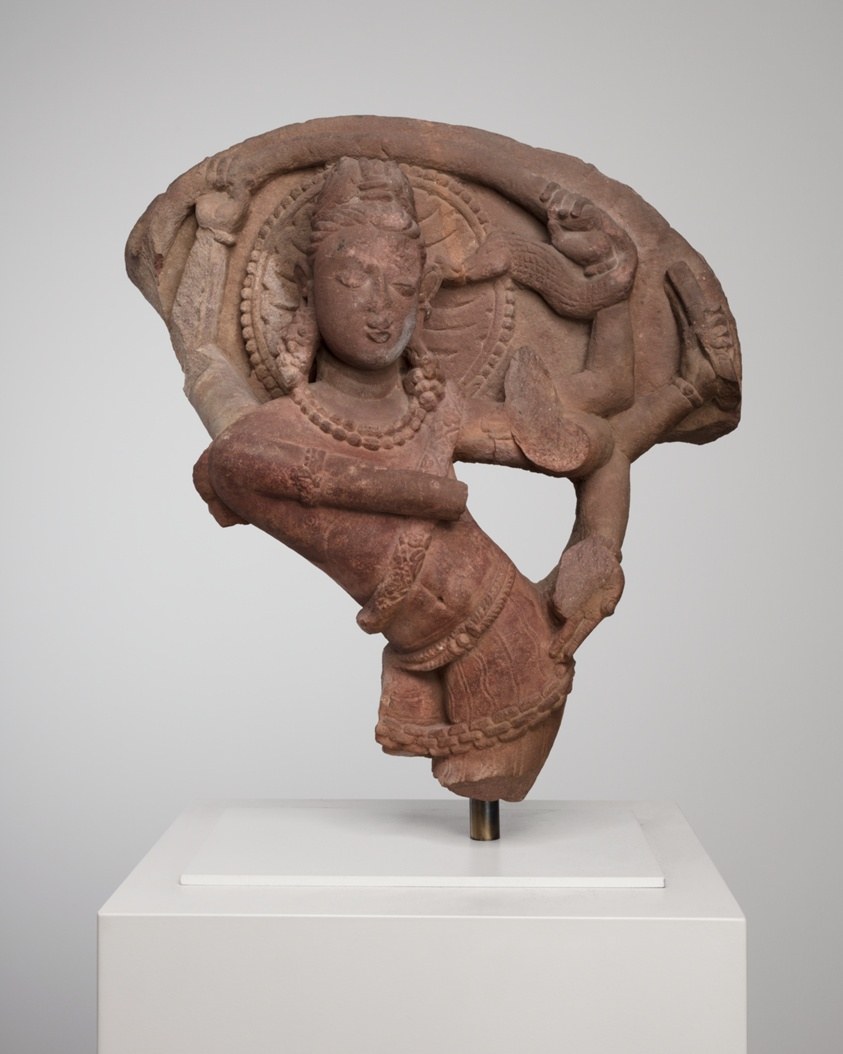
Dancing God Shiva Natesha
Unknown artist
- Source:
- Art Institute of Chicago
- Rights:
- Public domain — free to use, share and adapt.
- Recorded as:
- CC0 (Public Domain)
The Shiva Nataraja is perhaps the single most important visual representation of dance in world art, connecting sculptural form to a philosophical and religious tradition spanning more than a millennium. For anyone studying classical Indian dance—Bharatanatyam, Odissi, Kathak—this iconography is foundational: the pose, the gesture vocabulary, the idea of the dancer as a conduit for divine or cosmic force all originate here. This fragment, modest though it may be, carries the weight of that entire tradition.
What you are looking at
A terracotta sculptural fragment presents a richly adorned figure in profile, their body elegantly arched as though in mid-movement. The figure wears elaborate jewelry—multiple strands of beads encircle the neck and adorn the arms—and is dressed in what appears to be a decorated lower garment with ornamental patterning. Their hair is styled in an intricate arrangement, and the face is rendered with classical restraint. The composition is dominated by a sweeping curved form that frames the figure: a large, shell-like or leaf-like shape that dominates the upper portion of the fragment. The overall posture suggests dynamic motion, with the body weight shifted and limbs positioned as though caught mid-gesture. The stone has warm reddish-brown tones and shows the modeling marks and textures of hand-carved sculpture.
The dancing
A single figure is rendered in profile with the body arched backward or in a pronounced lateral curve, suggesting active movement rather than static display. The figure's arms are raised and positioned expressively; one arm extends upward while the other curves across the body. The legs appear to support this arched position, with weight distributed through the lower body. The head is held in profile with the gaze directed outward, and the overall frame conveys a sense of suspended motion—the moment of a turn or a devotional gesture held in stone.
The dance depicted
This appears to represent Shiva Nataraja (Shiva as the cosmic dancer), one of the most iconic images in Hindu philosophy and South Asian art. The arched body, upraised arms, and dynamic positioning are characteristic of the classical *tribhanga* (triple-bend) pose central to Indian classical dance idioms such as Bharatanatyam and Odissi. The figure's ornamentation—the elaborate jewelry and styled hair—and the devotional context indicate this is a temple sculpture or votive object. The theatrical presentation of the body in a moment of ecstatic movement reflects the theological concept of *natya* (dance) as a form of cosmic creation and divine expression. The fragmentary shell or arch form framing the figure may represent the celestial arch of creation or the halo typical of Nataraja imagery.
How it was made
This is carved terracotta, a medium that permits fine detail in the jewelry, facial features, and decorative patterning while maintaining the warmth and earthiness characteristic of South Asian temple sculpture. The sculptor has used modeling and incision to create the beaded ornaments and the patterned textile of the lower garment, and has left visible the tool marks that speak to hand-carving. Terracotta was a common material for votive and devotional sculpture in South Asia, accessible for widespread circulation in temple and household contexts. The fragment's condition suggests it is part of a larger architectural or sculptural composition, possibly from a temple facade or a standalone votive panel.
About this work
This terracotta fragment depicts a dancing figure in the classical South Asian idiom, most likely representing Shiva Nataraja in a moment of cosmic dance. The triple-bend pose, elaborate ornamentation, and dynamic arrest of motion are hallmarks of religious sculpture from medieval South Asia, where dance was understood as an expression of divine energy and spiritual transcendence. The work belongs in a dance gallery because it visualizes one of the world's oldest and most philosophically sustained traditions linking human movement to cosmic force—the Shiva Nataraja is not merely an image of a god who dances, but an image of the universe itself as dance.
How to look at it
Observe the pronounced backward curve of the torso and the positioning of the raised arms—this is not a static posture but a moment of movement arrested in stone. The figure is not standing but moving through space, and the sculptor has captured the instant of a turn or a rhythmic gesture. Notice how the elaborate ornaments—the beads, the styled hair, the patterned garment—do not weigh down the figure but instead enhance the sense of grace and divine lightness. The framing arch or shell form above suggests that this figure is not earthly but celestial, set apart in a sacred space. A viewer trained in classical Indian dance will recognize the *tribhanga* (three-bend) principle and the arm positions (*mudras*) as elements they themselves embody in their own practice.
The period
South Asian temple sculpture developed elaborate iconographic systems between the 5th and 13th centuries, with dance and dancing figures playing a central role in both theological and aesthetic thought. The Shiva Nataraja as a sculptural type became increasingly prominent from the Chola period onward (c. 9th–13th centuries), particularly in South Indian Hindu temples. This coincided with the formalization of classical dance traditions in the South Indian courts and temples, where dance (natya) and sculpture (shilpa) were understood as sister arts, both governed by similar principles of movement, proportion, and symbolic gesture. The terracotta medium suggests this may be a votive or devotional object intended for popular circulation, rather than a monumental temple sculpture, but it participates in the same iconographic and philosophical system.
Where it lives
The record indicates this work is held by the Art Institute of Chicago and was sourced through the AIC's collection database. The fragmentary condition and terracotta medium suggest it may be a devotional or votive sculpture, possibly originally part of a larger temple or household altar composition.
Dance in this work
Questions about this work
Is this definitely Shiva Nataraja?
The title in the catalogue record identifies it as such, and the visual evidence strongly supports this: the arched posture, the raised arms, the elaborate ornamentation, and the devotional context are all characteristic of Nataraja iconography. However, the fragment is incomplete, which means we cannot see any attributes (such as a drum or ring of fire) that would provide absolute confirmation. The pose and style are consistent with South Indian Hindu temple sculpture of the medieval period.
Why is this dance?
In Hindu philosophy and South Asian religious thought, the dance of Shiva (Nataraja) is not a metaphor—it is the fundamental principle by which the universe comes into being and is sustained. The *Natya Shastra*, an ancient Sanskrit text on performance arts, codifies the connection between human dance and cosmic creation. This sculpture visualizes that concept: the figure is in motion, the body is organized according to the principles of classical dance, and the entire composition communicates the idea of divine energy expressed through movement.
What dance style does this represent?
The Shiva Nataraja image predates the formalization of modern classical dance styles by many centuries, but it is the foundational iconography for all South Indian classical dance traditions, particularly Bharatanatyam and Odissi. Dancers in these traditions train their entire careers to embody the poses and gestures depicted in Nataraja sculptures. The triple-bend pose (*tribhanga*), the arm positions, and the overall aesthetic of graceful, controlled power all flow directly from images like this one.
More dance artwork