49 works in this view — arrow keys or swipe to move between them.
Dance in Art
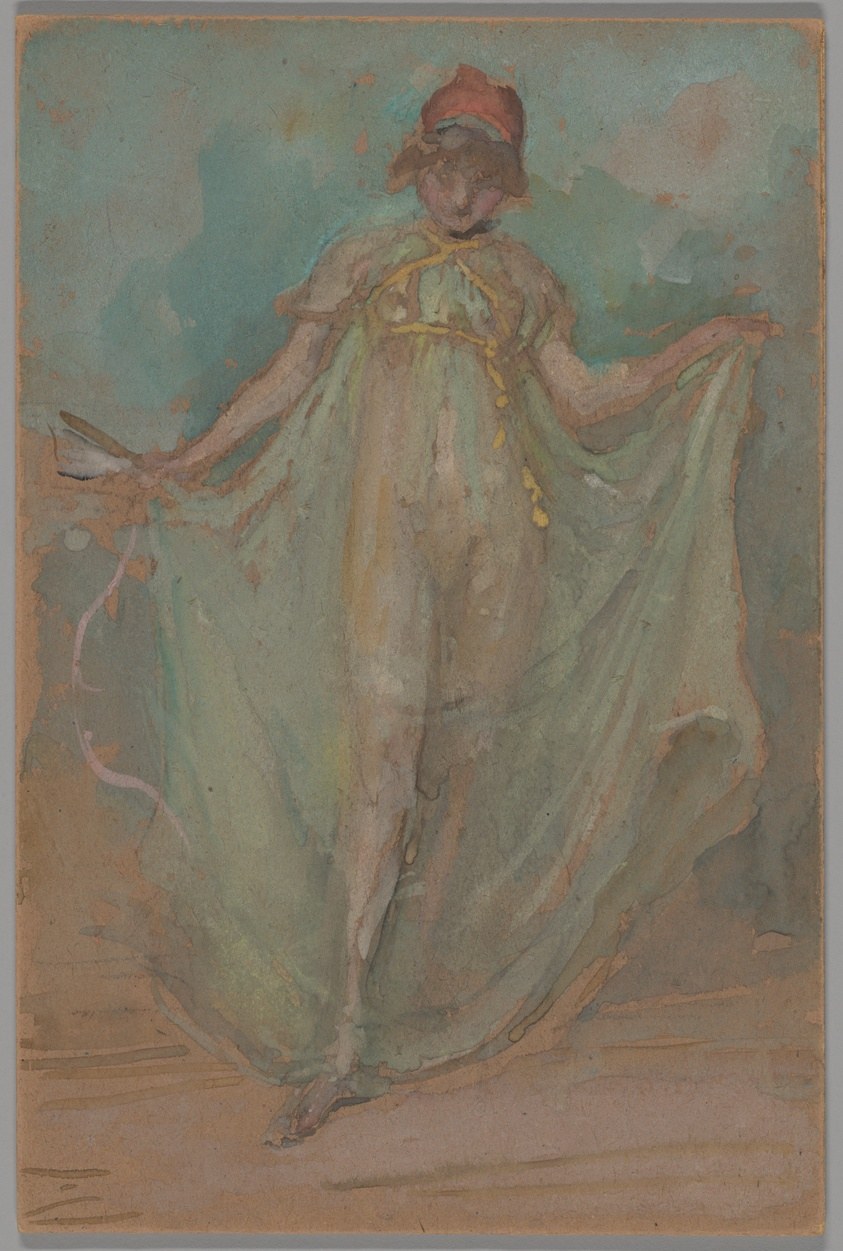
Green and Blue The Dancer
James McNeill Whistler
- Source:
- Art Institute of Chicago
- Rights:
- Public domain — free to use, share and adapt.
- Recorded as:
- CC0 (Public Domain)
This work is valuable evidence of how Romantic-era artists understood and idealized the ballet body in the nineteenth century. The figure's weightlessness and spiritual aspiration were not accidental but central to the period's aesthetic and technical innovations in dance—a visual record of how ballet dancers were supposed to appear and what they were meant to express. For dancers and historians, it illustrates the codification of a particular ideal body and movement quality that shaped ballet training and performance for generations.
What you are looking at
A single female figure dominates the composition, set against a soft blue-green ground that suggests an interior or neutral space. She wears a flowing, high-waisted garment in pale cream or buff, rendered with loose brushwork that captures the fabric's billowing movement. A deep red or rust-colored cap or headdress covers her head, and her bare arms are raised and extended outward in an expansive gesture. Her posture is upright and buoyant, with the weight of her body centered. The figure's gaze is directed upward and to one side, giving her an ethereal, almost abstracted quality. The drapery of her skirt is voluminous and animated, caught mid-movement or caught in a deliberately romantic, attenuated pose. The background remains atmospheric and undefined, rendered in soft greens and blues that recede gently, focusing all attention on the solitary dancer.
The dancing
A single dancer, portrayed in a lifted, upright stance with both arms extended outward and slightly forward, palms open in a gesturing or presenting attitude. The body shows no weight on the visible leg; the entire figure conveys weightlessness and elevation. The dancer's chin is tilted upward, the neck elongated, creating an impression of reverie or aspiration. The fabric of the dress moves independently of the body, suggesting either a captured moment of turn or a deliberately ethereal, floating presentation—the skirt fans outward in a manner that reads as both spontaneous and composed.
The dance depicted
This image most likely depicts a Romantic-era theatrical ballet figure, though the specific narrative context is unknown. The floating, uplifted posture, the pale classical dress, the upturned gaze, and the expansive arm gesture are all consistent with early-to-mid-nineteenth-century ballet vocabulary and the aesthetic ideals of the Romantic period—weightlessness, spirituality, and ethereal femininity. The pose could represent a moment of reverie or a supernatural or sylph-like character. The simplified, non-naturalistic rendering suggests this is not a literal documentation of a specific performance, but rather an idealized vision of the Romantic ballet body.
How it was made
The work appears to be executed in gouache or watercolor on paper, with a subtle, translucent application of color that creates soft modeling and atmospheric effect. The paper shows visible aging—discoloration and foxing consistent with nineteenth-century stock—and the paint has been applied in broad, loose washes, particularly in the background. The technique prioritizes the romantic, dreamy quality of the figure over anatomical precision; the artist has worked wetly into the fabric areas, allowing pigment to blend and diffuse. The framing border in brown or rust suggests this was a work on paper originally mounted or finished in this manner.
About this work
This is a study or finished artwork from the nineteenth century depicting a single dancer in the vocabulary and aesthetic of Romantic ballet. The figure embodies the period's central preoccupation with the ethereal, weightless female body elevated above the natural world—a visual expression of the Romantic movement's fascination with the supernatural, the transcendent, and the feminine ideal. The work captures not a literal performance moment but rather a crystallized vision of the Romantic ballet aesthetic: isolation, uplift, and a kind of transported reverie. It belongs in a gallery devoted to dance because it documents how artists of the period visualized and valued the dancing body, and because the pose, costume, and emotional tenor are historically specific to a particular moment in ballet's evolution.
How to look at it
Attend to the figure's verticality and the upward tilt of the head and gaze—these convey aspiration and transcendence rather than groundedness or naturalism. Notice how the skirt moves almost independently of the body, as if caught in a moment that defies gravity or realism; this is deliberate, part of the Romantic aesthetic. The raised, extended arms and open palms suggest presentation or offering rather than active movement or effort. The soft, atmospheric background and the isolation of the figure against it reinforce the sense of the dancer existing in a realm separate from the everyday world.
The period
This work dates to the nineteenth century, most likely the 1830s–1860s, when Romantic ballet dominated European theatrical dance. During this period, the ballerina became the central figure in ballet narrative and spectacle, elevated both literally (on pointe) and aesthetically as an embodiment of the unattainable ideal. Artists across media—painters, lithographers, and sculptors—documented and celebrated the ballerina, creating images for public consumption through prints and albums. The costume and pose here reflect the conventions of the Romantic ballet of this era: the classical tunic, the ethereal bearing, the focus on the solitary female figure. Contemporary works by artists such as Marie Taglioni (the premiere ballerina of the period and subject of countless portraits) would have established the visual vocabulary that artists drew upon.
Where it lives
The work is recorded as being held by the Art Institute of Chicago, as noted in the source field of the catalogue record. It appears to be a work on paper, likely watercolor or gouache, and may have been part of a collection of dance-related artworks or studies acquired by the museum in the nineteenth or early twentieth century.
Dance in this work
Questions about this work
Why is the dancer's body so weightless and floating?
This is a hallmark of Romantic-era artistic representation of ballet. The uplifted, ethereal body was central to the period's aesthetic ideals and to the actual technical evolution of ballet—dancers were trained to appear to defy gravity and to embody spiritual or supernatural qualities. The artist is not depicting naturalistic movement but rather an idealized vision of the ballet body.
What is the dancer wearing?
A pale, high-waisted classical tunic or dress typical of Romantic-era ballet costume, paired with a red or rust-colored cap or headdress. The garment is rendered in loose brushwork that emphasizes its fluidity and movement. This costume was standard for ballerinas of the period and appears in countless images of dancers from the 1830s onward.
Is this a portrait of a specific dancer or a generic study?
There is no identifying information in the catalogue record, so it is likely either a generic study of the Romantic ballet ideal or a representation of an unnamed dancer. It captures a type and an aesthetic moment rather than an individual's likeness.
What dance form is this?
This depicts theatrical ballet, specifically in the Romantic aesthetic that dominated the nineteenth century. The pose, costume, and artistic approach are consistent with how ballet dancers were represented during this period, though no specific narrative or role is identifiable from the image alone.
More dance artwork