28 works in this view — arrow keys or swipe to move between them.
Dance in Art · 1490
How to Read a Dance Manual | Articles and Essays | An American Ballroom Companion: Dance Instruction
Unknown artist
- Dance:
- Ballroom
- Era:
- Pre-1700 (Renaissance/Baroque)
- Source:
- Library of Congress
- Rights:
- Public domain — free to use, share and adapt.
- Recorded as:
- public_domain
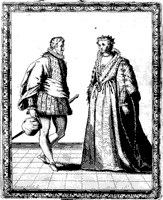
This is one of the earliest printed visual guides to ballroom dance, created when dance manuals were transforming from manuscript to printed form and becoming accessible beyond individual court circles. It shows the foundational postures and relationships of Renaissance courtly dance at the very moment those forms were being codified. For dancers and historians, it is direct evidence of how the body was supposed to look and move in noble dance at the threshold of the early modern period.
What you are looking at
Two figures stand in a framed rectangular space against a plain background, rendered in the linear style of a Renaissance engraving. On the left, a man in short doublet and hose with a feathered hat stands in profile or three-quarter view, one leg extended in what appears to be an active pose. On the right, a woman in a long gown with voluminous skirts and an ornate headdress or hair arrangement faces toward him. Both figures are rendered with the anatomical clarity typical of instructional or documentary engravings. The composition suggests a formal interaction or dance instruction moment rather than a dynamic action scene—the figures are presented as exemplars for study rather than caught mid-movement. The engraving's clean lines and careful hatching create a graphic rather than naturalistic effect.
The dancing
The man's posture suggests an active, extended leg position—possibly a lunge or galliard-style jump preparation—with his upper body upright and arms in a position that could indicate either balance or gesture toward his partner. The woman stands more reservedly, her long skirts falling vertically, her body upright and frontal. The spatial relationship between them is formal and measured; they are close enough to interact but not in contact. Neither figure displays the extreme elongation or idealized proportions of theatrical ballet; instead, they are rendered as plausible human bodies in courtly dress.
The dance depicted
This is almost certainly an illustration from a Renaissance dance manual or instruction book. The date of 1490 and the engraving technique place it at the very beginning of the printed dance-instruction tradition in Europe. The man's extended leg and the formal presentation of both figures against neutral space suggest this is a didactic image teaching the positions and deportment of courtly dance—most likely either the pavane, galliard, or almain, which dominated noble dance in this period. The woman's modest stance and the man's active posture may indicate a demonstration of the male dancer's role in leading or the moment of invitation. The image's purpose is to show the correct carriage and leg extension, not to capture spontaneous movement.
How it was made
This is a woodcut or engraving on paper, executed with fine parallel lines (hatching) to create tone and volume. The technique allows for sharp definition of contours and the clear depiction of fabric texture—note the careful rendering of the woman's skirt folds and the man's hose. The framing border and the formal presentation suggest this is a page from a printed book, not a standalone print. Woodcut or engraving technology in this period was the primary means of circulating visual instruction and knowledge across Europe; this image would have been seen by anyone with access to a printed dance manual, making it a form of mass communication about courtly practice.
About this work
This is a Renaissance dance instruction image, probably from a printed manual of the 1490s, showing two figures in the formal poses and dress of noble court dance. The man displays an active leg extension while the woman stands in upright, reserved posture. The image belongs in a gallery of dance art because it is one of the earliest surviving printed visual records of European ballroom dance, created at the moment when dance instruction began to be standardized and disseminated through print. It documents not just what people danced but how they were taught to stand, move, and present themselves in a formal social context.
How to look at it
Pay attention to the man's leg extension and the angle of his body—this is the moment of instruction, not the moment of motion. The artist has frozen a pose that a student would practice. Notice also the woman's stillness and her formal dress; she is presented as the partner and audience to the man's demonstration of technique. The framing and the neutral background direct your eye to the bodies themselves, removing any distraction. The linear engraving style creates clarity of form over atmosphere—you are meant to see exactly how the limbs are positioned and how the clothes should sit on the body.
The artist
Unknown. The engraving style and the subject matter suggest it was created by a professional engraver or woodcut artist working in service of a dance master or printer who was producing instruction materials. The formal clarity and precision of the line work indicates a skilled hand trained in the printmaking tradition of the late 15th century, but the image was made as an educational tool rather than as a signed work of art.
The period
In the 1490s, dance was undergoing a revolution in European courts. The older medieval carole and group dances were giving way to couple dances and more complex figures that required instruction and standardization. The printing press had recently arrived in Europe (Gutenberg's press dates to the 1440s), and dance masters were among the first to see the advantage of printed instruction—which could reach beyond single patrons and spread across courts and cities. Printed dance manuals of this era, such as those by Domenico and Guglielmo da Pesaro, were luxury objects and status symbols, but they established dance as a codified, teachable art. This image sits at the intersection of that transition: visual instruction, courtly culture, and the new technology of print.
Where it lives
The work comes from the Library of Congress collections and is identified as a page or print from a pre-1700 instructional context. It is catalogued within LODance as part of the collection of dance imagery spanning from the Renaissance through the Baroque periods. The specific holding institution and accession details are not provided in the available catalogue record.
Dance in this work
Questions about this work
Is this a real dance or a made-up pose?
This is almost certainly a real dance position, shown for instruction. The man's extended leg and upright carriage match descriptions and illustrations of galliard, pavane, and almain steps from the same period. The image was made to teach people how to stand and move, so it shows actual courtly dance practice, not invention.
Why are they not touching?
Renaissance couple dances involved a variety of positions—some with hand-hold, some without. This image may be showing the moment of invitation or approach, or it may be demonstrating individual carriage before teaching the contact position. The instruction manual it came from would have shown the next step as well.
How do we know when this was made?
The catalogue record dates it to 1490, placing it at the very beginning of the printed dance manual tradition. The engraving style, the dress, and the formal presentation are all consistent with Renaissance dance instruction from this era.
Could a modern dancer learn to dance from this?
Not fully—the image shows posture and some leg positions, but it lacks the fluidity, timing, and sequence that music and full-body movement provide. It would need to be paired with a written text explaining steps, timing, and the role of music, as the original manual would have done.
More Ballroom artwork