49 works in this view — arrow keys or swipe to move between them.
Dance in Art
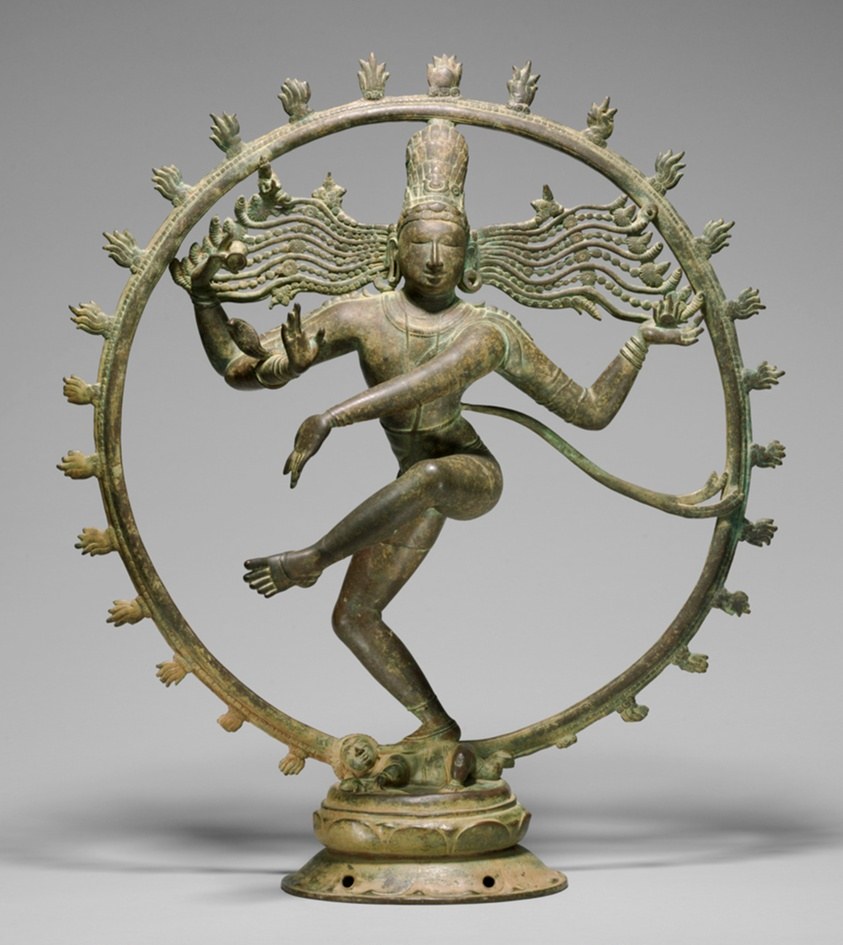
Shiva as Lord of the Dance Nataraja
Unknown artist
- Source:
- Art Institute of Chicago
- Rights:
- Public domain — free to use, share and adapt.
- Recorded as:
- CC0 (Public Domain)
Nataraja is the image that has most shaped global visual understanding of what dance is and what the dancing body can mean. This single iconographic form has been reproduced in millions of copies, from temple sanctums to airport gift shops, and has become a symbol of Indian dance and Hindu philosophy worldwide—often stripped of its religious context and repurposed as a secular emblem of dance itself. For historians and dancers, recognising the theological architecture behind the pose reveals how deeply visual representation and religious meaning can be intertwined, and how easily that meaning can be lost in circulation.
What you are looking at
A bronze sculpture depicts a four-armed figure in dynamic motion within a circular frame. The dancer stands on one leg with the other raised, the body twisted in a spiral pose that conveys both stillness and movement. The raised arms gesture in different directions—one hand raised, another lowered—while the lower pair of hands frame the body. A tall cylindrical crown rises from the head. The circular frame itself is composed of a ring of flame-like projections or petals radiating outward, each tipped with a stylized lotus bud or flame form. The base is a lotus platform from which the figure emerges. The entire composition is cast in dark bronze with areas of verdigris patination, the surface smooth and finely detailed.
The dancing
The single figure is poised on the ball of one foot with the opposite leg raised and bent, the torso arched in a spiral twist that demonstrates extreme flexibility and control. All four arms are positioned at different angles—two raised, two lowered—in a symmetrical yet dynamic arrangement that frames the body rather than reaching outward. The weight is concentrated on the supporting leg; the raised leg and sweeping arms create a sense of rotation and flight. The posture requires strength, balance, and a sophisticated understanding of how the body can articulate multiple lines simultaneously.
The dance depicted
This is Nataraja, the Hindu deity represented in his role as Lord of the Dance—a sacred iconographic form rather than a secular dance technique. The pose depicts Shiva's cosmic dance (tandava), which in Hindu cosmology represents the destruction and regeneration of the universe. This is not a performance dance but a metaphysical concept visualised through the body: the raised leg symbolises transcendence, the supporting leg grounds the dance in earthly existence, and the multiple arms represent divine omnipotence. The circular frame of flames (prabhamandala) signifies the cosmic fire in which this dance occurs. This imagery emerges from the Chola dynasty's sculptural tradition (10th–12th centuries) and became the dominant visual representation of Shiva in Tamil Nadu and beyond.
How it was made
This is a lost-wax bronze casting, a technique that allows for fine detail and the creation of sculpture in the round with projecting elements like the radiating lotus petals. The verdigris patination suggests age and outdoor or damp exposure, though we cannot determine whether this is the original surface or the result of later preservation. The technique permits the sculptor to render the complex geometry of the overlapping arms, the spiral of the torso, and the intricate flame forms of the prabhamandala with precision. Bronze casting of this type has been used for South Indian sacred sculpture for over a thousand years.
About this work
This is a Nataraja bronze, one of the most recognisable and enduring images of divinity in Hindu art. It represents not a dancer but a theological concept—the cosmic dance through which the god Shiva sustains the universe. The work belongs to the Chola sculptural tradition, which developed a formal iconography for this subject that has remained virtually unchanged for nearly a millennium. The pose itself is not derived from any actual performance dance; rather, it is a symbolic language encoded in the body's position and the multiple arms' gestures. To see it in a gallery of dance in art is to acknowledge that this image has become so visually associated with dance itself—with movement, rhythm, and the body's expressive capacity—that its theological origins sometimes recede. Yet the work deserves to be understood as much in terms of Hindu cosmology and devotional practice as in terms of aesthetic movement.
How to look at it
Approach this sculpture by first recognising the bilateral symmetry of the arms and the spiral twist of the torso, which creates a sense of rotation even in stillness. Notice how the supporting leg grounds the figure while the raised leg and extended arms reach outward, creating a dynamic tension between stability and flight. Observe the prabhamandala—the ring of flame forms—which is not a decorative border but a representation of the cosmic fire that contains the dance. The pose is designed to be read from multiple angles; walking around the sculpture will reveal how the twisted torso and raised arms create different silhouettes and compositions as the viewer's position changes. Finally, attend to the crown (makara-kirita) and the antelope-skin symbolism in the lowest arms, which mark this figure as divine rather than human.
The artist
The catalogue record lists no artist. This work is from the Chola dynasty's sculptural tradition (c. 10th–12th century), though the specific sculptor is unknown. Chola bronzes were cast by workshop communities using inherited techniques and iconographic conventions; the 'artist' in the modern sense did not exist. The tradition was sustained through apprenticeship and collective practice rather than individual authorship. What survives is the technique and the theological vision it embodied.
The period
The Nataraja form emerged during the Chola dynasty's reign in Tamil Nadu, a period of unprecedented patronage of Hindu temples and devotional sculpture. The 10th–12th centuries saw the development of a visual theology in bronze, with each gesture and attribute carrying precise theological meaning. At the same time, in the Islamic world and in Europe, different traditions of representing the human body and sacred narratives were crystallising. The Nataraja form represents a non-Western approach to depicting divinity through the expressive capacities of the dancing body—one in which the dance is not a separate activity but a metaphor for cosmic order itself.
Where it lives
The work is held by the Art Institute of Chicago. The catalogue record provides no date, artist, or accession details beyond the title and holding institution.
Dance in this work
Questions about this work
Is Nataraja a real dance that people perform?
Nataraja is not a dance style itself, but a theological and iconographic image. However, the pose has profoundly influenced how Indian classical dancers—particularly those trained in Bharatanatyam—understand and represent the dancing body. Modern dancers sometimes restage or reference the Nataraja pose, but they are engaging with an image and its symbolism rather than reconstructing an ancient dance practice. The original context was devotional sculpture and temple worship, not theatrical performance.
Why does the figure have four arms?
In Hindu iconography, multiple arms represent divine attributes and powers beyond human limitation. Shiva's four arms each carry symbolic meaning: one raises in blessing or liberation, another holds a drum (creation), another holds fire (destruction), and the fourth gestures reassurance. This is a visual language for expressing concepts—omnipotence, the simultaneous creation and destruction of the universe—that cannot be conveyed by a human body alone.
What is the ring of flames around the figure?
The prabhamandala (cosmic flame halo) represents the ring of fire that contains Shiva's dance, symbolising both the energy of creation and the cosmic cycles of time. In Hindu cosmology, this fire is not destructive in a negative sense but transformative—the necessary force through which the old order dissolves and renewal becomes possible. It situates the dance within a cosmic rather than an earthly or theatrical frame.
How old is this sculpture?
The catalogue record does not provide a date. Nataraja bronzes in this style were produced by the Chola dynasty (10th–12th centuries) and have continued to be cast in the same tradition for nearly a thousand years. Without examination or iconographic analysis, it is impossible to determine when this particular casting was made. The style and technique suggest South Indian manufacture, but the date remains unknown.
More dance artwork