49 works in this view — arrow keys or swipe to move between them.
Dance in Art
Spanish Dance
Hilaire Germain Edgar Degas
- Source:
- Art Institute of Chicago
- Rights:
- Public domain — free to use, share and adapt.
- Recorded as:
- CC0 (Public Domain)
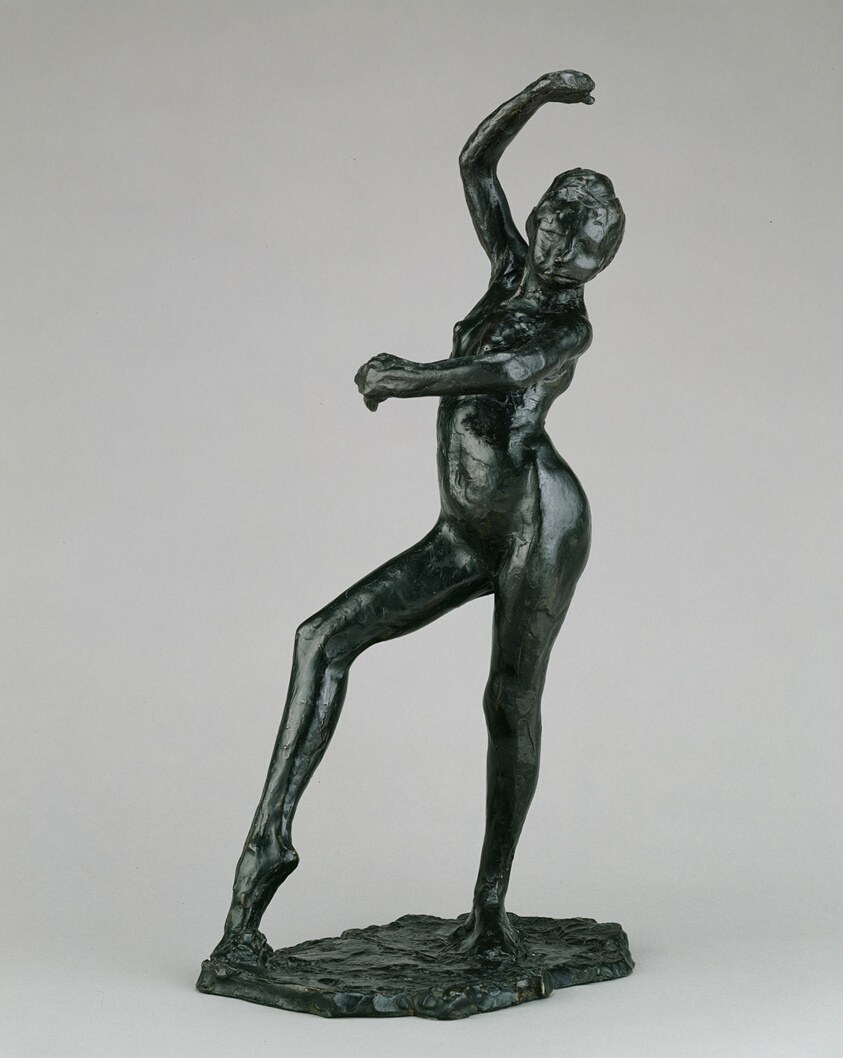
The sculpture reveals how European artists understood and represented 'Spanish' dance in the concert and fine-art contexts of the period—not through ethnographic documentation but through the filter of theatrical convention and neoclassical aesthetics. For historians of dance imagery, it shows the boundary between authentic dance forms and their theatrical or artistic appropriation in early-modern European culture.
What you are looking at
A bronze sculpture of a female figure in a dynamic, twisting pose against a neutral background. The figure stands on a rough, textured base and is captured mid-movement, her body arched and elongated in a spiral. Her left leg is extended and lifted, supporting the composition's upward momentum, while her right leg bends beneath her. Her left arm extends overhead in a graceful arc, and her right arm reaches across her torso. The figure's head is tilted back, her face composed and serene despite the athleticism of the pose. The sculpture exhibits the smooth, polished finish characteristic of bronze casting, with areas of darker patina giving depth to the musculature and contours of the body. The work captures a moment of suspension—neither fully grounded nor entirely in flight—suggesting the technical demands of dance performance.
The dancing
A single female dancer rendered in contrapposto-inflected movement, her weight shifted onto her extended left leg while her torso twists and arches. The raised right knee and overhead left arm create a spiraling line through the body. The pose demonstrates understanding of bodily articulation and balance; the artist has captured the muscular tension required to sustain such an extended, lifted position. The figure's serene facial expression and elongated proportions suggest this is a study in grace and control rather than explosive movement.
The dance depicted
The pose is consistent with classical or contemporary theatrical dance, particularly the kind of balletic arabesque or attitude variations that emphasize vertical lift and elongation. The dynamic spiral of the body, the extended arm, and the suspended quality of the movement suggest late-nineteenth or early-twentieth-century theatrical dance rather than folk or social forms. While the catalogue identifies this as 'Spanish Dance,' the formal vocabulary—the neoclassical proportions, the balletic line, the sculptural emphasis on individual virtuosity—suggests a European theatrical idiom rather than authentic Spanish or flamenco dance vocabulary. The pose may represent a Spanish-themed or Spanish-inspired theatrical number of the kind popular in European concert dance of that era.
How it was made
This is a bronze cast sculpture, recognizable from its patinated surface and the fluid modeling visible in the figure's musculature and drapery. The technique of bronze casting allows for the subtle articulation of form visible here: the tensed stomach, the defined shoulders, the elongated line of the extended leg. The work shows evidence of careful chasing and finishing after casting. As a small-scale bronze (likely a maquette or independent sculptural study), it would have been intended for exhibition and display among collectors and institutions interested in figurative sculpture—it is the kind of work found in museum decorative arts or sculpture collections rather than public monuments.
About this work
This is a bronze sculpture of a female dancer in a highly formalized, theatrical pose that combines balletic vocabulary with an upward spiral of movement. The catalogue identifies it as 'Spanish Dance,' but the execution—neoclassical in proportion, balletic in line—suggests a European theatrical conception of 'Spanish' movement rather than documentation of authentic regional dance. The work belongs to a tradition of late-nineteenth and early-twentieth-century sculptural celebration of the female dancer as a figure of grace, control, and aesthetic refinement. It exemplifies how European art represented dance in this period: as an elegant, codified physical accomplishment rather than as a social or cultural practice.
How to look at it
Attend to the moment of suspension the artist has chosen: the dancer is neither at rest nor in forward locomotion, but caught in a moment of torsion and lift that emphasizes the vertical axis of the body. Note how the head is tilted back, the chest open, the gaze directed upward—compositional choices that frame dance as aspiration and grace rather than technical skill or emotional expression. The spiral of the body creates visual interest from every angle, suggesting this sculpture was conceived to be walked around and examined from multiple viewpoints, a key principle of three-dimensional sculpture.
The period
This work dates stylistically to the late nineteenth or early twentieth century, a period when Spanish themes enjoyed considerable popularity in European high culture and theater. The 'Spanish craze' in Paris and other European capitals drew on both theatrical performances and fantasies of exoticism. Simultaneously, the sculptural celebration of the female dancer—often in classical or neoclassical form—became a major genre in European sculpture, connected to the rise of modern ballet and concert dance. Works of this kind were displayed in salon exhibitions, collected by wealthy patrons, and reproduced in multiple bronze casts for distribution to museums and private collections.
Where it lives
The work is held by the Art Institute of Chicago and comes to us through their collection documentation. The sparse catalogue record—artist unknown, date unknown, medium and provenance not recorded—is typical of decorative arts cataloguing from earlier eras, when small bronzes were often acquired without full attribution.
Dance in this work
Questions about this work
Is this actually Spanish dance?
The catalogue identifies it as such, but the formal language is balletic and neoclassical rather than consistent with documented Spanish regional dance forms like flamenco. It more likely represents a European theater piece with Spanish-themed styling—a common practice in early-modern concert dance.
Why is the dancer's head tilted back?
This is a compositional choice that emphasizes grace, aspiration, and the upward lift of the body. It was a common convention in dance sculpture of this period, suggesting spiritual elevation or transcendence rather than the grounded, weight-aware postures of modern or authentic folk dance.
Who would have owned a sculpture like this?
Small bronze sculptures were sold through galleries and salons to wealthy collectors, institutions, and museums. Editions could be cast from the same mold, making them accessible to a broader audience than unique marble sculptures, though still expensive by working-class standards.
More dance artwork