49 works in this view — arrow keys or swipe to move between them.
Dance in Art
The Dance
Pietro Longhi
- Source:
- Art Institute of Chicago
- Rights:
- Public domain — free to use, share and adapt.
- Recorded as:
- CC0 (Public Domain)
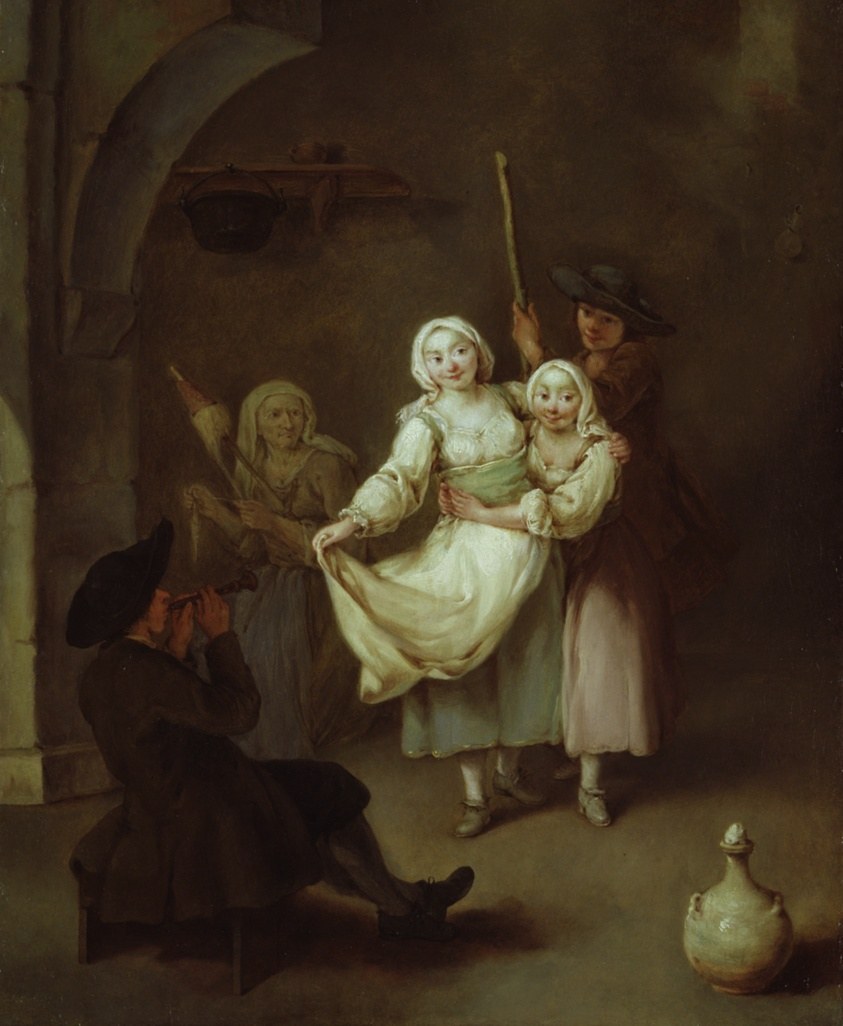
The image is an important visual document of how balletic form was understood and represented in the late 18th or early 19th century. It captures the balletic body not in grand spectacular action but in the controlled, extended posture that defined trained dancing, and it shows that posture in a context that suggests domestic accomplishment and performative display—crucial to understanding how ballet existed outside the theater during this period.
What you are looking at
A woman in a white chemise and green sash dances alone in a shadowed interior, her body caught mid-movement in a graceful arabesque or similar balletic pose. She wears a white bonnet tied under her chin and pale stockings. Two young girls in similar white bonnets and simple dresses stand beside and behind her, watching or participating. At the left, a seated figure in dark clothing—possibly a nurse or elderly attendant—observes from a chair. In the background, a man in a tricorn hat and dark coat leans against the shadowed wall, also watching. A large ceramic vessel sits on the floor in the foreground. The setting is plainly furnished, with arched stone architecture suggesting a basement, cellar, or institutional interior lit by a single strong light source that casts sharp shadows across the composition.
The dancing
The central dancer's posture suggests trained movement: her body is elongated and lifted, her arms held with deliberate grace, her leg extended in a controlled line. Her weight appears centered rather than grounded, and her frame shows the kind of extension and verticality that implies balletic training. The two girls beside her—one with a hand on her shoulder—are posed as attendants or younger dancers. The watching figures create a narrative frame: this is not a moment of spontaneous play but a composed scene, possibly a demonstration or performance for the seated observer and the man in the hat.
The dance depicted
This appears to be a theatrical or domestic balletic scene, most likely from the late 18th or early 19th century. The woman's posture, the formality of her dress, and the presence of observers suggest either a private dance lesson or a theatrical rehearsal. The pose itself—body lifted, leg extended, arms held in a structured frame—is consistent with early Romantic ballet, though the setting and supporting cast point toward either a genre scene of dancing instruction or a theatrical moment depicting a dance performance. The image captures balletic form without showing the dynamic action of a full choreographed movement, instead freezing a single held position.
How it was made
This is a painted work, executed in oil on canvas based on the handling of light, shadow, and the soft modeling of fabric. The artist employs a limited palette dominated by whites, greens, browns, and deep shadow, with careful attention to the fall and texture of textiles. The technique is naturalistic rather than grand; the brushwork is precise but not showy, suggesting a work made for a specific patron or institution rather than for public exhibition. The chiaroscuro lighting—a strong source from one side leaving much of the interior in shadow—is characteristic of 18th-century European painting and suggests either Flemish or Spanish influence.
About this work
This is a domestic or theatrical scene of balletic instruction or performance from the era of Romantic ballet. The precise dating and artist are unknown, but the image documents an important moment in dance history: the moment when ballet—once the exclusive province of courts and professional theaters—began to appear in literary and visual culture as a subject worthy of serious artistic representation. The woman's trained posture, the formal composition, and the presence of witnesses all point to a scene where dance was understood as a refined accomplishment and a form of social performance. The work sits at the intersection of genre painting and dance documentation, recording both the aesthetic ideal of early Romantic ballet and the social contexts in which it was practiced and consumed.
How to look at it
Attend first to the dancer's body: her lifted spine, extended leg, and held arms show a trained clarity of line that distinguishes her from untrained movement. The artist has chosen a single held position rather than a moment of dynamic action, emphasizing the sculptural quality of the balletic form. Notice how the composition centers on her as the object of attention—the children nearby, the seated observer, the man at the wall all create a visual frame around her body, turning her into a spectacle to be watched and evaluated. The single light source is theatrical, as if from a stage lamp or candle, intensifying the sense that this is a moment of performance, not casual movement.
The period
This work was created during or shortly before the Romantic era in ballet, when the form was beginning to shift from court spectacle to theatrical narrative drama. The late 18th century saw the codification of balletic vocabulary and the emergence of ballet as a subject of artistic and literary interest among the educated classes. Domestic dancing—accomplished young women performing for family and guests—was a sign of refinement and education, and such scenes became popular in European painting. Simultaneously, the professional theater was witnessing the rise of the ballerina as a figure of cultural importance, with dancers like Marie Taglioni establishing new standards of technique and beauty. This painting documents the moment when balletic movement began to filter into bourgeois domestic life as an accomplishment and a performance.
Where it lives
The work is recorded in the Art Institute of Chicago collection. It is catalogued as "The Dance" with artist unknown and uncertain date.
Dance in this work
Questions about this work
Is this a real scene or an invented one?
It is almost certainly an invented or idealized scene—a genre painting that depicts a type of social encounter (a young woman dancing for witnesses) rather than a specific historical event. The careful composition, theatrical lighting, and posed figures all indicate artistic construction rather than documentary observation.
What kind of dance is she doing?
The posture and line suggest balletic training, and the early Romantic era date implies she is demonstrating or performing in a balletic style. The single held position makes it impossible to identify a specific step or phrase, but her body shows the characteristic extension and lift of ballet as it was practiced and valued in that period.
Why are there children and observers in the painting?
The presence of witnesses frames dancing as a social and performative act, not a solitary or purely athletic one. This reflects the reality of 18th- and 19th-century domestic dancing, where accomplished young women danced for their families and guests, and where the approval of observers—older women, male admirers—was part of the social meaning of the performance.
What is the setting?
The arched stone walls and shadowed interior suggest a basement, cellar, or institutional room—not a ballroom or theater stage. This ambiguity is characteristic of Romantic-era genre painting, which often represented refined activities in humble or unexpected settings to create a sense of timeless, universal human accomplishment.
More dance artwork