49 works in this view — arrow keys or swipe to move between them.
Dance in Art
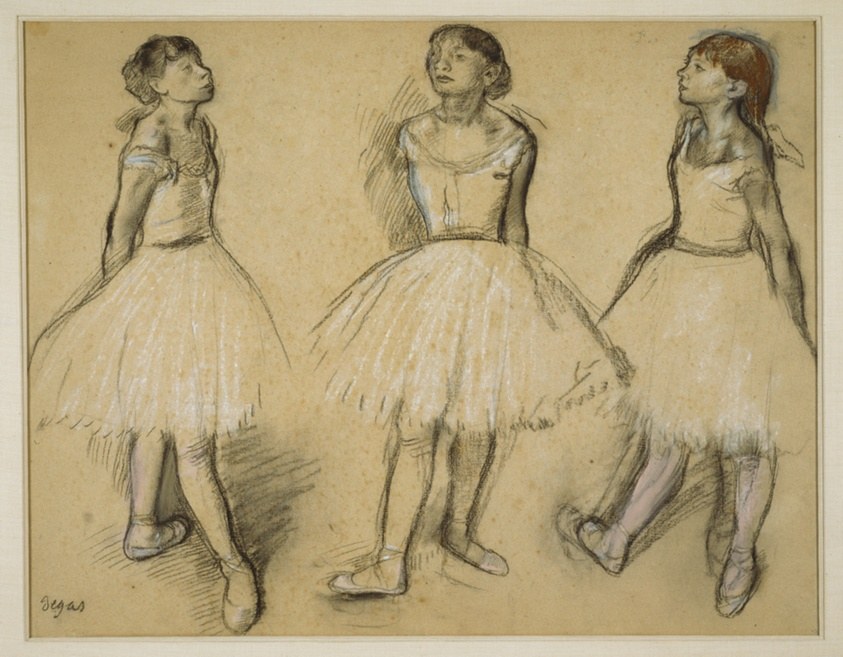
Three Studies of a Dancer in Fourth Position
Hilaire Germain Edgar Degas
- Source:
- Art Institute of Chicago
- Rights:
- Public domain — free to use, share and adapt.
- Recorded as:
- CC0 (Public Domain)
This sheet demonstrates that Romantic ballet, for all its appearance of spontaneity and otherworldly grace, was built on exacting technical standards—and that these standards were recorded and transmitted through drawing. The image shows us how a ballet master or choreographer would document a correct position, allowing dancers and students to study and replicate it. Few such study sheets survive, making this a rare window into the pedagogical practice of nineteenth-century ballet.
What you are looking at
Three young female dancers are presented in three separate studies on a single sheet, arranged left to right. Each figure wears a short tulle skirt in the Romantic style and a fitted bodice, with hair pinned up in the fashion of the mid-nineteenth century. The dancers are drawn in profile or three-quarter view, their bodies upright and elongated. All three figures gaze upward with lifted chins and serene expressions. The artist has rendered the tulle skirts with delicate parallel hatching lines that suggest the fabric's transparency and volume; the bodies are defined with charcoal or ink line work over a toned ground. The paper is cream-colored, aged to a warm tan. The drawing style is economical and assured—no background, no setting, no narrative context. This is a study sheet, the kind a ballet master or choreographer would create to document positions, postures, or a sequence of movement.
The dancing
Each dancer stands with weight concentrated and the body lifted through the spine. The legs are straight and closely aligned, characteristic of turned-out ballet positions. The arms hang at the sides or are held with gentle extension. The head position—lifted and tilted back slightly—suggests either an arabesque penché or an épaulement (the balletic carriage of the upper body and arms). The lifted gaze and the arched line from hip through the crown of the head convey the ethereal, weightless quality that defined Romantic ballet technique. All three figures share the same pose with only minor variations in arm and head position, suggesting a single movement captured from slightly different angles.
The dance depicted
This is documentation of classical ballet in the Romantic era, almost certainly depicting students or dancers in the fourth position or a related turnout pose. The title specifies fourth position, one of the five fundamental positions of the feet in ballet technique. The ethereal quality of the pose—the lifted body, the upward gaze, the delicate tulle—places this squarely in the aesthetic world of Romantic ballet (circa 1830–1860), the era of *La Sylphide* and *Giselle*, when ballerinas were trained to appear weightless and otherworldly. The sketch likely served a pedagogical purpose: documenting correct posture and alignment for ballet pupils, or preserving the line of a particular movement for a choreographer's records.
How it was made
This is a drawing on paper executed in charcoal or graphite pencil with ink accents, heightened with light wash or gouache on the tulle skirts. The artist worked on a prepared or aged paper ground to create a subtle mid-tone that makes the line work and the highlights on the fabric read clearly. The technique is direct and economical—no preliminary underdrawing is visible, and the line is confident and assured. The method allowed rapid, repeatable documentation of body positions and could be easily copied or shared among dancers and ballet masters, making it a practical tool of the ballet world rather than a finished artwork for public exhibition.
About this work
This is a working study sheet documenting the correct posture and alignment of a fundamental ballet position during the Romantic era. The three figures are variations on a single pose—the fourth position—rendered with the ethereal line and lifted carriage that defined the aesthetic ideals of mid-nineteenth-century classical ballet. The drawing is neither a portrait nor a narrative scene, but rather a pedagogical document: a record of how a student's body should be arranged, and how the line of the torso, the tilt of the head, and the fall of the tulle skirt combined to create the impression of weightlessness and grace. The work belongs in a dance collection because it reveals not the performance itself but the training and documentation practices behind it—the way ballet technique was taught, corrected, and preserved before photography.
How to look at it
Look at the upward tilt of the head and the lifted line of the body in all three figures. This is not a natural stance; it is a cultivated posture that creates the visual effect of weightlessness and aspiration. The artist has captured the moment when the dancer is fully 'placed'—when all the turnout, alignment, and carriage are correct—rather than showing movement or transition. Notice how the tulle skirt, rendered with careful hatching, frames the lifted body and emphasizes the line from the hip through the crown of the head. The slight variations between the three figures are telling: they show the dancer or student in the same position from different viewpoints, as if the ballet master were circling the student to check the alignment from all sides.
The period
The Romantic era in ballet (1830–1860s) coincided with a shift in artistic values across Europe: a move away from the virtuosity and spectacle of the Neoclassical ballet toward an emphasis on ethereal beauty, delicate emotion, and the supernatural. Dancers began dancing on the tips of their toes (en pointe) to heighten the illusion of weightlessness. The tulle skirt—the hallmark costume of this era—became shorter and stiffer, allowing audiences to see the dancer's legs and feet clearly while maintaining an otherworldly silhouette. In the visual arts, the study sheet or *académie* was a standard pedagogical tool: artists and teachers would produce drawn studies to document correct form and allow for reproducible instruction. In ballet, such sheets served a similar function, documenting positions, lines, and alignments that had to be memorized and replicated by students.
Where it lives
The work is held by the Art Institute of Chicago and is catalogued as coming from their collection. No artist attribution is recorded in the catalogue, and the date and medium are not documented, indicating that the work may have entered the collection without full provenance or identifying information.
Dance in this work
Questions about this work
What is 'fourth position' in ballet?
Fourth position is one of five fundamental positions of the feet in classical ballet. In fourth position, one foot is placed directly in front of the other, turned outward, with a space of about one foot length between the heel of the front foot and the toe of the back foot. Both feet are turned out from the hip (rotated outward). It is a position of balance and poise, neither as stable as first or second position nor as challenging as fifth position.
Why would a ballet master create a study sheet like this?
Ballet technique must be taught and corrected through repetition and precise alignment. A study sheet allowed a ballet master to document the correct line for a particular position or movement, so that dancers could refer to it in the studio, students could study it between lessons, and the line could be preserved for future choreographic work. It also served as a tool for correction—the master could compare a student's posture to the documented ideal.
What does the upward gaze suggest?
The lifted head and upward gaze were essential to the aesthetic of Romantic ballet. They created the visual impression of ethereality and transcendence—as if the dancer were weightless or in communion with something beyond the material world. This was not merely a pretty gesture; it was a fundamental aspect of the technique and the storytelling of Romantic ballet.
Is this a finished artwork or a working document?
This is a working document—a study sheet intended for practical use in the ballet studio. However, the precision and care of the drawing, and its careful preservation, suggest it held real value to the ballet world. The distinction between 'finished art' and 'working document' is less clear in the history of dance than in painting; study sheets like this are both practical tools and historical records of how dancers moved and how technique was taught.
More dance artwork