49 works in this view — arrow keys or swipe to move between them.
Dance in Art
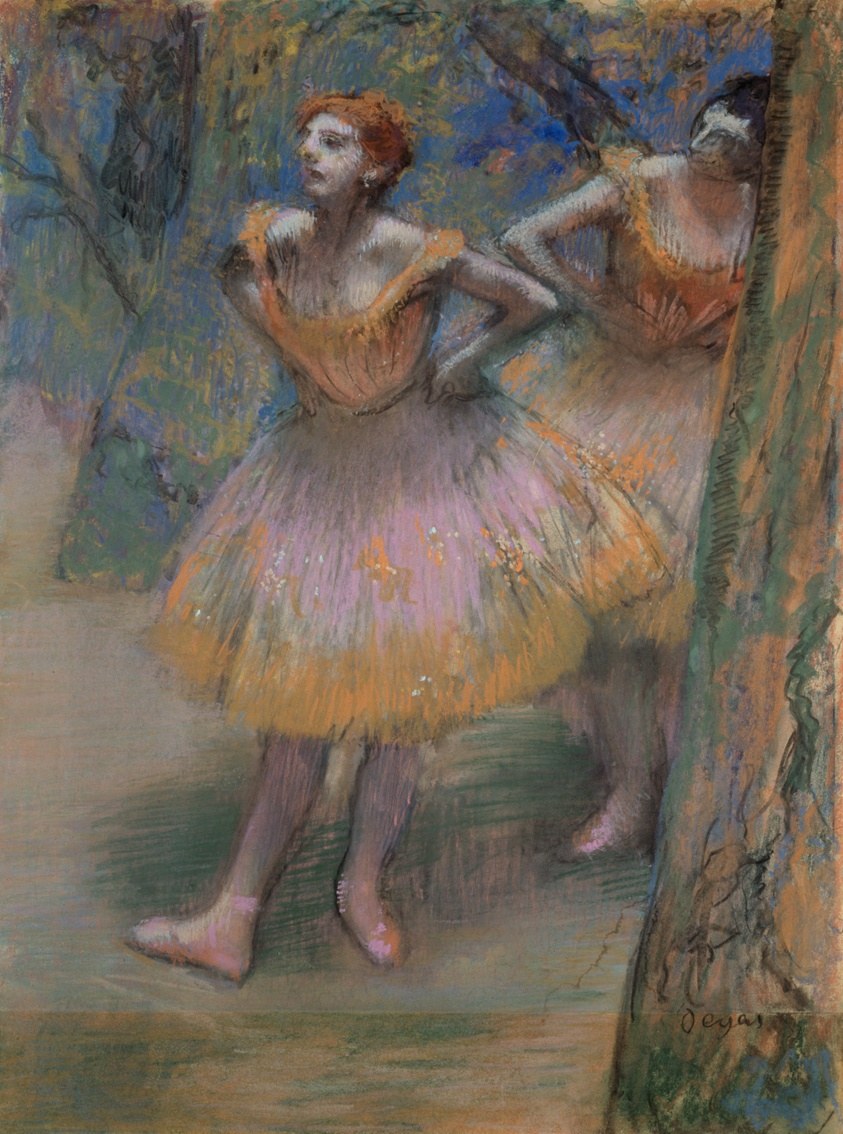
Two Dancers
Hilaire Germain Edgar Degas
- Source:
- Art Institute of Chicago
- Rights:
- Public domain — free to use, share and adapt.
- Recorded as:
- CC0 (Public Domain)
This work documents the aesthetic and compositional interests of late 19th-century artistic practice: the fascination with ballet dancers as subjects for study, the preference for candid informal moments over theatrical spectacle, and the use of pastel technique to capture movement and atmosphere. For dancers and historians, it offers evidence of how artists of the period understood and translated the body in motion, and of the social and artistic contexts in which ballet training and rehearsal took place.
What you are looking at
Two dancers are captured mid-movement in an interior space defined by architectural elements—a doorway or alcove with earth-toned walls creates the setting. The dancer on the left, with reddish hair, faces toward the viewer's left in profile, her body twisted in a dynamic pose. The dancer on the right, partially visible, is turned away. Both wear pale, gossamer tutus in lavender and cream tones with warm ochre accents, their legs bare and delicate. The skirts are rendered with vigorous, directional strokes that suggest rapid motion and the weight of fabric in movement. The background is worked in blues, greens, and browns with loose, expressive brushwork that creates atmospheric depth. The composition captures a fleeting moment—perhaps a backstage pause or a transition between movements—rather than a formal pose.
The dancing
The left dancer's weight appears centered over her legs, her torso twisted sharply, arms raised with elbows bent and hands positioned near her shoulders in a gesture of exertion or self-regard. Her body shows the classical line of ballet training—elongated neck, turned-out legs—but the pose is informal and unresolved, caught between movements. The right dancer is less distinct, shown from behind with a similar raised-arm position. Both dancers are barefoot or in soft slippers, consistent with ballet practice. The poses suggest weariness, anticipation, or the candid moment of rehearsal rather than performance.
The dance depicted
This almost certainly depicts ballet dancers, identifiable by the tutus, bare legs, turned-out positions, and the delicate, ethereal quality of their dress and posture. The style and subjects align with late 19th-century French academic ballet, the era when short skirts and pointe work became standard. The informal quality—the private, backstage mood—suggests this is rehearsal or a candid moment rather than staged performance. The work may reference the Romantic ballet tradition or the emerging Impressionist interest in dancers' unglamorous, quotidian reality, though the exact ballet or narrative context cannot be determined from the image alone.
How it was made
This is a pastel work, identifiable from the soft, blended surfaces and the visible texture of chalk on paper or board. The artist has used hatching, layering, and directional strokes to create form and movement, particularly in the tutus where vigorous parallel marks suggest the action of the skirts. Pastel allowed for rapid execution and rich color blending while maintaining visible brushwork—ideal for capturing momentary poses. The technique suggests an intimate, sketch-like approach rather than monumental finish, consistent with late 19th-century practice studies of dancers.
About this work
This is a pastel study of two ballet dancers in an interior setting, likely French academic ballet of the 1880s–1890s based on the costume and compositional approach. The work captures not the spectacle of the stage but the private, quotidian reality of dancers at rest or in rehearsal—a subject that fascinated Impressionist and Post-Impressionist artists of the period. The loose technique and candid framing mark it as a working study rather than a finished exhibition piece, yet it conveys more about how dancers actually moved and inhabited space than many more formal portraits.
The painting belongs to the tradition of ballet as a subject for avant-garde visual art, a tradition that includes Degas, Toulouse-Lautrec, and others who found in dancers' bodies and the ballet studio a laboratory for studying movement, light, and the human form under strain. The work values the unglamorous truth of labor over the fantasy of the stage.
How to look at it
Attend to the caught moment: neither dancer is performing for an audience, and neither is in a resolved classical position. The artist has chosen the pause, the shift in weight, the moment of self-awareness or fatigue. Notice how the tutus dominate the composition through color and vigorous handling, emphasizing the weight and texture of fabric rather than its ethereal lightness in performance. The architectural framing—the doorway or alcove—suggests a backstage or rehearsal room, a space of labor rather than spectacle. The soft pastel technique allows the viewer to see the artist's hand and process, inviting intimate rather than distant viewing.
The artist
The artist is not recorded in the available catalogue information. The signature visible at lower right remains to be identified. The style—loose pastel technique, Impressionist-influenced color and composition, subject matter focused on dancers in private moments—places the work within late 19th-century French artistic circles engaged with ballet as a modern subject.
The period
The late 19th century saw ballet established as a major subject for avant-garde visual art, particularly in France. Artists including Edgar Degas pioneered the depiction of dancers in rehearsal, backstage, and off-stage moments, treating the ballet studio as a space of aesthetic research. This coincided with the professionalization and codification of ballet technique under the Romantic and Classical traditions. The choice of pastel—a medium favored by Impressionists and Post-Impressionists—reflects broader artistic movements toward spontaneity, visible technique, and the capture of fleeting impressions of modern urban life.
Where it lives
The work is held in the Art Institute of Chicago collection. Its acquisition history and accession number are not provided in the available record. The signature at lower right indicates a trained academic artist working within institutional or gallery contexts of the late 19th century.
Dance in this work
Questions about this work
Are these dancers performing or rehearsing?
The informal composition, the private interior setting, and the unresolved poses suggest rehearsal or a candid backstage moment rather than staged performance. The artist has chosen to depict dancers in their working reality—tired, pausing between movements, adjusting their dress—rather than in the fantasy of the stage.
Why are there no pointe shoes?
The dancers appear to be barefoot or in soft ballet slippers, which was normal for rehearsal and studio work. Pointe shoes were reserved for performance and formal training sessions. The choice to depict bare feet emphasizes the intimacy and candor of the moment.
What period is this from?
The style of tutus, the academic ballet training evident in the dancers' posture, the pastel technique, and the artistic approach to subject matter all point to the 1880s–1890s, a period when artists across Europe became fascinated with ballet dancers and the ballet studio as subjects for modern art.
Is this a finished work or a study?
The loose handling, the sketch-like quality, and the informal composition suggest this is a working study or sketch rather than a finished exhibition piece. Yet it contains complete artistic vision and would have circulated among artists and collectors as evidence of modern practice.
More dance artwork