49 works in this view — arrow keys or swipe to move between them.
Dance in Art
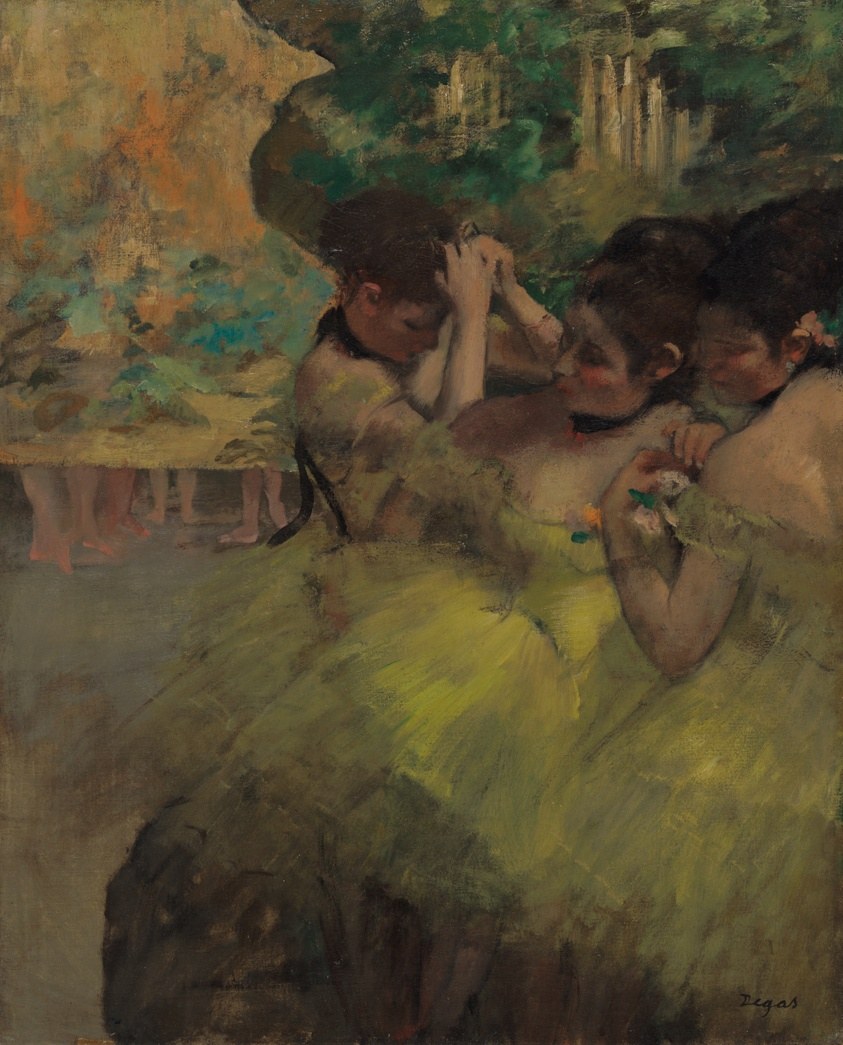
Yellow Dancers In the Wings
Hilaire Germain Edgar Degas
- Source:
- Art Institute of Chicago
- Rights:
- Public domain — free to use, share and adapt.
- Recorded as:
- CC0 (Public Domain)
This work is rare in its focus on the *waiting* moment rather than the dance itself—a compositional choice that reveals what fascinated artists about theater ballet: the austere discipline and the gap between the public spectacle and private preparation. For dance historians, it offers evidence of late 19th-century ballet costume, grouping, and the physical reality of ensemble work in ways that written sources do not.
What you are looking at
Three young female dancers in yellow tutus stand together in the wings of a theater, waiting to perform. They are positioned against a backdrop of architectural columns and a sketchy architectural setting rendered in muted greens, browns, and ochres. The lighting is warm and diffuse, creating a sense of backstage atmosphere. The leftmost dancer has her hand raised to her head in a gesture of anticipation or adjustment; the other two stand close beside her, their bodies leaning slightly inward toward one another. The composition captures an intimate, off-stage moment—not the performance itself but the quiet tension of preparation.
The dancing
All three dancers are en pointe in soft ballet positions, their bodies aligned vertically in classical posture. Their arms are varied: one dancer's arm is raised near her head, the others' arms hang more naturally at their sides or rest against their bodies. The dancers are grouped tightly together, creating a unified compositional mass rather than individuals in separate space. Their turn-out and vertical carriage are consistent with ballet training, and there is no visible partnering or interaction—they are separate dancers sharing the same stage moment.
The dance depicted
This is theatrical ballet, most likely French or Italian ballet of the late 19th century, captured in the backstage moment before entrance. The yellow tutus, pointe shoes, and classical posture are unambiguous markers of ballet practice. The title 'Yellow Dancers In the Wings' confirms this is a representation of the professional theater ballet of the Romantic or early Post-Romantic era. The image does not show active choreography but rather the suspended moment of waiting—a subject that fascinated visual artists of this period as it revealed the discipline and preparation behind the spectacle.
How it was made
This appears to be oil on canvas or possibly pastel, executed in a painterly style that prioritizes tonal harmony and atmospheric effect over sharp definition. The artist has used broken color and soft blending to suggest backstage light and the texture of fabric and stage surfaces. The technique is consistent with late 19th-century academic and Impressionist approaches to theatrical subjects, allowing for both the capture of momentary observation and the formal composition of a studio work. The softness of execution and the muted palette are characteristic of works intended for exhibition rather than rapid journalistic documentation.
About this work
This work depicts three ballet dancers in the wings of a theater, dressed in yellow tutus and pointe shoes, in the moment before they step onto the stage. It is a backstage scene—a popular subject in European art of the late 19th century, particularly among artists associated with Impressionism and the French academic tradition. The painting captures not the spectacle of performance but the private discipline and anticipation that precedes it. The work belongs in a gallery of dance art because it documents both the physical reality of ballet practice (the costumes, the posture, the pointe work) and a particular cultural moment in which the theater and its rhythms became a subject worthy of serious artistic attention.
How to look at it
Attend first to the yellow color of the tutus: it is a unifying formal element and also a historical marker of a specific moment in costume design. Notice the posture of the three figures—the classical vertical alignment is maintained even in stillness and anticipation. Look at the handling of space: the women are tightly grouped, and the background is deliberately vague, keeping focus on the figures. The raised arm of the leftmost dancer is the only gesture that breaks the symmetry; this small movement suggests the nervousness or last-moment adjustment before performance. The overall effect is one of formal beauty achieved through restraint.
The artist
Unknown. However, the style, subject, and technique are consistent with late 19th-century French and Italian academic painters and Post-Impressionists who specialized in theatrical scenes. Artists such as Edgar Degas, Pierre Renoir, and Jean-Louis Forain made the ballet studio and backstage the subjects of sustained artistic investigation; this work sits within that tradition.
The period
Ballet in the late 19th century was undergoing significant change. The Romantic era's emphasis on ethereal, otherworldly femininity was being challenged by more naturalistic observation and by the rise of Russian Imperial Ballet under Marius Petipa. The tutu had become standardized; pointe work was universal among professional female dancers. At the same time, the theater itself—not just the dance—had become a subject of intense artistic interest in European modernism. Artists were as interested in the social and physical reality of the theater as in the fantasy it created on stage.
Where it lives
The work is recorded in the Art Institute of Chicago's collection. It is listed as 'Artwork from the Art Institute of Chicago' with no further documentation of artist, date, medium, or previous ownership in the available record.
Dance in this work
Questions about this work
Who painted this?
The artist is not recorded in the available catalogue information. The style and subject matter are consistent with late 19th-century French and Italian academic or Post-Impressionist painters who specialized in theatrical scenes, but attribution would require further research.
When was this painted?
The date is not recorded. However, the style of tutus, the technique, and the subject matter all point to the late 19th century, most likely the 1870s–1890s. The yellow tutu and pointe work are consistent with ballet practice from that period.
What does 'in the wings' mean?
'In the wings' refers to the side area of the stage, just out of sight of the audience, where dancers wait to enter. It is a theatrical term for the space behind or beside the curtain where performers prepare and wait for their cue.
Is this a finished work or a study?
It appears to be a finished exhibition work rather than a quick study. The composition is carefully structured, the palette is harmonious, and the tonal modeling is complete. It was intended to stand as a complete artistic statement.
More dance artwork