39 works in this view — arrow keys or swipe to move between them.
Dance in Art
ballet flats
Unknown artist
- Dance:
- Ballet
- Rights:
- Not recorded. Do not assume this image is free to reuse — check the source record.
Ballet technique is built through the foot and ankle, and the soft shoe is the first instrument a dancer uses to learn to feel and articulate those joints. This drawing preserves the actual form of that instrument at a specific moment in history, before standardization, showing us what dancers trained in and how their teachers imagined the foot. For historians, it is evidence of what was valued in the ballet studio; for dancers, it is a reminder that technique begins not with grand movement but with the careful relationship between foot and floor.
What you are looking at
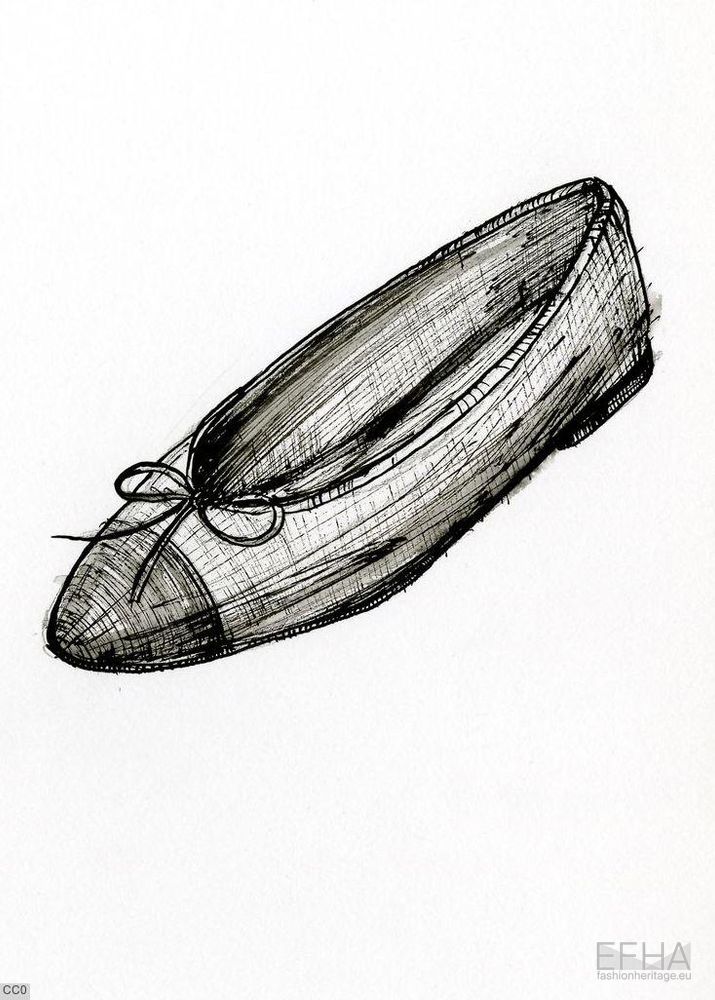
A single soft ballet shoe drawn in ink against a white ground, shown in three-quarter view from above. The shoe is rendered with meticulous cross-hatching and fine linear detail, creating volume and fabric texture. A delicate ribbon or drawstring is tied at the throat of the shoe, the loops rendered with careful attention to how fabric falls and folds. The artist has used varying densities of line to suggest the shoe's construction: you can read the sole's edge, the slight gathering where the upper meets the sole, and the flexibility of the material. The shoe casts no shadow; it floats on the page as a technical study rather than as an object in space.
The dancing
No figures or bodies are present. This is a still study of a single object from a single vantage point. The artist's interest is in the shoe's form itself—the curve of the foot bed, the soft collapse of the unsupported upper, the way the ribbon ties suggest the shoe waiting to be put on or just removed. The subject is the readiness of the shoe rather than the dancer.
The dance depicted
This is a ballet flat: the soft shoe worn for barre work, rehearsal, and training, and in some contemporary ballet for performance. The image does not depict dance itself but rather the instrument of ballet technique. The soft shoe is fundamental to ballet training because it permits articulation of the foot and ankle while protecting them, and because it allows the dancer to feel the floor. This is not a pointe shoe (which would have a hard box and a long, thin profile), but rather the everyday tool of the ballet studio.
How it was made
This is an ink drawing, likely executed with pen or fine brush, using cross-hatching, stippling, and closely-spaced parallel lines to build tone and volume. The technique is typical of technical or naturalistic drawing from the 18th or 19th century—the kind of approach used in anatomy studies, botanical illustration, and fashion drawing. The fineness of line suggests it may have been intended for reproduction by engraving or lithography, though the original object appears to be a hand-drawn work. The precision and labour involved indicates this was created for a purpose beyond casual sketch—either as a fashion plate, a costume study for theatre, or a technical reference.
About this work
This is a study of a ballet soft shoe, the foundational tool of ballet training. It belongs in a gallery about dance not because it depicts movement, but because it documents the material culture of ballet practice—the objects dancers inhabited as they learned their craft. The careful, almost anatomical attention to how the shoe sits and folds suggests an artist with intimate knowledge of ballet, whether as a choreographer, costume maker, dancer, or designer observing from within the profession. The drawing records not a moment of performance but the everyday apparatus that made performance possible.
How to look at it
Study how the artist rendered the ribbon: it is not drawn with a single outline but built from the crossings of fine lines that suggest its weight and the way it sits on the shoe. Notice also the sole—the artist uses a denser line here to show wear and use, whereas the upper is rendered more lightly, suggesting fabric flexibility. The shoe is drawn from exactly the angle a dancer or fitter would use to assess its form: high enough to see inside but not so high that perspective distorts the proportions. The artist is teaching you, through line, how to see the shoe as a dancer would.
The period
The style of drawing—the precise cross-hatching, the absence of shadow or ground, the focus on constructed form—is consistent with 19th-century technical and fashion illustration. This period saw an explosion of printed fashion plates and costume studies, many of them produced to document and circulate designs. Ballet itself was experiencing transformation during this time: pointe work was becoming standard for women (Taglioni danced *La Sylphide* en pointe in 1832), and the soft shoe remained the foundational training shoe. Technical drawings of costume and equipment were a common way for designers and makers to communicate across distances before photography.
Where it lives
This work is held in the Europeana digital collection, which aggregates digitized cultural objects from European memory institutions. The catalogue record provides no information about the holding institution, artist, date, or original medium, suggesting this is a secondary record or an unattributed work within a larger collection.
Dance in this work
Questions about this work
Is this a pointe shoe?
No. A pointe shoe has a hard box at the toe, a long shank, and a distinctive profile. This is a soft ballet flat—a shoe made entirely of soft leather and fabric, used for training and rehearsal. Dancers wear soft shoes before they begin pointe work and continue to wear them in the studio throughout their careers.
Why would an artist draw a shoe instead of a dancer?
Because the shoe is the object that matters technically. In ballet training, the foot is the instrument; the shoe is the tool that teaches the foot. Costume and equipment studies like this one were created to document designs, to instruct makers, or to preserve the material culture of dance. This drawing tells you everything you need to know about how this shoe was constructed and how it fit.
When would a dancer wear this shoe?
Every day in the ballet studio. A dancer wears soft shoes for barre, centre work, and rehearsal of choreography. Soft shoes allow the foot to articulate—to feel and control each joint—in a way that pointe shoes do not. In contemporary ballet, dancers also sometimes perform in soft shoes.
More Ballet artwork