38 works in this view — arrow keys or swipe to move between them.
Dance in Art
Ballet Philippines Ballet Evening
Unknown artist
- Dance:
- Ballet
- Rights:
- Not recorded. Do not assume this image is free to reuse — check the source record.
Ballet Philippines was one of the first companies to establish a sustained classical ballet presence in the Philippines and to develop a company identity rooted in Southeast Asian culture. This image documents the company's commitment to classical technique at a formative moment in its history, showing how academic ballet was taught, performed, and presented to audiences outside Europe and North America. For historians of dance in the post-colonial era and in Asia, this simple photograph is evidence of the global reach and local adaptation of classical ballet in the late 20th century.
What you are looking at
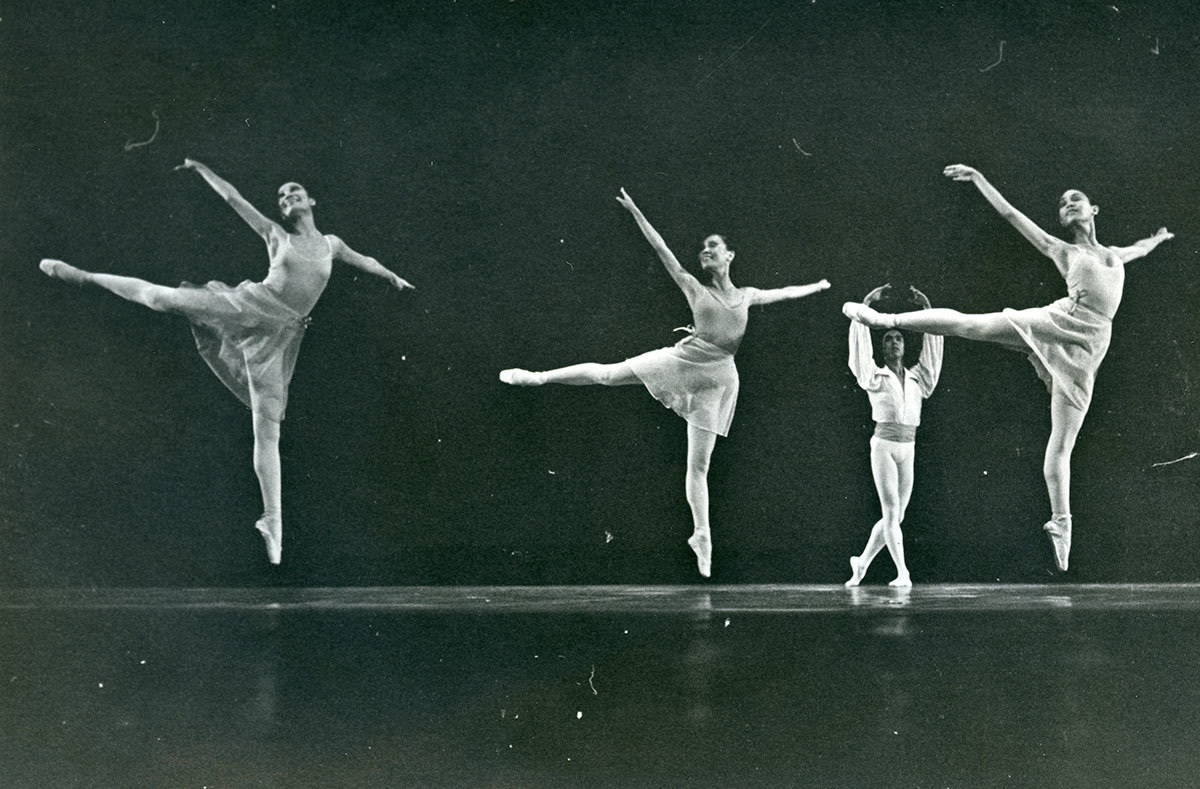
This is a black-and-white photograph of five ballet dancers on stage, arranged in a line across a reflective floor that suggests a theatrical setting. They are captured mid-performance, each posed in a distinct classical ballet position. The figure on the far left stands in an arabesque with the left leg extended high behind and both arms in port de bras; the second dancer from left performs a développé devant with the right leg unfolded forward at a high extension, arms aloft. The central figure wears what appears to be a short skirt or tutu and holds a développé à la seconde, leg extended to the side at hip height. The figure second from right mirrors the opening position with an arabesque, and the dancer on the far right concludes the sequence in a penché or extended arabesque with arms reaching forward and back. All five dancers wear pale, simple costumes—either leotards with brief skirts or tunics—and pointe shoes. The stage floor is dark and reflective, creating silhouettes and emphasizing the vertical extension of the poses. The photograph is printed on aged paper with visible creasing and surface wear.
The dancing
All five dancers are en pointe, demonstrating control and turnout. The positions progress through the fundamental extensions of classical ballet vocabulary: arabesque, développé devant, développé à la seconde, and penché. Each body is held with the upright carriage and turned-out legs characteristic of academic ballet training. The arms move through graceful épaulement positions, rising and opening in harmony with the leg work. The spacing is even, the alignment suggests synchronized practice, and the matching costume palette indicates this is a unified company performing a codified suite of positions rather than a narrative work.
The dance depicted
This is unmistakably classical ballet, most likely a photograph of a formal demonstration, company class, or 'ballet evening' showcase in which company dancers perform a sequence of foundational poses. The title 'Ballet Philippines Ballet Evening' suggests this is from a performance by the Ballet Philippines company, which was founded in 1969 and has been central to developing a Philippine national ballet identity. The image shows no narrative staging or set pieces; instead, it documents pure technique—a parade of balletic extensions that would have been recognizable to any trained dancer of the 20th century. The style and costume suggest mid-to-late 20th century ballet, consistent with the company's era.
How it was made
This is a black-and-white photograph, likely printed or published rather than an original negative. The even theatrical lighting, the composition across a stage floor, and the professional registration suggest it was taken during a rehearsal or performance and subsequently reproduced—possibly for archival, documentary, or promotional purposes. The photograph's distribution through Europeana indicates it entered a public or institutional collection. The aging visible in the paper and surface speaks to its history of handling and preservation.
About this work
This is a documentary photograph of a classical ballet ensemble performing a sequence of extensions and foundational poses, identified as part of a Ballet Philippines performance. It belongs in a dance gallery because it records both a specific moment in the history of ballet in the Philippines—a company dedicated to establishing a national ballet tradition in Southeast Asia—and a universal language of ballet technique that was, and remains, central to how ballet dancers learn and are evaluated. The photograph is valuable not for its artistic composition but for its documentation of how a particular company presented classical ballet training to an audience.
How to look at it
Notice the progression of poses: each dancer performs a single, held position rather than moving through a sequence. This is characteristic of a formal demonstration or 'ballet evening'—a format in which technique is presented as completed, legible, and perfected rather than embedded in narrative or flow. The photograph freezes the moment at full extension, the point at which each pose is most striking and most demanding of the body's control. The mirror effect of the paired arabesques (left and right figures) and the symmetry of the grouping suggest the image records a choreographed display of classical positions rather than a moment caught in passing.
The period
Ballet Philippines was established in 1969 by Edades, a pioneering figure in Philippine dance who sought to create a company capable of performing classical ballet while developing works that engaged with Philippine culture and contemporary themes. In the 1960s and 1970s, the establishment of national ballet companies in Asia was part of a broader movement to assert cultural identity and modernity; classical ballet was adopted as a prestigious international language while being inflected with local choreographic voices. This photograph dates to that period of institutional consolidation, when ballet companies presented both classical showcases and new works, and when documentation of performances served both archival and promotional purposes.
Where it lives
The image enters scholarship through Europeana, a digital aggregation of European and international cultural heritage collections. The original holding collection and accession number are not recorded in the available metadata.
Dance in this work
Questions about this work
What is Ballet Philippines?
Ballet Philippines was founded in 1969 and became one of Asia's leading ballet companies. It was established to promote classical ballet training and performance in the Philippines while creating new works rooted in Philippine culture and contemporary themes. The company played a crucial role in establishing ballet as an institution in Southeast Asia during the post-colonial period.
What are these dancers doing?
They are performing a formal showcase of classical ballet positions and extensions: arabesque, développé devant, développé à la seconde, and penché. Each dancer holds a single position on pointe, demonstrating the foundational vocabulary of academic ballet. This format—sometimes called a 'ballet evening'—allowed companies to present pure technique to audiences as a distinct form of entertainment.
How do we know this is Ballet Philippines if the photograph is undated?
The catalogue record titles it 'Ballet Philippines Ballet Evening,' which is the only attribution available. Without additional provenance information, we cannot independently confirm the date or context, though the style of costume and the quality of the photograph suggest mid-to-late 20th century.
Why photograph a sequence of positions rather than an actual performance?
Formal technique showcases were a staple of mid-20th-century ballet presentation, particularly in companies establishing themselves institutionally. Photographing such sequences served documentation, promotion, and educational purposes—allowing the company to record and circulate images of its dancers' technical training and capability.
More Ballet artwork