37 works in this view — arrow keys or swipe to move between them.
Dance in Art
ballet slippers
Unknown artist
- Dance:
- Ballet
- Rights:
- Not recorded. Do not assume this image is free to reuse — check the source record.
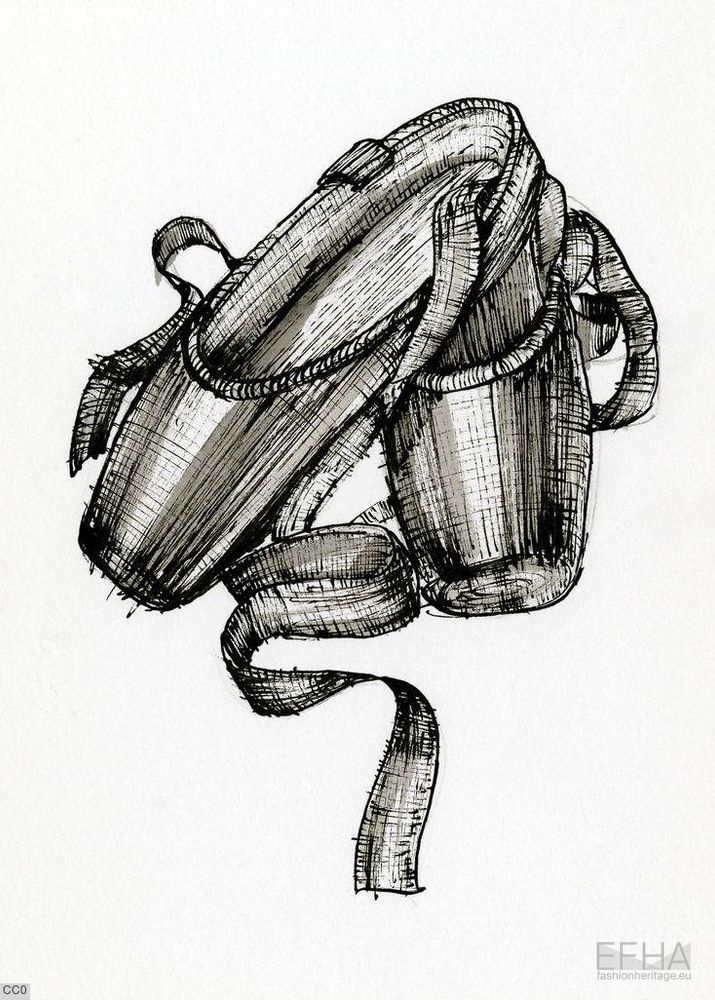
The pointe shoe is one of the most recognizable symbols of ballet, and its history is inseparable from the history of technique, aesthetic ideals, and the discipline's gendering. This direct study of the shoe—its construction, its wear, its materiality—offers insight into how ballet was understood and represented in art beyond the traditional stage scene or portrait.
What you are looking at
A pair of pale pointe shoes dominates the composition, rendered in careful ink cross-hatching and linear detail. The shoes are positioned at a slight angle, their ribbons trailing downward and coiling loosely across the lower portion of the page. The artist has captured the worn, fabric texture of the shoes through varied line weight and shading, showing creases and soft folds in the material. The shoes appear to rest or float against a plain white ground; there is no setting, no stage, no dancer's body. The drawing emphasizes the object itself—its construction, its fragility, its material presence—rather than its use. Light falls evenly across both shoes, creating subtle shadow beneath the soles.
The dancing
There are no figures. The work is a still-life study of inanimate objects—two ballet pointe shoes with their ribbons. The artist has rendered them with anatomical attention to the structure of the shoe: the reinforced box, the shank, the sole, the way fabric bunches at the heel. The ribbons are shown in relaxed curves, as if the shoes have just been removed and placed down. This is documentation of the tool of ballet, not a representation of the dancer in motion or repose.
The dance depicted
This is not a depiction of dance in the traditional sense—it contains no figures or movement. It is instead a study of the material culture of theatrical ballet. The pointe shoe is the defining equipment of classical ballet technique, and its inclusion in artistic representation signals the codification and professionalization of ballet as a theatrical form. The careful, almost scientific rendering suggests this may be a study, sketch, or stand-alone observation rather than part of a narrative scene. The work documents ballet through its apparatus rather than its bodies.
How it was made
This is a pen-and-ink drawing, likely executed with a fine nib or technical pen. The artist has used parallel hatching and cross-hatching to build tone and shadow, a technique common in botanical and anatomical illustration. The consistent line work and careful buildup of value suggest either a study from life or a preparatory work. The formal precision of the technique contrasts with the everyday subject matter—elevating the humble pointe shoe to the status of a formal study object.
About this work
This is a observational ink drawing of a pair of used ballet pointe shoes with their ribbons trailing across the page. It is neither a performance scene nor a portrait of a dancer, but rather a still-life study of the material object central to classical ballet practice. The work belongs to a broader tradition of artists documenting the tools, dress, and apparatus of dance—a way of understanding dance through its physical infrastructure rather than through its performers in action. It records what a ballet dancer wears and how it looks when set aside.
How to look at it
Examine the detail of the shoe's construction: the cross-hatching that suggests the stiffness of the box, the softer lines of the fabric at the heel and instep, the way light falls on the sole. Notice how the artist has rendered the ribbons as a secondary element, casual and relaxed in contrast to the precise structure of the shoe. This tension between the precise instrument and the everyday gesture of removing it—letting the ribbons fall—captures something essential about ballet: the rigorous discipline it demands and the worn, used reality of training.
The period
The technique and style of this drawing suggest it may date to the 19th or 20th century, a period in which ballet was being professionalized and codified into a formal technique with standardized equipment. The pointe shoe itself became widespread in the Romantic era (1830s onward) and evolved significantly through the 19th century. If this drawing dates to the late 19th or early 20th century, it would reflect a period of intense interest in ballet as both a performance art and a subject for fine artists.
Where it lives
The work is recorded as part of the Europeana digital collection, a European aggregator of cultural heritage materials. No holding institution, date, or artist name is recorded in the catalogue.
Dance in this work
Questions about this work
Why is this a work about dance if there is no dancer?
Dance is not only bodies in motion. It is also the techniques, disciplines, and material practices that make movement possible. The pointe shoe is as fundamental to ballet as the body of the dancer—it is where the dance literally happens, where technique is executed. Artists studying dance have always been interested in these material conditions.
Is this a preparatory sketch for a larger work?
It is possible, but not certain from the image alone. The finish and care of the drawing suggest it may be a complete study in its own right—a formal study of an object, rather than a preliminary sketch for a narrative scene. Many artists of the 19th and 20th centuries made such studies as independent works.
When were pointe shoes first used?
Pointe work emerged gradually in the 1820s and 1830s during the Romantic era of ballet, becoming standard for professional female dancers by the mid-19th century. The shoes themselves evolved significantly over time in construction and materials. This drawing captures a particular historical moment in that technology.
More Ballet artwork