35 works in this view — arrow keys or swipe to move between them.
Dance in Art
Cuban National Ballet Ballet Evening
Unknown artist
- Dance:
- Ballet
- Rights:
- Not recorded. Do not assume this image is free to reuse — check the source record.
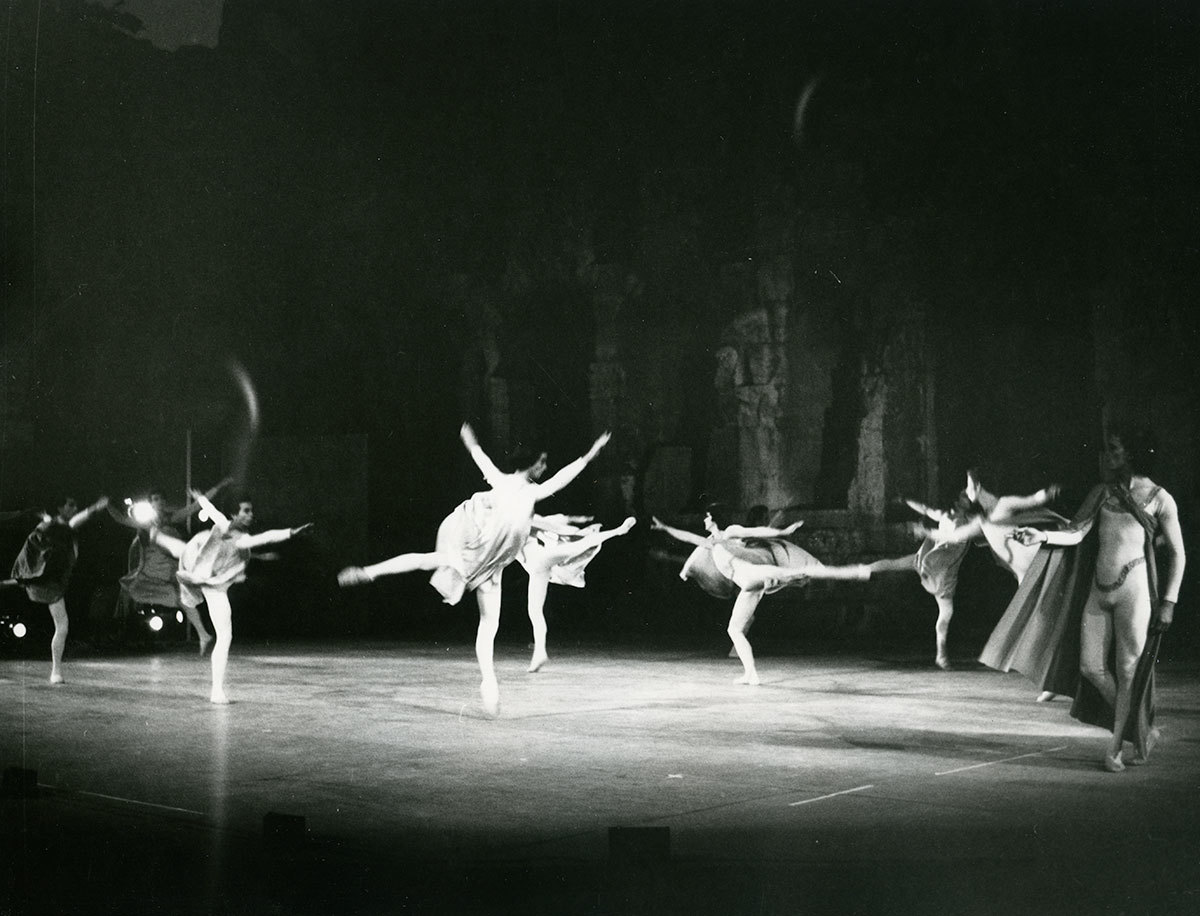
This photograph documents the Cuban National Ballet and provides rare visual evidence of how classical European ballet was performed and staged in the Caribbean during the 20th century. It demonstrates the global reach of classical ballet technique and the formation of national ballet institutions outside Europe, while the formal, symmetrical composition itself embodies the aesthetic principles that governed classical ballet choreography of the period.
What you are looking at
A stage photograph captures a classical ballet ensemble in a formal evening performance. The composition is dominated by five dancers en pointe, arrayed across a brightly lit stage floor against a dark backdrop suggesting a painted theatrical set. The central dancer performs a supported arabesque or attitude, arms extended, while four companions frame her in a symmetrical arrangement—two on either side in mirrored poses, all in pale tutus that read as white or cream against the darkness. The lighting is theatrical and directional, throwing the dancers into sharp relief. On the far left, a sixth figure in darker dress appears to be a male dancer or accompanist. On the right, a figure in a long skirt—possibly a choreographer, rehearsal master, or character dancer—observes or participates. The overall effect is of a tableau vivant from classical ballet's golden age: formal, symmetrical, hierarchical, with the soloist commanding attention at the centre.
The dancing
The central figure balances en pointe in a classical supported position, her torso upright and her free leg extended. Her arms are raised and opened—one extended to the side, the other forward or upward—in the controlled, geometric line characteristic of classical technique. The four surrounding dancers adopt similar turned-out positions with raised arms, their bodies aligned to create visual harmony. All five wear classical tutus and pointe shoes. The positioning suggests either a moment from an arranged classical variation or a formalized rehearsal photograph. The symmetry and formal spacing indicate trained classical technique; these are not improvised or vernacular movements.
The dance depicted
This is unquestionably classical ballet, most likely from the late 19th or early 20th century based on the costume, pointe work, and compositional style. The title references the Cuban National Ballet, suggesting this documents a Cuban professional ballet company or a visiting European company performing in Cuba. The formal symmetry, tutus, pointe work, and staged tableau all point to the Romantic or early Classical ballet repertory—possibly a grand pas or ensemble scene from a work such as *Swan Lake*, *The Sleeping Beauty*, or a similar canonical ballet. The staging suggests either a full performance documentation or a formally arranged cast photograph taken onstage. Without identifying marks or further documentation, the specific ballet cannot be determined, but the style and technical vocabulary are unmistakably classical European ballet.
How it was made
This is a black-and-white stage photograph, likely taken during a live performance or professional cast photography session under theatrical lighting. The photographic technique captures the directional stage lighting of the era, which creates sharp shadows and high contrast between the lit dancers and the dark scenery. The film stock and printing technique suggest mid-20th-century photographic practice, though the theatrical style depicted may date earlier. The photograph has survived in the Europeana digital collection, which holds European cultural heritage materials; its presence there suggests it was either created in Europe or was of sufficient significance to a European institution to be acquired and digitized.
About this work
This photograph documents a moment from classical ballet as performed by the Cuban National Ballet, capturing five dancers en pointe in a formal, symmetrical tableau characteristic of 19th-century Romantic or early Classical ballet choreography. The image records not only the dance itself but the theatrical apparatus that surrounded it—the staged lighting, the composed ensemble arrangement, the formal tutus and pointe work that had by this era become the international standard for professional ballet. The photograph preserves a specific historical moment: the presence of a Cuban national ballet company performing European classical repertory, evidence of how thoroughly ballet had become a global, metropolitan art form by the 20th century, even as national ballet institutions emerged across the Americas.
What makes this work significant to dance history is precisely what it shows without explanation: the international codification of ballet technique and the complex relationship between European classical forms and their adoption in the Caribbean and Latin America. The image is plain, documentary, and unembellished—a stage photograph rather than an artistic interpretation—which gives it particular value as historical evidence.
How to look at it
Attend to the precision and uniformity of the five dancers' positions: the turned-out legs, the lifted spines, the controlled arm placement. These details reveal the extent to which classical ballet had become a standardized, teachable technique by this period. Notice also the theatrical apparatus—the dark backdrop, the directional lighting, the formal stage floor—which was as essential to ballet's identity as the movements themselves. The symmetry of the composition is not accidental; it reflects both the choreography and the photograph's role as official documentation, meant to preserve and celebrate the company's technical achievement.
The period
Classical ballet underwent dramatic codification and internationalization during the late 19th and 20th centuries. Following the Russian Imperial Ballet's dominance in the early 1900s and the Ballets Russes' influence on European and American dance from 1909 onward, classical ballet technique and repertory spread globally. By the mid-20th century, national ballet companies had been established across Europe, the Americas, and beyond—part of a broader pattern in which ballet became understood as a marker of cultural sophistication and national artistic achievement. The Cuban National Ballet's formation and performances fit squarely within this context: the adoption of European classical forms as a vehicle for national cultural expression and international prestige.
Where it lives
This photograph is held in the Europeana digital collection, a pan-European platform for cultural heritage. Its cataloguing as 'Cuban National Ballet / Ballet Evening' suggests it was either created in Cuba or acquired by a European institution as documentation of the Cuban company's international profile.
Dance in this work
Questions about this work
When was the Cuban National Ballet founded?
The photograph's date is unknown, but the Cuban National Ballet was officially founded in 1955. The style of the photograph—film stock, costume, and theatrical practice—suggests it may date from the 1950s onward, though it could be earlier documentation of a predecessor company.
What ballet is this from?
The specific ballet cannot be identified from the photograph alone. The formal ensemble tableau and classical tutus suggest it may be from a 19th-century work such as *The Sleeping Beauty* or *Swan Lake*, or from another canonical ballet of that tradition, but without visible title cards or further documentation, the work remains unidentified.
Why is there a person in a long dark skirt on the right?
This figure may be a rehearsal master, choreographer, or character dancer (such as a queen or other courtly role). In formal ballet photographs and performances, such figures often appear at the margins to frame or comment on the soloists' actions. The exact role cannot be determined from the photograph alone.
How does this compare to ballet photography from Europe at the same period?
The theatrical style—the formal arrangement, the symmetrical composition, the emphasis on pointe work and tutus—is entirely consistent with European classical ballet documentation of the mid-20th century. The photograph suggests that the Cuban National Ballet had adopted not only European technique and repertory but also the European conventions for documenting and presenting ballet to audiences.
More Ballet artwork