49 works in this view — arrow keys or swipe to move between them.
Dance in Art
dancer 283
Unknown artist
- Rights:
- Not recorded. Do not assume this image is free to reuse — check the source record.
The work documents how Romantic ballet, then the dominant theatrical form in Europe, was not confined to the stage: its imagery and its vocabulary of the body were miniaturized, collected, and placed on the dressing tables of the wealthy. It shows what a contemporary considered worth preserving—the moment of triumph, the impossible extension, the male dancer as weightless and supernatural rather than grounded. For historians of dance in design and domestic culture, it is evidence that ballet was not a marginal or esoteric art, but one woven deep into the visual and tactile world of nineteenth-century luxury.
What you are looking at
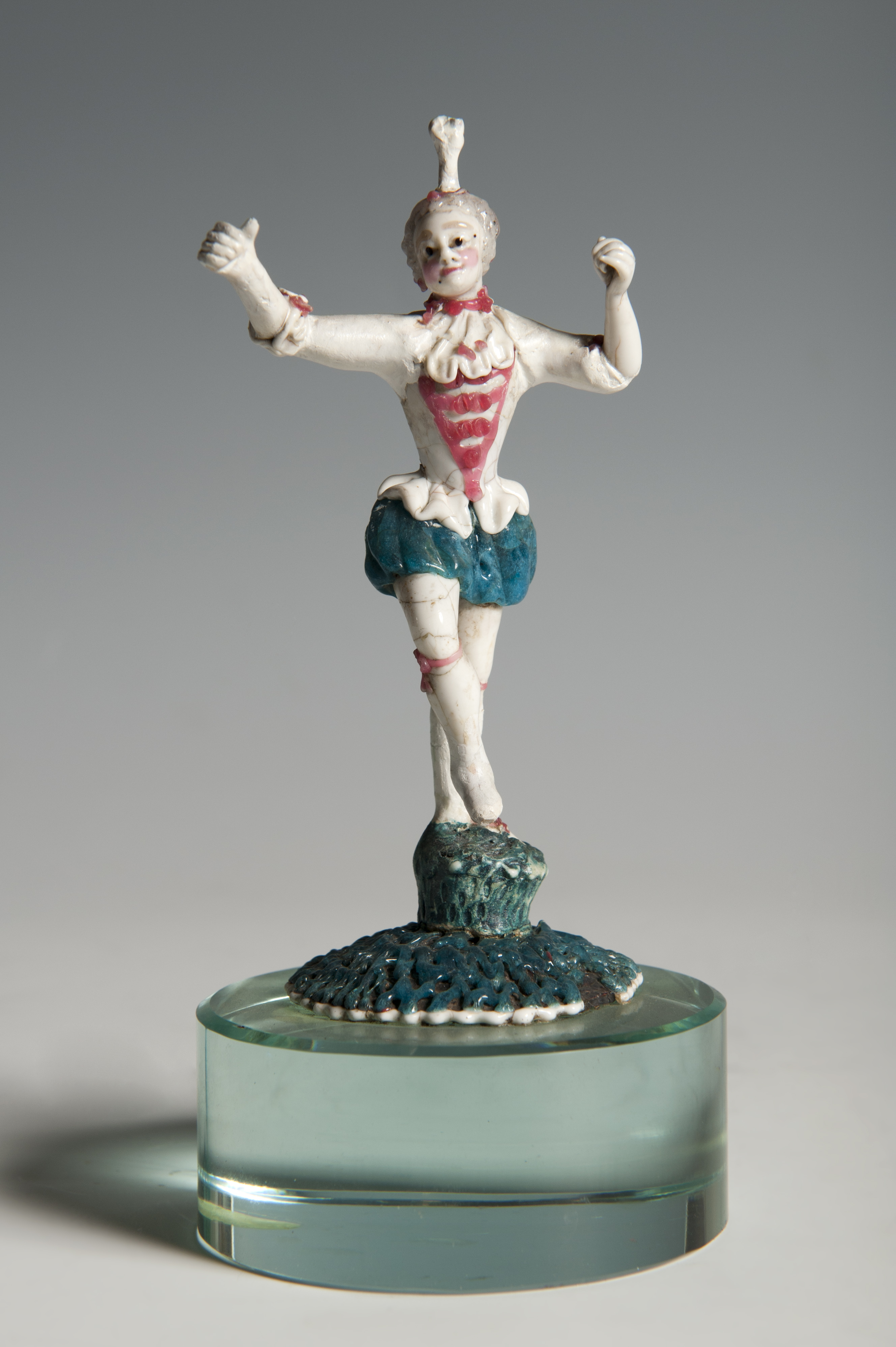
A small articulated figure in white bisque or porcelain stands triumphantly on a dark textured base mounted on a pale jade-green glass cylinder. The dancer is shown in a classical pose of exultation: legs extended in a sharp vertical split or écart, torso upright, both arms raised to shoulder height with palms facing outward in a gesture of joy or celebration. The figure wears a fitted white tunic or corset with red or pink decoration across the chest in a diamond or lattice pattern, and a pair of short gathered blue breeches that sit just above the knee. The head is delicately modeled in white with painted features—dark eyes, rouged cheeks, and what appears to be a topknot or plume of hair rising from the crown. The base itself is sculptural: a dark bronze or similar metal, finely textured like foliage or rockwork, sits beneath the smooth glass mount, suggesting this is a decorative object of some refinement, possibly a perfume bottle stopper, scent-bottle finial, or jewelry casket ornament.
The dancing
A single dancer, shown at roughly eight inches in height, occupies the composition with complete conviction. The weight is centered; the legs are stretched into a nearly vertical split with the supporting leg locked straight and the raised leg extended equally high, a feat of extreme flexibility. The torso remains perfectly upright without the forward lean typical of many acro-dancers, and the arms are held at middle height with the palms open outward—a gesture of display or accomplishment rather than control. The modeling of the limbs shows anatomical knowledge: the thighs are finely proportioned, the feet are pointed, and the transition from hip to raised leg reads as a continuous line of elevation.
The dance depicted
This appears to depict a moment from Romantic-era theatrical dance, most likely from the 1830s–1850s ballet vocabulary, when such extreme vertical splits (écart or grands écarts) were a mark of virtuosity. The pose and costume suggest the character of a male dancer in the role of a sprite, cherub, or triumphant male lead—roles that demanded both acrobatic control and an impression of weightless joy. The gesture is not a working step but a held pose of display, the kind that would conclude a variation or mark a character's supernatural elevation. No specific ballet is identifiable from the image alone, but the vocabulary and the confidence of the execution suggest a work made to commemorate or celebrate a celebrated dancer's signature moment or role.
How it was made
This is a small decorative sculpture in white bisque porcelain with hand-painted enamel details in red/pink and blue. The base consists of a separately modeled bronze or gilt-metal sculptural element mounted on a pale jade or translucent glass cylinder, suggesting this object served a functional purpose—likely as a stopper for a scent bottle, the finial of a jewelry casket, or a decorative object for a lady's dressing table. The bisque technique allowed for fine detail and a matte finish that would have been valued for its softness and refusal to compete with the glass. The pairing of porcelain figure with gemstone-colored glass mount suggests manufacture in a luxury porcelain center, likely French or German, for a wealthy clientele. Such objects were collected as cabinet pieces and gifts.
About this work
This is a small Romantic-era porcelain figure of a male ballet dancer caught in a moment of exultation, mounted on a decorative glass and metal base. The work captures a vocabulary of display and virtuosity—the vertical split, the open arms, the upright torso—that was central to the spectacle of Romantic ballet. As a functional object (likely a scent-bottle stopper or casket finial), it represents the fashion for ballet imagery in the domestic interior during the decades when Romantic ballet was at its height. The work is an artifact of how ballet became woven into the aesthetics and objects of everyday luxury.
How to look at it
Attend first to the geometry of the pose: the dancer is captured not mid-movement but in a state of held display, a moment frozen at the peak of an effort that would have taken seconds to achieve. The vertical alignment of the legs and torso, combined with the outward gesture of the arms, creates a sense of effortless ascendancy—an optical illusion that the artist has achieved through precise proportion and balance. Notice also the contrast between the delicate white figure and the dark, complex texturing of the base; the glass mount acts as a neutral stage, lifting the figure and framing it as an object of contemplation rather than action. The red and blue accents on the costume draw the eye inward, grounding the figure despite its airborne pose.
The artist
Unknown. The work bears no visible signature and the catalogue record does not attribute it. The quality of the modeling and the refinement of the mount suggest a hand trained in the porcelain sculpture workshops of a major center—likely Meissen, Sèvres, or Vienna—where such decorative figures were a specialty. These objects were sometimes produced in series, commissioned by dancers or their admirers, or sold through luxury goods merchants to wealthy clients.
The period
This object dates stylistically to the Romantic era of ballet, approximately 1830–1860, when male dancers performed roles as ethereal spirits, sylphs, and magical beings, and when the vocabulary of elevation and extension reached new extremes. Porcelain figures of dancers and theatrical subjects were fashionable decorative objects in this period; they were displayed in cabinets alongside cameos, minerals, and other curiosities. The work coincides with the fame of dancers such as Jules Perrot, Arthur Saint-Léon, and Lucien Petipa, whose technical command of such feats made them international celebrities. The pairing of dance imagery with luxury glass and metal mounting also reflects the mid-nineteenth-century taste for combining fine art with industrial and decorative materials.
Where it lives
The work is held in the Europeana digital collection, where it is described only as 'dancer 283' with no attribution, date, medium, or institutional affiliation recorded. It may be part of a series of similar objects, or a unique commission. Without access to the physical object or to detailed provenance records, its original maker and owner cannot be established.
Dance in this work
Questions about this work
Is this figure doing a splits?
Yes, it is performing a grand écart or vertical split, with one leg raised to or above shoulder height while the supporting leg remains straight and locked. This was a celebrated feat of Romantic-era male dancers and a signature moment in many roles. The pose was not a traveling step but a held display of virtuosity and supernatural ability.
Why is this object made of porcelain?
Porcelain was the premium material for small luxury decorative objects in the nineteenth century. This figure was likely made as a stopper for a perfume bottle, a casket finial, or a cabinet piece—objects that appeared on the dressing tables of wealthy people. Ballet imagery was fashionable for such objects, and porcelain allowed for fine detail and a soft matte finish that suited the subject.
What ballet is this from?
The specific ballet cannot be identified from the image alone. The costume and pose suggest a male supernatural or romantic role from the Romantic era (1830–1860), but without inscription or provenance, any attribution would be speculation.
More dance artwork