49 works in this view — arrow keys or swipe to move between them.
Dance in Art
dancer 401 item BKAFR
Unknown artist
- Rights:
- Not recorded. Do not assume this image is free to reuse — check the source record.
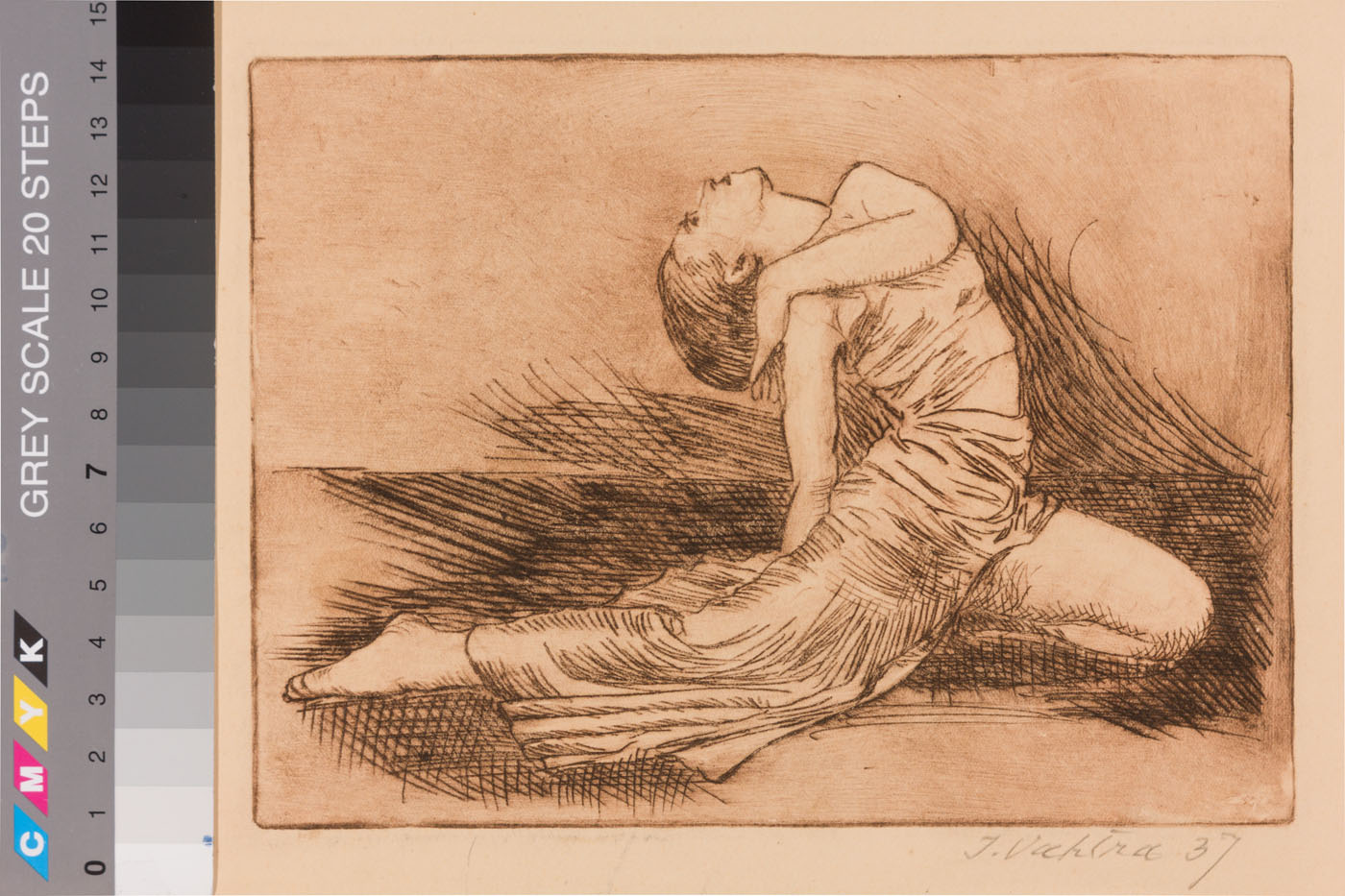
Romantic ballet's emotional intensity depended on the dancer's ability to register extremes of feeling through the body. This print documents one of the period's signature poses—the swoon—and shows how artists of the time captured not movement but the stillness at the moment of greatest dramatic effect. For historians, it is evidence of how dance was studied and circulated in print culture before photography.
What you are looking at
A single female figure reclines on the ground in a languorous, arched pose, her body weight supported on one arm while her head tilts back and one leg extends forward. She wears a simple draped garment that falls loosely across her torso and legs, leaving much of her body exposed. The figure occupies the right two-thirds of the composition against a plain background with minimal setting details. The artist has rendered the pose with careful attention to the curve of the spine and the stretch through the torso—a posture suggesting exhaustion, abandon, or the resolution of exertion. The etching technique creates strong contrasts through parallel hatching, particularly in the shadows beneath and behind the figure, which ground her against the lighter paper.
The dancing
The dancer's weight is shifted to one arm in a reclined position, with the torso arched backward in a deep extension. The head is thrown back, the neck exposed and extended. One leg appears bent or folded while the other extends along the ground. The pose is one of complete release from tension—the kind of collapse that follows intense physical effort or emotional extremity. There is no technical balletic alignment here; instead, the body is shown in a state of languor or abandon.
The dance depicted
This appears to represent a Romantic-era dance moment, likely from theatrical ballet of the 1830s–1850s, captured in a moment of dramatic intensity or denouement. The pose resembles the swoon or collapse often depicted in Romantic ballet—a woman overcome, fallen, or at the moment of greatest emotional vulnerability. Works like *La Sylphide* and *Giselle* feature such moments. The artist has chosen to isolate the figure at the climax of the action, without narrative context, emphasizing the body's expressive capacity at the threshold between control and dissolution. The intimate scale and the absence of male support (common in such images) suggests this may be a study from rehearsal or a private moment rather than a stage tableau.
How it was made
This is an etching or drypoint, established by the fine linear hatching and the characteristic inky blacks built through parallel lines rather than wash or solid tone. The medium's delicate line-work allows precise rendering of musculature and drapery while maintaining the luminosity of the paper itself. Etchings circulated as prints in portfolios, print cabinets, and the growing market for dance imagery in the early 19th century. The technique suggests a work aimed at connoisseurs rather than mass reproduction—the kind of study that would appeal to dancers, choreographers, or collectors of theatrical art.
About this work
This is a figure study in etching depicting a single dancer in a moment of Romantic-era collapse or swoon—a posture central to the emotional vocabulary of 1830s–1850s theatrical ballet. The artist has rendered the body with anatomical precision while capturing the psychological drama of the moment: the release of tension, the vulnerability of the exhausted or overcome figure. The work belongs to a tradition of dance prints made for educated audiences, recording not the spectacle of the stage but the dancer's body in its most expressive and unguarded state.
The image's power lies in its refusal of narrative framing. We see neither the cause nor the resolution of this collapse—only the body itself, studied with the kind of attention usually reserved for life drawing. This approach was revolutionary for dance imagery, which typically emphasized the full silhouette and the geometry of stage positioning.
How to look at it
The artist has frozen the moment immediately after climax—when the body's dramatic tension converts to release. Note the arch of the spine and the thrown-back head: these register emotional extremity before narrative explanation. Observe how the single point of contact with the ground (one arm) makes the body appear unsupported, almost weightless. The hatching in the background creates depth and shadow that throw the pale, extended body forward; the viewer's eye is drawn to the exposed flesh and the vulnerability of the pose. This is a study in how much the Romantic body could express through posture alone.
The period
The etching dates to the early–mid 19th century, when Romantic ballet was at its height in Paris and across Europe. This was the era of *La Sylphide* (1832), *Giselle* (1841), and the dominance of the ballerina as the central figure of theatrical dance. Dancers' bodies became subjects for prints, lithographs, and engravings aimed at audiences who could not afford theatre tickets or who wished to preserve images of celebrated performers. The pose itself—the swoon, the collapse—was a stock dramatic moment in Romantic narrative ballet, always feminized and often marking the heroine's loss of agency or life. The medium of etching allowed artists to circulate these studies as affordable, portable objects, making dance imagery accessible to a wider circle than stage performance alone allowed.
Where it lives
The work is held in Europeana, a European digital library aggregating cultural heritage collections. The presence of a signature or inscription notation ('Michela 27' or similar) at the lower right suggests the artist's name or workshop attribution, but the catalogue record does not supply attribution or provenance details. It circulated as a print, likely in the early 19th century.
Dance in this work
Questions about this work
Is this a portrait of a specific dancer?
The catalogue record does not name either artist or subject. The print may depict a celebrated ballerina of the 1830s–1850s, or it may be a generic study of a Romantic pose. Without inscription or attribution, we cannot establish this from the image alone.
What dance is being shown?
This is not a moment from a named ballet, but rather a study of a pose—the swoon or collapse—that appeared across Romantic ballets of the era. The figure is not in a recognizable balletic position; instead, the artist has isolated a moment of emotional climax.
Why would an artist make a study of just this moment?
Etched prints of single figures or poses were made both as documentary records and as studies of expression. Dancers used such prints to study each other's technique or to preserve images of celebrated performers. Print collectors and ballet enthusiasts also purchased them as affordable alternatives to attending live performances.
Is this from a rehearsal or a performance?
The intimate scale and the absence of costume, setting, or supporting figures suggest this is a study rather than a record of a staged moment. However, the pose is one that would have been performed on stage; the print captures a moment of theatrical intensity.
More dance artwork