49 works in this view — arrow keys or swipe to move between them.
Dance in Art
dancer 401 item TUAPV
Unknown artist
- Rights:
- Not recorded. Do not assume this image is free to reuse — check the source record.
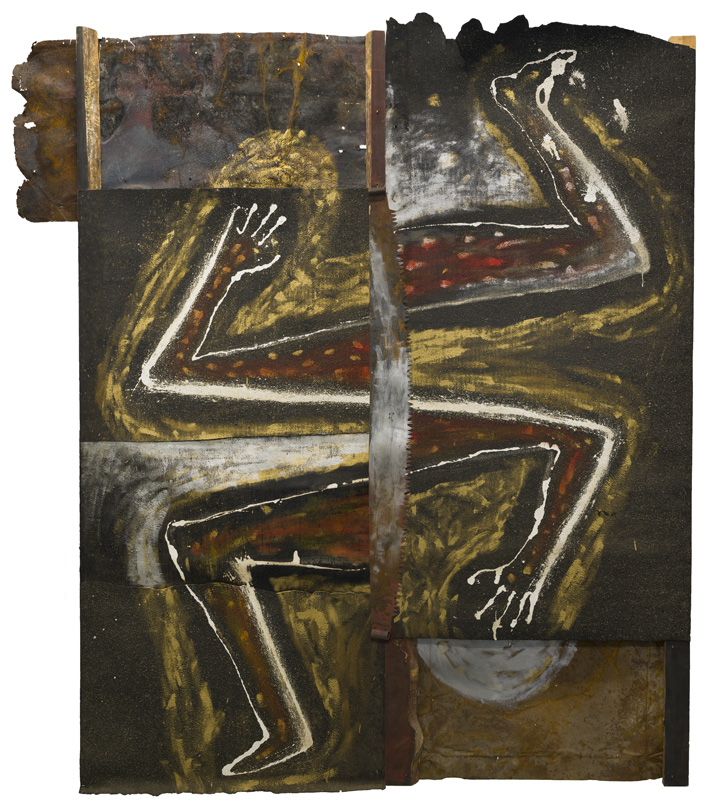
This work is vital for understanding how experimental and contemporary dance practice—particularly Butoh—was documented and visualized in the mid-to-late 20th century. It shows a radically different conception of the dancing body than ballet or ballroom traditions: not striving toward virtuosic line or social grace, but toward expressions of vulnerability, internal states, and physical transformation. The graphic intensity and expressionist language reveal how dancers and artists working in avant-garde traditions used visual media to record and theorize their own practice.
What you are looking at
This is a stark, expressionist work on weathered paper or board, divided into two unequal panels by a vertical grey stripe. The composition shows a single figure rendered in white outline against a dark ground, with areas of ochre, rust-red, and black pigment creating a sense of internal anatomy or raw movement. The figure appears in contorted positions across both panels—in the left panel, a torso and limbs bend acutely; in the right, the body twists further, with the head tilted back and one arm extended. The work has the quality of charcoal, chalk, or similar dry media applied and partially erased or weathered, creating a palimpsestic effect. The background is dominated by dark tones with golden-ochre gestures suggesting musculature or emotional intensity. The overall effect is of witnessing a body in extreme exertion or distress, abstracted from naturalism but anatomically conscious.
The dancing
A single dancer or figure occupies the composition, rendered in white line against darker tones. The body is hyperextended and twisted through multiple planes—the spine arches sharply, the neck is thrown back, limbs reach and contract. The articulation suggests a training method focused on extreme flexibility and internal awareness rather than balletic turnout or closed holds. The repetition of the figure across the two-panel format suggests either multiple exposures of a single action or the decomposition of movement into sequential moments. Weight appears suspended or distributed through the torso rather than grounded through the feet.
The dance depicted
This work most likely documents or represents Butoh or related contemporary expressionist movement practice. The extreme bodily contortion, the emphasis on internal states over external line, the use of white delineation against darkness, and the theatrical presentation of the body as a site of psychological intensity all align with Butoh aesthetics that emerged in mid-20th-century Japan. The figure is not performing a recognizable social or classical dance form; instead, it explores the body as a medium for expressing states of vulnerability, transformation, or raw emotional release. Without documentation or signature, the artist and date remain uncertain, but the visual language is unmistakably aligned with experimental movement practice rather than traditional choreography.
How it was made
The work appears to be executed in mixed dry media—likely charcoal, chalk, and possibly gouache or paint—on aged paper or cardboard. The vertical division suggests the piece may be collaged from two separate sheets, or scored and folded. The weathered quality, with loss of pigment and visible creasing, suggests significant age or intentional distressing. The technique of white outline against a dark ground is economical and graphic, allowing the artist to define the figure through negative space rather than modeling. This approach resembles both Expressionist drawing practices and the graphic vocabularies of experimental performance documentation, suggesting the work may be a record of live practice rather than an autonomous artwork.
About this work
This is a fragmentary, expressionist study of a body in extreme states of flexibility and contortion, rendered in white line and dark grounds. The work belongs to the visual archive of 20th-century experimental and contemporary dance, particularly the Butoh tradition or related avant-garde movement practices that treat the human body as a site for exploring psychological and physical extremity. It is not a representation of social dance or classical training but rather a document or visualization of a philosophical and physical discipline focused on transformation and vulnerability. The work's rough condition and graphic intensity suggest it may be a preliminary study or a direct record of performance practice rather than a finished artwork intended for display.
How to look at it
Attend to the contortion of the spine and the relationship between the head, torso, and limbs—the artist has chosen to show the body not in a moment of stable extension but in active twisting and surrender. The white outline functions like a dancer's negative space; it is created by the darkness around the figure rather than by line itself. Notice how the two panels suggest not two separate figures but two moments or states of the same body, implying a sequence of transformation. The weathering and wear of the surface itself becomes part of the content, as if the body's intensity has eroded or abraded the very ground it is inscribed upon.
The period
This work emerges from the postwar experimental avant-garde, a period in which dancers and visual artists were radically rethinking the body's role in performance and representation. Butoh, developed in Japan by Tatsumi Hijikata and Kazuo Ohno in the late 1950s and 1960s, rejected both Western ballet and traditional Japanese dance forms in favor of exploring the body's capacity to express states of being rather than narratives or formal beauty. European Expressionism and the wider turn toward abstraction and gestural intensity in visual art of the same period created a shared language across disciplines. This work sits at the intersection of these movements, using the graphic vocabulary of Expressionism to document the philosophy and practice of contemporary experimental dance.
Where it lives
The work is held in the Europeana digital collection as item TUAPV. No acquisition information, artist attribution, date, or institutional location has been recorded in the available metadata. The work's condition and presentation suggest it may have been rediscovered or digitized from archival or performance documentation rather than acquired as a finished artwork.
Dance in this work
Questions about this work
What dance style is this?
This is most likely Butoh or a related contemporary experimental movement practice, not a classical or social dance form. Butoh emerged in postwar Japan and emphasizes exploration of the body's capacity to express psychological and physical extremity rather than achieving formal beauty or narrative clarity.
Why does the figure look so contorted?
The extreme flexibility and bodily distortion are central to the artistic philosophy being documented. In Butoh and similar avant-garde practices, the body is pushed to extremes of vulnerability and transformation as a means of exploring states of being. The contortion itself is the point.
Is this a finished artwork or a study?
That is difficult to determine from the image alone. The weathered condition and graphic quality suggest it may be a study, a rehearsal document, or a direct record of performance practice. It may also be a finished work that intentionally uses rough materials and degraded surfaces as part of its aesthetic.
Who made this?
The artist is not recorded in the available metadata. Without signature, date, or provenance information, attribution is not possible. The visual language suggests a practitioner working in European Expressionism or Japanese Butoh traditions in the mid-to-late 20th century.
More dance artwork