49 works in this view — arrow keys or swipe to move between them.
Dance in Art
dancer 401 item YFROR
Unknown artist
- Rights:
- Not recorded. Do not assume this image is free to reuse — check the source record.
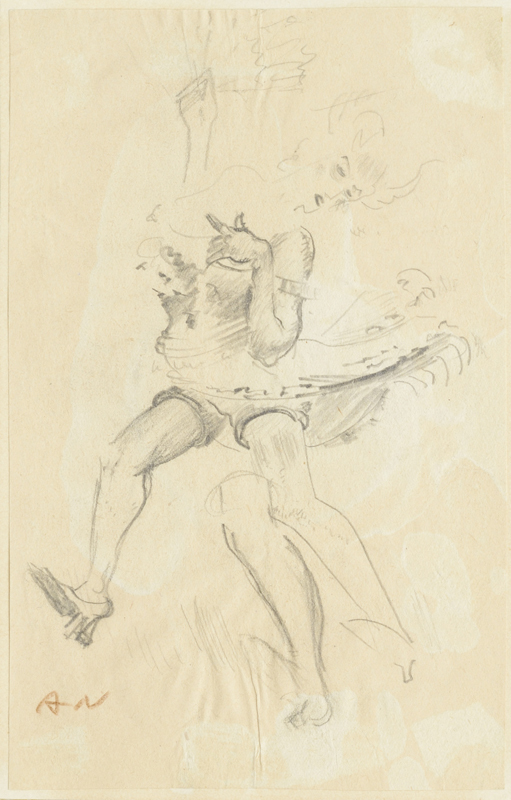
The sketch provides direct visual evidence of balletic pose and bodily alignment at a time when photography of dance was rare and documentary sources are valuable. It shows the artist's understanding of the mechanics of extension, balance, and theatrical presentation—how a dancer's body was shaped to convey grace and emotional expressivity. For historians and dancers, it is a primary-source record of actual performance aesthetics from the period.
What you are looking at
A single female dancer dominates this sketch, captured mid-performance in a dynamic, balletic pose. She wears a short tunic or corselet with what appears to be a fitted bodice, and her legs are bare or in tights. Her left leg extends behind her in an arabesque or similar extension, while her right leg supports her weight in a controlled stance. Her arms frame the movement with raised gestures—the right arm lifted and extended, the left arm also raised. The dancer's head tilts back expressively. The sketch is rendered in graphite pencil with varied pressure and hatching, creating volume and musculature in the figure. The composition isolates the dancer against a blank ground with only her body and its gesture defining the space. A small inscription or artist's mark appears in the lower left.
The dancing
The dancer's weight is concentrated on her supporting leg while the other extends into space—a classic balletic principle showing controlled suspension rather than earthbound movement. Her torso is arched and her neck extended, suggesting expressive, romantic-era choreography. The arms are raised in an open, theatrical frame rather than held in tight classical positions; this suggests a more generalized theatrical gesture than strict academic vocabulary. The bare or lightly clad legs and the absence of pointe shoes are notable and may indicate either a preliminary sketch or a style of dance that did not require them.
The dance depicted
This appears to be a female dancer in a theatrical or balletic idiom, most likely from the nineteenth-century romantic period of ballet or from a generalized theatrical dance context. The extended leg, arched back, and expressive arm and head positions are consistent with romantic ballet vocabulary—figures like the arabesque were central to that vocabulary. The sketch's informality and the artist's focus on capturing a moment of suspension and extension suggest it may be a study from life or a memory of a performance rather than a formal academic exercise. Without inscription or further context, the specific identity of the dancer or the particular ballet cannot be determined.
How it was made
This is a graphite pencil sketch on paper, with hatching and varied line weight used to suggest form, musculature, and drapery. The technique indicates a working or study drawing rather than a finished presentation work—the line is economical but confident, and the artist has not filled in all details. The paper is aged to a cream or tan tone. The directness of pencil allowed the artist to capture the moment quickly and spontaneously, suggesting this may have been drawn from observation or from memory shortly after witnessing a performance.
About this work
This is a nineteenth-century sketch of a female dancer in an extended balletic pose, rendered in graphite with an artist's sensitivity to the body in motion. The work belongs to a rich tradition of dance studies by artists of the period, whether made for their own reference, as preliminary studies for larger works, or as finished works of art in their own right. The sketch captures a moment of theatrical suspension—the dancer's weight and frame organized around principles of elevation and expressive gesture that were central to romantic ballet and theatrical dance of the era. It is a document of how the body was posed and presented in mid-to-late nineteenth-century European dance practice.
How to look at it
Attend to the precise angle of the supporting leg and the extension of the free leg—these capture the specific geometry of the pose. Note the arching of the spine and the backward tilt of the head, which create an overall impression of emotional abandon or transcendence rather than strict control. The raised arms and open frame suggest a moment in which the dancer is projecting outward toward an audience, and the artist has chosen to freeze that moment of expression rather than a moment of transition or technical difficulty.
The period
This sketch was likely made in the nineteenth century, a period of intense artistic fascination with dancers and the ballet. Romantic ballet was at its height or in living memory, with works like *La Sylphide* (1832) and *Giselle* (1841) establishing new ideals of weightlessness, otherworldliness, and female grace. Artists including Edgar Degas, Jean-Auguste-Dominique Ingres, and many others made extensive studies of dancers and rehearsals. The sketch's focus on a single figure in an extended, expressive pose reflects the values of romantic choreography: the illusion of effortlessness, the supremacy of line, and the dancer as an idealized rather than naturalistic body.
Where it lives
The work is recorded in Europeana, a digital aggregator of cultural heritage collections across Europe. The holding collection is not specified in the available record. The sketch is a study or independent work on paper, consistent with the large body of working drawings made by visual artists studying dance in this period.
Dance in this work
Questions about this work
Is this a study for a larger painting?
That cannot be determined from the record. It may be a preliminary study, a finished independent work, or a memory sketch made after a performance. The economy of line and lack of finish suggest it is a working drawing, but such drawings were also highly valued as independent artworks.
What is the dancer wearing?
She wears what appears to be a short theatrical tunic or corselet with a fitted bodice. Her legs are bare or in light-colored tights, and there is no visible evidence of pointe shoes, which was typical of mid-nineteenth-century romantic ballet costume.
Can you identify which ballet or dancer this depicts?
No inscription on the work identifies the dancer, ballet, or choreographer. The pose and period costume suggest romantic-era ballet, but the specific identity cannot be established without additional documentation.
More dance artwork