27 works in this view — arrow keys or swipe to move between them.
Dance in Art
Royal Opera Ballet, Stockholm Ballet (3)
Unknown artist
- Dance:
- Ballet
- Rights:
- Not recorded. Do not assume this image is free to reuse — check the source record.
Photographs of ballet rehearsal and training are far rarer in art history than images of performance; this image offers direct evidence of how classical ballet training was conducted in a major European company during the 20th century. The Royal Opera Ballet in Stockholm maintained a continuous classical tradition independent of the dominant Russian and Western European schools, making documentation of its practice methods historically significant. For contemporary dancers and teachers, the image provides a concrete record of flexibility standards and training methodology in a historically important institution.
What you are looking at
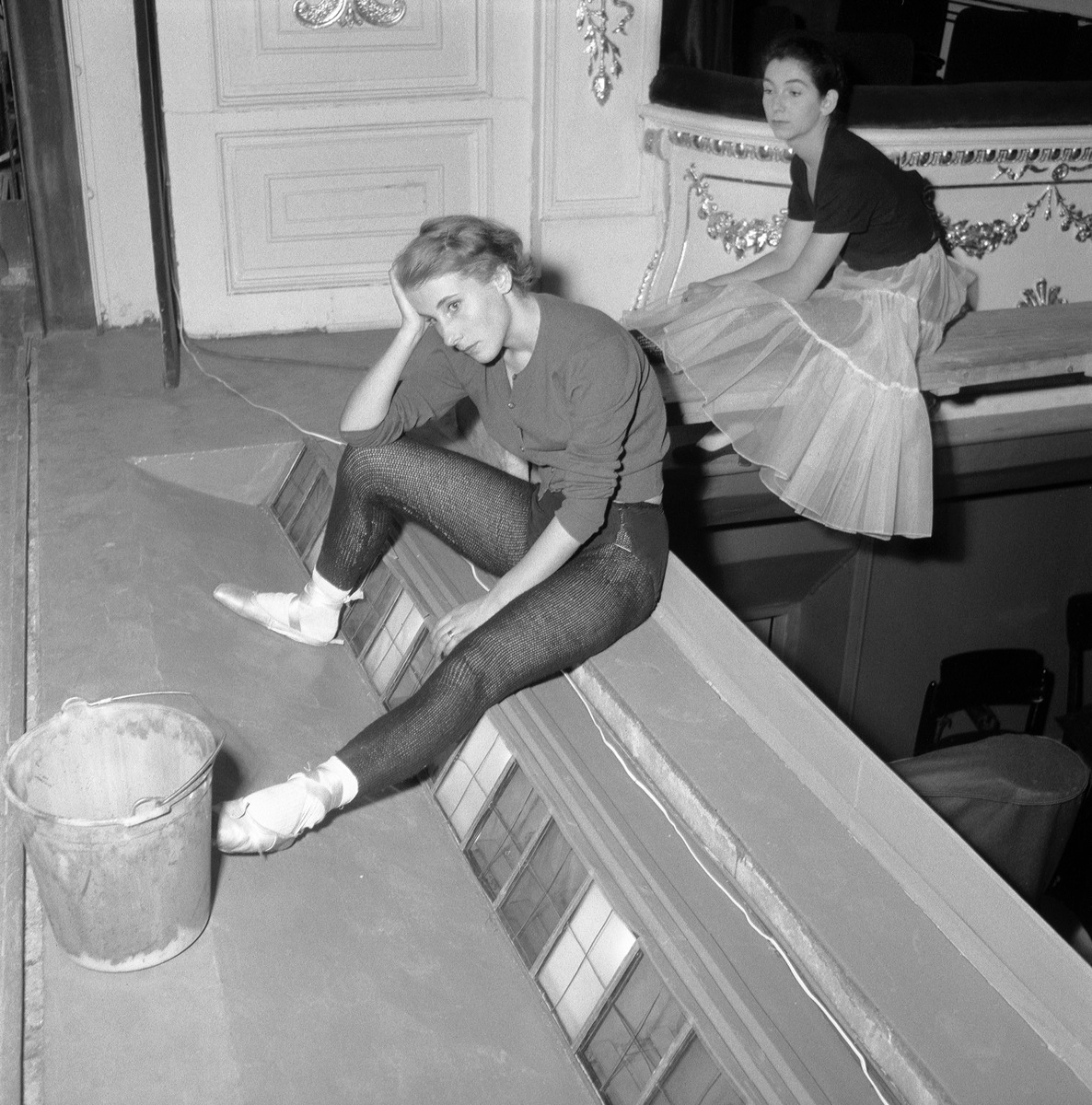
A black-and-white photograph captures two young women in a rehearsal or practice space within an ornate interior. The nearer figure sits on the floor with her legs extended in a dramatic split, her body angled forward with one hand supporting her head in a pose suggesting either rest or concentration. She wears dark leggings, white socks, and a dark short-sleeved top. Behind her, a second figure in a pleated skirt and black top stands or crouches on what appears to be a low platform or bench, also in a flexible position. The setting is grand: panelled walls, a marble or stone floor, and an ornate fireplace or mantelpiece visible in the background suggest this is taking place in a palace or grand institutional space. A bucket sits on the floor in the foreground, implying active maintenance or use of the space. The photograph's composition emphasizes the physical demands and intimate scale of ballet training, catching both the elegance and the effort of the work.
The dancing
Both figures display extreme flexibility and extension typical of trained ballet dancers. The seated figure's split is fully achieved, with hips open and torso forward-folded in a configuration that demonstrates advanced turnout and hip mobility. The standing figure's posture suggests either a similar deep extension or a recovery position. Both wear practice clothes rather than performance costumes, and their focus appears inward—on the work itself rather than presentation. The spatial relationship suggests these are peer dancers or colleagues rather than teacher and student in a formal instruction moment.
The dance depicted
This is documentary evidence of ballet rehearsal or training at an advanced level. The Swedish Royal Opera Ballet (Kungliga Operan) was one of Northern Europe's most important classical ballet companies, with a continuous tradition reaching back to the 18th century. The photograph captures the type of flexibility training that underpins classical ballet technique—the splits and extensions shown here are foundational to roles in the Romantic and Classical repertoire. The informal setting and lack of mirrors or barres suggest this may be a conditioning or maintenance session rather than a formal class or choreographic rehearsal.
How it was made
This is a black-and-white photograph, likely taken mid-20th century based on the film stock, grain, and printing technique. The image shows the characteristics of press or documentary photography: available light, candid framing, and focus on the human content rather than formal composition. The photograph's archival quality and its inclusion in Europeana suggests it may have been part of a Swedish institutional archive or collection documenting the Royal Opera Ballet's work. Such photographs typically circulated among dance professionals, critics, and arts institutions rather than the general public.
About this work
This photograph documents a moment of ballet training at the Royal Opera Ballet, Stockholm—one of Europe's oldest and most prestigious classical companies. It is a rare visual record of the physical work that lies behind performance, capturing the extreme flexibility and strength required of professional classical dancers. The image is valuable precisely because it shows ballet as practice rather than spectacle, revealing the bodily demands and intimate scale of the training that produces the art form. The grand architectural setting paradoxically emphasizes the focused, almost private nature of the work: two dancers alone in an ornate space, attending to the fundamentals of their craft.
How to look at it
Observe the precision and control evident in both figures' positioning: the seated dancer's split shows not just flexibility but active engagement—the spine is lengthened, the hip flexors are fully extended, and the posture suggests strength as much as suppleness. Notice the practical indifference to the grand setting: these dancers are focused entirely on their bodies and the work. The photograph freezes a moment that reveals ballet as labour—the sweat, concentration, and repetition that enables the illusion of effortless grace on stage. The bucket in the foreground is a reminder that rehearsal spaces, however grand their architecture, are places of active, physical work.
The period
This photograph dates to an era when ballet was at the height of its cultural importance in Western Europe and Scandinavia. The Swedish Royal Opera Ballet, founded in 1773, had by the 20th century developed its own school and aesthetic distinct from the Russian imperial tradition that dominated much of European ballet. The mid-century period saw increasing institutional documentation of ballet training and rehearsal, driven partly by growing academic and critical interest in dance as an art form worthy of serious study. The photograph's archival preservation and inclusion in Europeana reflects the later 20th-century recognition that such documentation had historical and cultural value.
Where it lives
The photograph is held in Europeana, the European digital library, which aggregates cultural heritage materials from institutions across Europe. The Swedish attribution and Royal Opera Ballet identification suggest the original is likely held in a Swedish institutional archive, possibly the Royal Opera House itself or the Swedish National Museum.
Dance in this work
Questions about this work
What is the Royal Opera Ballet, Stockholm?
Kungliga Operan, the Royal Opera of Sweden, was founded in 1773 and maintains one of Europe's oldest continuously operating ballet companies. It developed its own classical tradition and training methods distinct from the Russian imperial school that dominated much of 20th-century ballet. The company has produced significant choreographers and dancers and remains an important institution in Northern European dance.
Why does rehearsal look so different from performance?
Rehearsal is where dancers build and maintain the physical capacity to perform. This image shows conditioning and flexibility training—the foundational work that enables the turns, extensions, and sustained positions audiences see on stage. Performance demands energy, artistry, and narrative; rehearsal is where the body learns to obey the demands of technique.
How flexible do professional ballet dancers need to be?
The splits shown here—particularly the full front split with an open hip and extended back leg—represent the minimum standard for professional classical ballet dancers at major companies. This level of flexibility enables the leg extensions, lifts, and rotations required by classical repertoire. It is developed through years of consistent, disciplined training beginning in childhood.
More Ballet artwork