26 works in this view — arrow keys or swipe to move between them.
Dance in Art
Royal Opera Ballet, Stockholm Ballet (4)
Unknown artist
- Dance:
- Ballet
- Rights:
- Not recorded. Do not assume this image is free to reuse — check the source record.
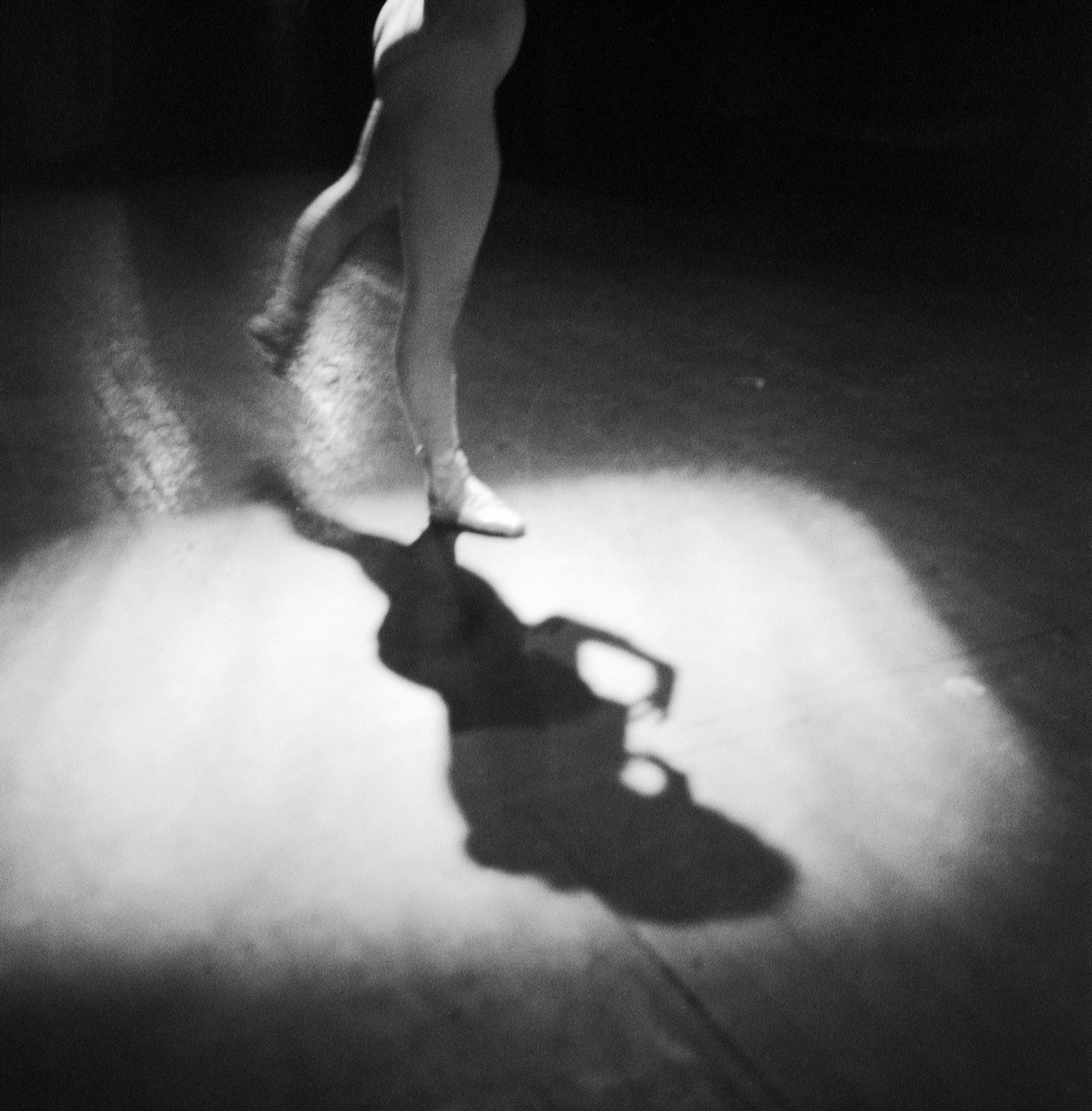
For dancers and historians, the photograph preserves a moment of ballet execution and offers a record of Swedish and Royal Opera ballet practice in an era when the technique was codified but not yet globalized. The photographer's choice to isolate the legs and emphasize line shows how the visual language of dance photography developed to make technique legible—a shift from narrative illustration toward abstraction that mirrors broader modernism in the visual arts.
What you are looking at
A black and white photograph captures a moment of classical ballet in performance or rehearsal. Two figures dominate the frame: in the foreground, a dancer in a dark leotard is captured mid-movement, legs extended in a horizontal line suggesting a développé or sustained extension. Above, a second dancer in pale tights and a light-colored top is seen from approximately waist down, creating a striking vertical composition. The lighting is dramatic, with bright pools illuminating the dancers' bodies against deep shadow, suggesting either stage lighting or careful darkroom technique. The photograph's soft focus and grainy quality, along with the cropped framing that isolates portions of the dancers' bodies, emphasizes the line and form of the movement rather than narrative context.
The dancing
Both dancers exhibit the elongated line and sustained extension characteristic of ballet technique. The lower figure maintains a clean horizontal leg extension with an engaged, lifted upper body despite the extreme position—suggesting advanced training and control. The upper figure's partial visibility (legs and torso only) creates compositional interest while suggesting a supporting role or a moment of interaction between partners. The lighting catches the musculature and line of the legs, emphasizing the precision demanded by the form. There is no visible partnering hold; these appear to be independent positions rather than a supported duet.
The dance depicted
This is almost certainly classical ballet, most likely from the mid-20th century based on the photograph's aesthetic and the catalogue attribution to the Stockholm Ballet and Royal Opera Ballet. The elevated leg extensions, pointed feet, and the overall quality of line suggest ballet of the Romantic or Classical tradition rather than contemporary work. The photograph's composition—isolating the legs and their geometric precision—implies this may be documentation of rehearsal or a formal study of technique rather than a narrative performance moment. Without more specific information about the photographer or the source, the exact ballet cannot be determined, though the Stockholm context suggests Scandinavian ballet practice of that era.
How it was made
This is a black and white photograph, likely gelatin silver or contact print, judging by the grain structure and tonal range visible in the image. The technique appears to be studio or stage photography rather than casual documentation—the composition is deliberate, the lighting controlled to emphasize form and line, and the cropping strategic. The soft focus and dramatic chiaroscuro suggest either careful darkroom work or the photographer's intentional aesthetic choice. The photograph's arrival via Europeana suggests it was part of an institutional or archival collection, likely documentary photography of dance rather than art photography.
About this work
This photograph documents a moment of classical ballet training or performance, capturing two dancers in extended positions illuminated against shadow. The image shows the technical precision and bodily control that define ballet practice, with the photographer's eye trained on the geometric clarity of leg extensions and line. The work belongs to a mid-20th-century European context, likely Scandinavian, and exemplifies how photography became a tool for recording and studying ballet form in the decades after the arrival of modernist dance photography in the 1920s–1930s. It is both a document of a specific institutional practice and a formal study of the human body in motion.
How to look at it
Notice the photographer's choice to crop the frame so that we see only the dancers' legs and lower torsos—a formal decision that isolates line from personality or expression. Observe how the lighting catches the curve and extension of the legs, making the geometry of the position legible; this is not documentary record but formal study. The extreme extension and the way the dancer maintains lift through the torso despite the horizontal leg position reveals the balletic principle that even the most extreme extensions must be sustained with control and alignment. The soft focus and grain of the photograph emphasize texture and atmosphere rather than sharp detail, a choice that romanticizes the form without sacrificing its clarity.
The period
The photograph dates to the mid-20th century, a period when ballet was becoming professionalized and institutionalized across Europe. The Stockholm Ballet and Royal Opera Ballet were major companies engaged in both the preservation of classical repertory and the gradual incorporation of contemporary choreography. This was also the era when dance photography emerged as a serious medium in its own right, influenced by modernist photography's interest in form, abstraction, and the human body—photographers like Barbara Morgan in America and Gjon Mili were developing new approaches to capturing movement. The soft focus and dramatic lighting in this image reflect that emerging aesthetic.
Where it lives
The work is held in Europeana, the European digital library, suggesting it came from an institutional archive or museum collection. The catalogue attribution to the Royal Opera Ballet and Stockholm Ballet indicates it was part of official documentation of these companies' activities, though neither the specific ballet nor the photographer is recorded.
Dance in this work
Questions about this work
What ballet is this from?
The catalogue does not identify the specific ballet. The photograph is simply attributed to the Royal Opera Ballet and Stockholm Ballet, and appears to be documentation of rehearsal or technique rather than a specific performance. The composition and dramatic lighting suggest the photographer was interested in form and extension rather than narrative, so this may be a study of technique rather than a scene from a named work.
What year was this taken?
The catalogue does not record a date. The style of the photograph—the grain, tonal range, and aesthetic approach—suggests mid-20th century, likely 1940s–1960s, but this cannot be confirmed without additional archival information. The attribution to Swedish companies supports a Northern European context in that era.
Why are we only seeing the dancers' legs?
The photographer deliberately cropped the frame to isolate the legs and emphasize line and extension. This was a modernist formal choice, influenced by abstract and photographic movements of the 20th century. By removing the head and upper body, the photographer makes the extended leg—and the technical control behind it—the sole subject, a choice that treats the body as pure form rather than as a narrative or emotional vehicle.
Is this classical or contemporary ballet?
This is classical ballet. The sustained extensions, pointed feet, and overall aesthetic of the position—and the way the dancers maintain lift and alignment—are consistent with Classical and Romantic ballet technique. The soft focus and studio lighting suggest this is documentation of technique or rehearsal rather than a contemporary performance.
More Ballet artwork