36 works in this view — arrow keys or swipe to move between them.
Dance in Art
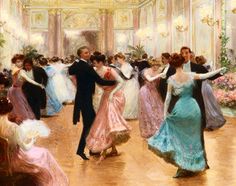
Parisian Ball
Jean Béraud
- Era:
- 1900-1920 (Ragtime/Early Jazz)
- Rights:
- By Jean Béraud. In the public domain in the United States.
- Recorded as:
- public_domain
This work is historically valuable as a visual record of how ballroom dances were performed, taught, and experienced by the Parisian elite at the turn of the 20th century. It also exemplifies how dance—specifically social ballroom dancing—was a subject worthy of serious artistic attention and exhibition, treated with the same sophistication and technical ambition as portrait or landscape painting. For dancers and historians, it provides evidence of body carriage, hold, spatial relationships, and the cultural context in which these dances thrived.
What you are looking at
A grand ballroom scene bathed in warm, diffused light from what appears to be gas lamps or early electric chandeliers. The space is filled with formally dressed couples in motion across a polished floor. The composition is dense with figures, many in the middle distance and background, creating depth and a sense of fashionable social gathering. The women wear pale, high-necked gowns with long sleeves and high waistlines characteristic of the 1900s–1910s; their skirts are full and floor-length, some caught mid-movement. The men wear dark evening dress—tailcoats, white dress shirts, and bow ties. The palette is dominated by soft creams, pale pinks, greens, and earth tones, with deep shadows defining the figures. The architecture suggests Belle Époque opulence: decorative wall panels, ornamental details, and a sense of spacious luxury. The brushwork is loose and impressionistic, dissolving detail at the edges and focusing the eye on the central couples.
The dancing
The dancers display closed-position ballroom hold—men's right hand on women's back, women's left hand on men's shoulder, with raised arms connecting. The bodies are upright and formal, moving in smooth, gliding patterns across the floor. Several couples are in mid-stride, their forward momentum and the flow of the women's skirts suggesting elegant, traveling steps rather than pivoting or turning in place. The nearest figures are rendered more clearly; those receding into the background blur into suggestion. The overall frame is one of controlled, refined partnered movement, with the women appearing to follow the men's lead in a synchronized social dance.
The dance depicted
This depicts the waltz or foxtrot as performed in elite Parisian ballrooms during the Belle Époque and early 20th century. The 1900–1920 era label aligns with the height of ballroom culture among the upper classes, when formal social dancing was a central ritual of courtship and social display. The closed hold, the traveling patterns across a spacious floor, and the elegantly upright carriage of the bodies are consistent with the Viennese or modern waltz and the foxtrot—dances that dominated fashionable ballrooms during this period. The setting and dress confirm this is salon dancing among the haute bourgeoisie or aristocracy, not theatrical performance. The emphasis on the women's flowing skirts and the men's guiding role reflects period conventions of partnered ballroom dance.
How it was made
The work appears to be oil on canvas, executed in an impressionistic style with loose, gestural brushwork. The artist has used translucent washes of color and suggestions of form rather than precise detail, allowing the eye to move fluidly across the composition as it would across a crowded ballroom. This technique was common among society painters of the Belle Époque who depicted the leisure activities of wealthy Parisians. The soft focus and atmospheric handling of light—particularly in the chandeliers and the glow suffusing the space—are characteristic of Impressionist influence on late 19th and early 20th-century salon painting. The scale and finish suggest a finished exhibition work intended for a cultured audience familiar with contemporary Parisian life.
About this work
This is a scene of elite Parisian ballroom dancing, rendered by an artist steeped in Impressionist technique and the social observation of Belle Époque life. The work captures a moment of formal social dance—most likely a waltz or foxtrot—during the 1900–1920 period, when such gatherings were central to aristocratic and upper-middle-class society. The painting is both a record of a specific dance tradition and a study of light, atmosphere, and the social spectacle of courtship. It belongs in a gallery of dance art because it documents how the waltz and foxtrot were actually performed and experienced in their moment of greatest social prestige: as refined, public rituals of partnered movement in luxurious interiors.
How to look at it
Observe the moment the artist chose: the dancers are in full motion, traveling across the floor, not frozen at a single point in a step. The women's skirts create a visual accent that conveys momentum and grace; notice how the folds and hems suggest movement without becoming confused or chaotic. Look at the hands and arms—the raised position and the alignment of shoulders, elbows, and wrists show the formal geometry of the closed ballroom hold. The background couples are rendered less distinctly, which invites the eye to move from foreground clarity into an atmospheric depth, mimicking how one experiences a crowded ballroom. The lighting is soft and unified, avoiding harsh shadows; this was how such interiors actually appeared under early electric illumination, and it contributes to an impression of harmony and refinement.
The artist
Jean Béraud (1849–1935) was a French society painter and illustrator celebrated for his depictions of Parisian leisure, fashion, and social life during the Belle Époque. Known for his loose, impressionistic handling of light and his keen eye for contemporary costume and manners, Béraud was a prolific recorder of fashionable gatherings—café scenes, promenades, theater interiors, and, as here, ballroom events. He worked in oil, watercolor, and pen and ink, and his work appeared regularly in illustrated journals of the period. Béraud's subject matter and style made him a bridge between academic salon painting and the more modern, observational approach of Impressionism.
The period
The 1900–1920 period marked the height of the waltz and foxtrot in elite European ballrooms. The waltz had dominated since the early 19th century, but the foxtrot and other ragtime-influenced social dances were emerging during the 1910s, reflecting broader cultural shifts toward modernism and American influence. In Paris, ballroom dancing remained a cornerstone of aristocratic and wealthy bourgeois social life, even as new dances and jazz were beginning to enter urban culture. The Belle Époque was characterized by lavish entertainment, the perfection of gas and early electric lighting, and a last great flowering of 19th-century social ritual before World War I. Painters like Béraud documented this world with sympathy and technical refinement, recording a social order that would soon be disrupted.
Where it lives
It was catalogued with the era label 1900–1920 (Ragtime/Early Jazz period), though the painting itself does not directly illustrate ragtime or jazz; rather, it documents the formal ballroom tradition that coexisted with and preceded the jazz age.
Dance in this work
Questions about this work
What dance are they dancing?
Most likely a waltz or foxtrot. The closed ballroom position, the traveling patterns across the floor, and the elegant upright carriage are consistent with both dances as performed in elite ballrooms during the 1900–1920 period. Without seeing footwork or a clearer view of the frame, it is difficult to distinguish between them, but the formal setting and fashionable dress confirm this is high-society ballroom dancing.
Who would have danced like this?
Members of the Parisian aristocracy and wealthy bourgeoisie. Ballroom dancing was a central social ritual for these classes, essential to courtship, social display, and the maintenance of social hierarchy. Men and women of marriageable age were expected to be accomplished dancers, and such balls were regular events in the social calendar.
Is this a real ballroom or invented?
The setting is typical of real Parisian ballrooms of the period—the ornamental detailing, the scale, the gas or early electric chandeliers—but the artist has simplified and abstracted it in an impressionistic manner. It is not a portrait of a specific room, but rather a convincing evocation of the type of luxurious interior where such dancing took place.
Why does the painting matter to dance history?
It documents how ballroom dances were actually performed and experienced in their social context. It shows body carriage, hold, the role of costume (especially women's skirts), and the atmosphere of formal courtship through dance. It also demonstrates that dance was regarded by serious artists as a worthy subject for ambitious painting, not mere illustration.
More dance artwork