35 works in this view — arrow keys or swipe to move between them.
Dance in Art
Parisian Salon Ball
Jean Béraud
- Era:
- 1900-1920 (Ragtime/Early Jazz)
- Rights:
- By Jean Béraud. In the public domain in the United States.
- Recorded as:
- public_domain
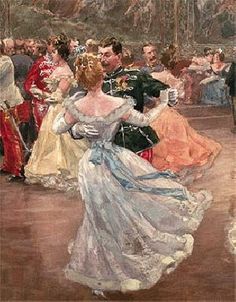
This painting captures the Waltz not as a historical artifact but as a living social practice, showing how the dance functioned as courtship, performance, and spectacle simultaneously. For dance historians, it is documentary evidence of ballroom technique, frame, and context; for art historians, it is an example of how modern painters represented movement and leisure in the Belle Époque. The image shows what a ballroom dance actually looked like in the moment, rendered with enough precision that a dance reconstructor could identify the hold and the step.
What you are looking at
A crowded formal ball unfolds in an elegant Parisian interior, painted in warm ochres, blush tones, and muted jewel colors. The perspective draws us into a densely populated salon where dozens of figures in evening dress cluster around the margins, watching the action at center. In the foreground, a woman in a pale blue-grey gown executes a turn, her skirt billowing in a full arc around her body, the fabric caught mid-movement with visible momentum. Her partner in dark tailcoat stands at her side in the closed position. The lighting is soft and diffused, suggesting gaslight or candlelight, which catches the shimmer of silk and satin and throws the figures into a slightly hazy atmosphere of leisure and spectacle. The composition is crowded but carefully orchestrated, with the dancing couple framed by onlookers whose postures register attention and social engagement. The setting appears to be a grand salon with high ceilings and the accumulated warmth of a fashionable Paris gathering.
The dancing
The primary dancing couple occupies center-right in closed ballroom position: the woman's right arm rests on the man's left shoulder, her left hand in his right, a textbook frame for the Waltz or similar couple dance. Her body leans slightly into the turn, weight clearly in motion, skirt lifted and spreading by centrifugal force—the artist has captured the exact moment of rotation. Her posture is upright but fluid, characteristic of trained ballroom dancing. The man's frame is stable and leading, his silhouette darker and more static, anchoring the woman's movement. Around them, dozens of figures stand, sit, or converse in small groups; these observers are rendered with less anatomical detail but positioned to direct the eye toward the central pair.
The dance depicted
This is almost certainly a Waltz or Viennese Waltz of the 1900s–1920s era. The closed position, the turning movement, the formal salon setting, and the social context all align with the ballroom waltz at the height of its fashion in Belle Époque Paris. Waltzes were the dominant couple dance in European high society during this period, performed at balls and soirées among the same Parisian elite this painting depicts. The woman's skirt, caught mid-twirl, is the visual signature of waltz choreography—the rotational frame that creates that distinctive silhouette. The ballroom context and the number of spectators suggest this is a formal, social performance of the dance, not a theatrical or professional exhibition.
How it was made
This appears to be an oil painting, executed with soft, impressionistic brushwork that creates a sense of atmosphere and movement. The artist has used a warm palette of ochres, greys, and flesh tones to unify the crowded scene and avoid visual chaos. The technique allows for the capture of transient light effects—the shimmer of fabric, the glow of skin—and enables the artist to render both the precise moment of the dancer's rotation and the diffuse social context around it. The impressionistic approach suggests this was made for exhibition and reproduction, likely for a sophisticated urban audience familiar with both ballroom culture and modern painting.
About this work
This is a formal ballroom scene depicting the Waltz in its moment of maximum social prestige, painted in the Belle Époque period when the dance dominated European high society. The artist chose to freeze a single couple mid-turn while embedding them in the larger social spectacle of the salon—the orchestra is absent, but the crowd of observers performs the role of audience, emphasizing that ballroom dancing was as much a social ritual as a choreographic practice. The work is a document of both dance history and the world in which it took place: the dress, the architecture, the gender roles, the conventions of courtship and display that made the ballroom central to turn-of-the-century Paris.
How to look at it
Attend to the skirt: the artist has captured the precise moment when rotational momentum lifts and spreads the fabric, and this is the visual language through which he communicates the Waltz to us. Watch how the woman's body leans into the turn, her frame anchored by her partner's lead—this is the physics of the dance made visible. Notice how the painting is structured to pull your eye from the watching crowd to the couple, recreating the social experience of the ballroom, where the dance was both performance and social participation. The soft, hazy light creates an atmosphere of elegance and transience—the mood of the moment rather than its documentary facts.
The artist
Jean Béraud (1849–1935) was a French academic painter best known for genre scenes of Parisian life, particularly the leisure activities of the bourgeoisie and upper classes. His works often focused on the social rituals of Paris—café culture, fashion, promenades, balls, and intimate moments in salons and theaters. Béraud worked in a realist tradition but with an impressionistic softness; his paintings were exhibited in the Paris Salon and found a ready market among the Parisian collectors whose world he depicted. He had a particular gift for rendering fabric, light effects, and the psychology of social gathering, which made him ideal for capturing the atmosphere of formal balls.
The period
The Belle Époque (roughly 1870–1914) was the apex of the Waltz's cultural dominance in Europe. The dance had been the primary couple dance in ballrooms since the early 19th century, but by the 1900s it was at the height of its prestige, performed in formal settings and often the subject of musical composition and visual art. Simultaneously, the period saw the emergence of new social dances—the Tango arrived in Paris from Argentina around 1912, the foxtrot and other syncopated American dances were becoming fashionable. Painting of social leisure was also at its height during this period; Impressionism and Post-Impressionism had created a market for scenes of modern life, and artists competed to capture the visual and atmospheric qualities of contemporary society. Béraud's work sits in the tradition of Realist genre painting but with modern techniques of light and color.
Where it lives
The catalogue record does not provide acquisition history, current location, or medium specification; the assessment of medium is made from the visual evidence of the work itself.
Dance in this work
Questions about this work
Is this definitely a Waltz?
The closed ballroom position, the turning frame, the formal salon context, and the era all support identification as a Waltz or Viennese Waltz. The woman's skirt, caught in a full rotational spread, is the visual signature of the dance. However, other formal couple dances of the period—some variants of the Polka or Mazurka in ballroom style—cannot be ruled out from the image alone.
When was this painted?
The catalogue record does not provide a date. The dress, hairstyles, and painting style suggest 1900–1920, as stated in the era label. Béraud was active and exhibiting throughout this period, and his style is consistent with work from the Belle Époque and early 20th century.
Who is dancing?
The painting does not identify the dancers. They are types—members of the Parisian leisure class—rather than historical figures. The work is about the social practice of ballroom dancing among the Paris elite, not about the biography of any individual couple.
What was the Waltz used for?
In this period, the Waltz was the primary couple dance at formal balls and salons. It served as both entertainment and courtship ritual; dancing with a partner was an intimate gesture in a society with strict social codes, and the ballroom was one of the few settings where such closeness was sanctioned. The Waltz was also a marker of social class and refinement—to dance well was to display education and status.
More dance artwork