27 works in this view — arrow keys or swipe to move between them.
Dance in Art · 2020
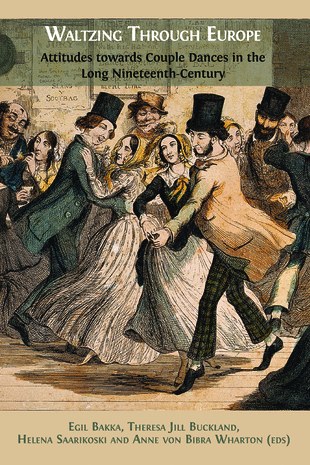
Waltzing through Europe : Attitudes towards couple dances in the long Nineteenth Century
Unknown artist
- Medium:
- Illustration
- Dance:
- Waltz
- Era:
- Early 1800s (Waltz Revolution)
- Source:
- Library of Congress
- Rights:
- Public domain — free to use, share and adapt.
- Recorded as:
- public_domain
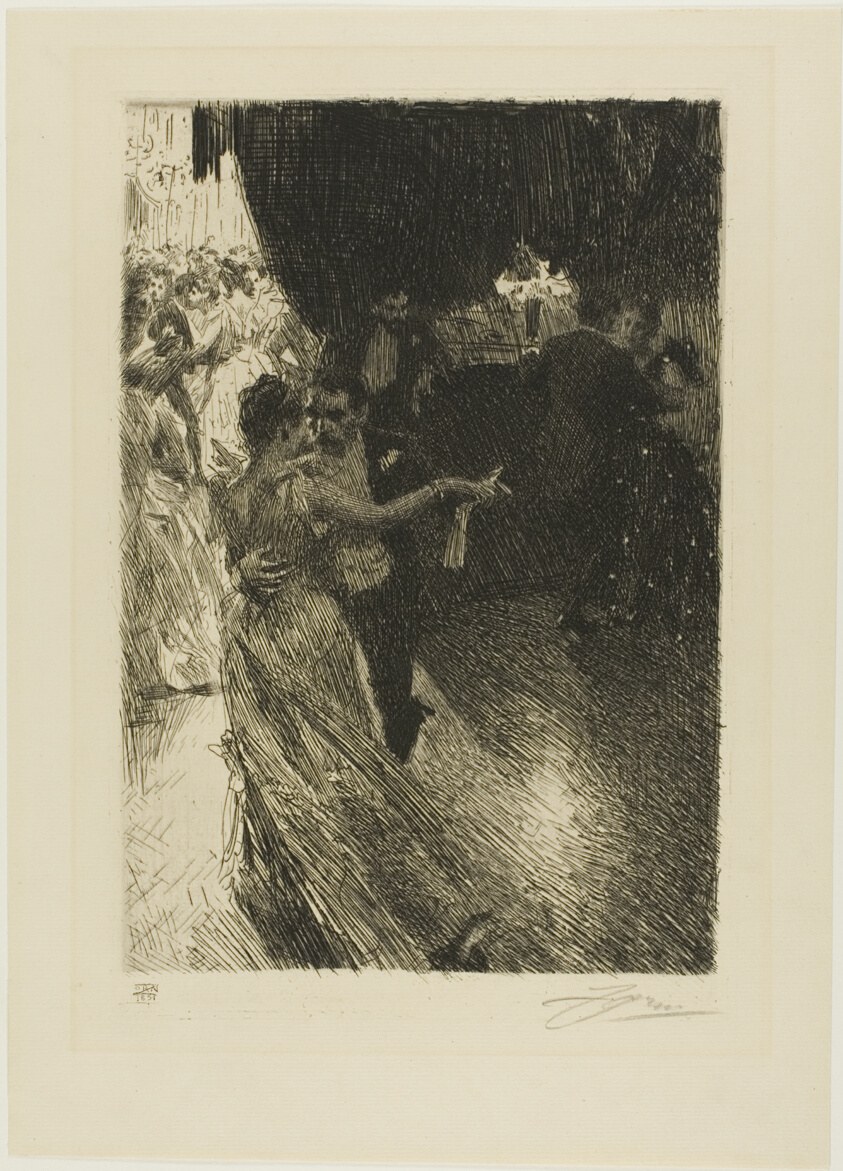
The waltz was one of the most consequential developments in the history of ballroom dance, introducing the closed couple embrace and continuous rotation that became the template for modern ballroom. This engraving is evidence of how the waltz looked in motion and how it was received by its contemporaries—simultaneously as exhilarating and as transgressive. For dancers and historians, it offers concrete visual information about frame, posture, and the social context of early nineteenth-century dance that written sources cannot provide.
What you are looking at
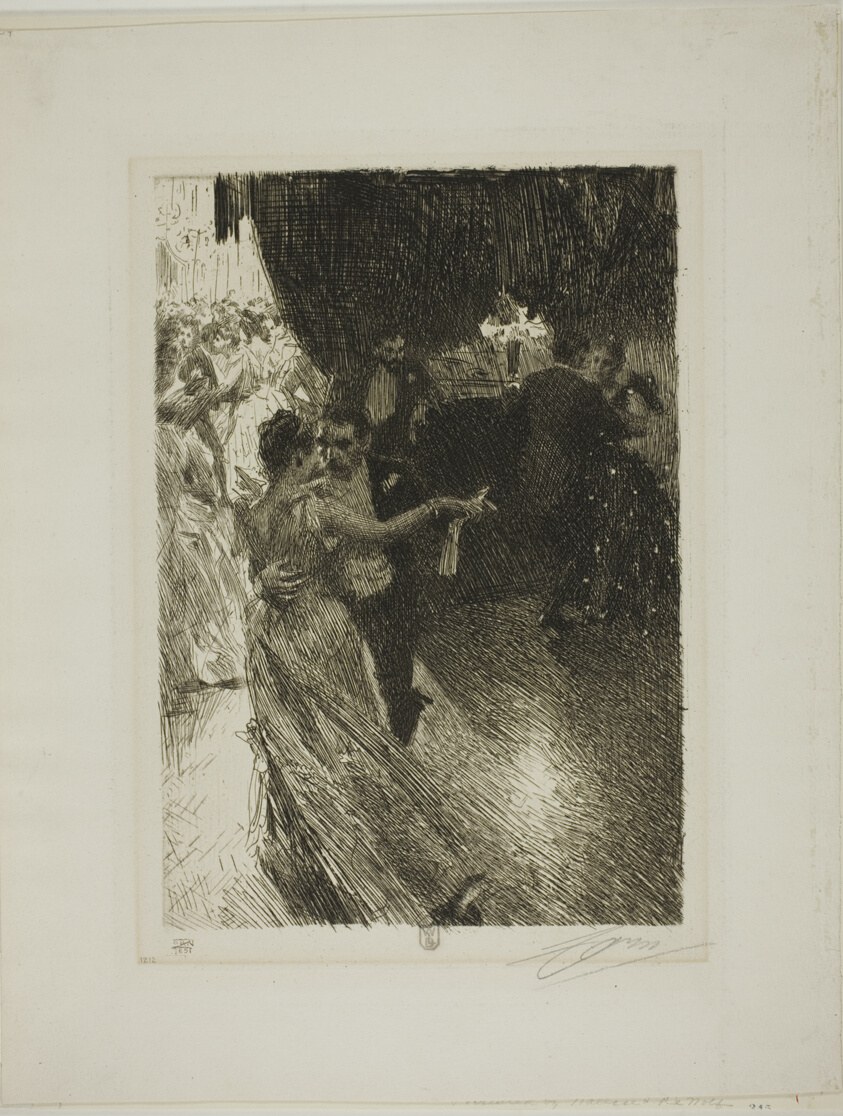
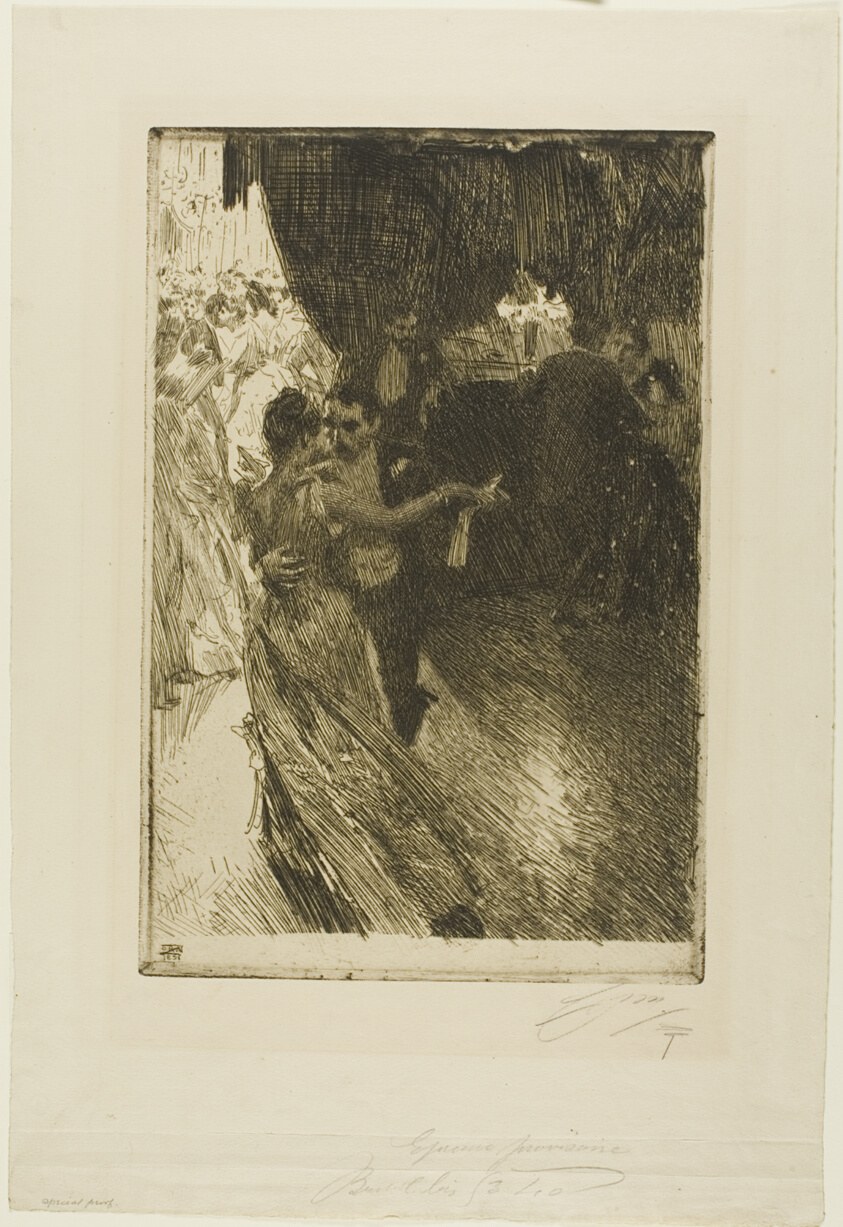
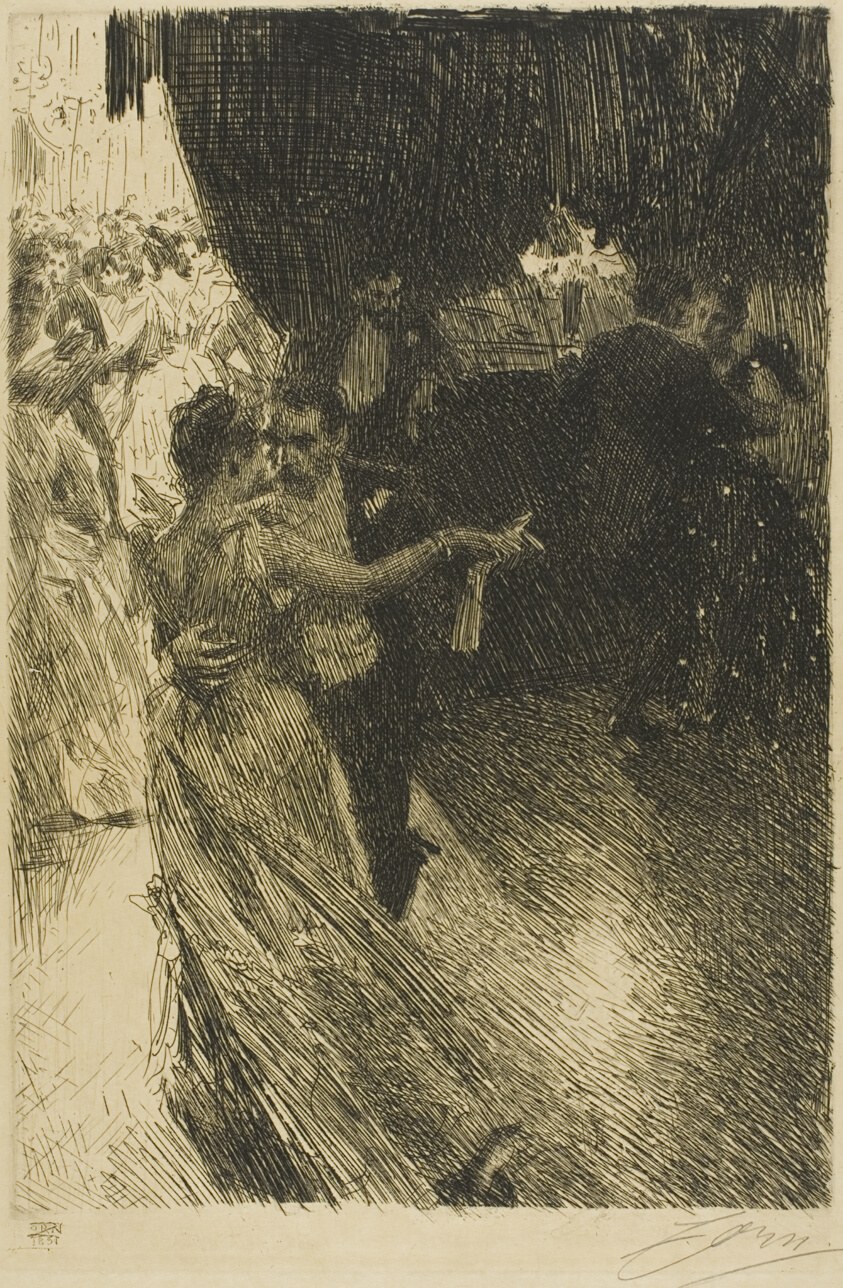
A colored engraving depicting a lively ballroom scene in the early nineteenth century, with multiple couples engaged in social dance. The composition is crowded and animated, with figures arranged across the picture plane in various stages of movement. In the foreground, a couple dominates: the woman wears a high-waisted white gown with a full skirt caught mid-swirl, her partner in dark tailcoat and breeches holding her in a closed ballroom hold. The woman's skirt billows outward in a dynamic arc, suggesting rapid rotation. Surrounding them are other couples and onlookers in evening dress—women in long white and pastel gowns, men in black formal coats. The background is filled with spectators and musicians. The overall mood is one of exuberance and social mingling, with the energy concentrated in the turning couples at center. The hand-colored engraving technique gives the scene a warmth and immediacy appropriate to its subject.
The dancing
The central couple holds in a closed ballroom position, with the man's right hand at the woman's waist and their outside hands joined. Their bodies are angled into a turning motion, with the woman's weight clearly shifted to execute a rotational step. Her skirt rises and spreads radially around her legs, indicating rapid hip and body rotation. The surrounding dancers are less precisely rendered but show the same basic closed-hold frame. Several couples are in profile, revealing the characteristic upright posture and arm extension of early nineteenth-century ballroom dance. The positioning of feet is not clearly visible, but the dynamic turn of the principal couple and the gathered spectators suggest a spirited, continuous movement.
The dance depicted
This is almost certainly the waltz, the dominant couple dance of the early nineteenth century and the subject announced in the title. The waltz revolutionized European dance by placing couples in a close embrace, turning rapidly in three-time music, and abandoning the formal geometric patterns of earlier quadrilles and cotillions. The engraving captures the characteristic excitement and social controversy of the waltz: the closeness of the couple, the speed of rotation, and the informality of the gathering all reflect contemporary accounts of waltz mania. The title's reference to 'attitudes towards couple dances' suggests the print documents not only the dance itself but also contemporary reception—the mixture of enthusiasm and disapproval visible in the onlookers' expressions. This is a document of a moment when the waltz was still new enough to provoke comment.
How it was made
This is a hand-colored engraving, a reproductive technique that allowed wide circulation of images in the early nineteenth century. The engraved line work is precise and fine, with careful attention to the folds of fabric and the individual figures in the background. The hand-coloring—applied with watercolor or colored ink over the printed base—gives individual character to each figure's dress and adds warmth to the scene. The technique was ideal for satirical or documentary social commentary, allowing both artistic finish and rapid reproduction for a popular audience. The survival of this image in the Library of Congress suggests it was distributed as a print or as an illustration in a periodical, reaching a broad public rather than a patron-commissioned artwork.
About this work
This engraving documents the waltz as a social phenomenon in the early nineteenth century, capturing both the dance itself and contemporary attitudes toward it. The image shows a moment of high energy and social mixing—the defining characteristics of waltz culture—and the technical precision of the engraving allows us to read the ballroom hold, the rapid rotation, and the exhilaration of the dancers. The print is valuable as both a dance history document and a window into how the period's own observers understood the waltz: not merely as a step or a tune, but as a social force that changed how men and women touched and moved together in public.
The work belongs in a gallery of dance in art because it collapses the boundary between representation and historical evidence. We see not an imagined ideal but an attempt to document an actual social practice—the specific hold, the height and cut of the dress, the crowded informality of the ballroom. This is dance as it was lived, filtered through the conventions of printmaking and satirical commentary.
How to look at it
Attend first to the central couple's hold and the dynamic tilt of their bodies into the turn—this is the visual signature of the waltz and the source of both its appeal and its notoriety. Notice how the woman's skirt creates a cone or bell shape as it swings outward, a consequence of the continuous three-beat rotation that defined the dance. Look also at the crowd: the mix of dancers and onlookers, the range of expressions, and the sense of controlled chaos all tell you this was a moment of social ferment, not a staid court occasion. The engraver's choice to capture the moment mid-turn, with the woman's weight shifted and her skirt at full extension, freezes the motion in a way that suggests speed and abandon.
The period
The waltz emerged in Vienna and southern Germany in the late eighteenth century, but its rapid spread across Europe in the 1810s-1820s caused genuine moral and social anxiety. Conservative commentators objected to the close embrace, the speed, and the dominance of the couple unit over group formation. By the 1820s-1830s, when this print was likely made, the waltz had become the defining dance of the Romantic era, celebrated in music by composers like Weber and Strauss, and documented in prints and satirical images across Europe. The title's reference to 'attitudes towards couple dances in the long nineteenth century' positions this image within a broader project of examining how dance was understood and represented over a long historical span. The engraving's style and hand-coloring suggest production in the 1820s-1840s, the peak period of waltz mania.
Where it lives
This illustration is held by the Library of Congress and is catalogued as part of their collection on the history of dance and social customs. The record identifies it as from the early 1800s (Waltz Revolution period), though without attribution to a specific artist or print publication. The image may be from a periodical or a standalone satirical print, both common formats for dance imagery in the period.
Dance in this work
Questions about this work
Why did the waltz cause such controversy?
The waltz introduced an intimate closed embrace between partners and rapid continuous rotation, departing radically from the formal, geometric, and often group-based dances that preceded it. Conservative critics found the closeness of the couple and the loss of formality scandalous. This print documents that moment of transition, showing both the exhilaration the dance generated and the social mixing it enabled.
What is the hold shown in this image?
The central couple is in the closed ballroom position that became standard for the waltz: the man's right hand on the woman's waist, their outside hands joined, bodies angled into the turn. This intimate frame was itself a novelty in the early nineteenth century and was central to the dance's appeal and its notoriety.
How do we know this is a waltz and not another dance?
The three-beat turning motion, the closed couple embrace, the rapid rotation, and the billowing of the woman's skirt are all distinctive to the waltz. The title explicitly names the waltz as the subject. Earlier couple dances like the minuet or contredanse had different frames and movement patterns. The engraver has captured the characteristic energy and speed of the waltz as contemporary observers experienced it.
What does the hand-coloring tell us?
Hand-coloring was a labor-intensive process that made prints more expensive and more prestigious, suggesting this image was meant for a middle-class or upper-middle-class audience. The careful differentiation of the dancers' dress—whites, pastels, blacks—helps the viewer read the social composition of the ballroom and the formal evening-wear conventions of the era.
More Waltz artwork